The standard cloud solution which serves all users is starting to become outdated. Organizations across different industries attempted for many years to modify typical platforms so they could use them for their specific operational needs and their legal requirements and their customer service standards. The expected result occurred because companies needed expensive custom solutions which maintained security problems and used workarounds to slow down their progress.
Industry cloud functions as the solution for this problem.
The system represents more than an upgrade because it creates an entirely new way of thinking.
Industry cloud platforms create a combination between the extensive reach and cost advantages of public cloud technology and dedicated operational capabilities which serve industries like healthcare and financial services and manufacturing and retail. Businesses now have the option to choose operational environments which already match their industry standards instead of having to modify a standard system to function in their domain.
Gartner predicts that by 2027, over 50% of enterprises will rely on industry cloud platforms—up from under 15% in 2023.
That kind of acceleration signals more than adoption; it reflects a structural change in how organizations approach digital transformation.
An industry cloud platform (ICP) is designed with a deep understanding of a specific sector’s operational realities. It goes beyond layering industry-specific features onto a standard cloud—it embeds them into the core architecture. From compliance frameworks to workflow automation and data models, everything is built to reflect the nuances of your industry.
A simple way to think about it:
A general-purpose cloud hands you a toolkit and expects you to figure things out. An industry cloud, on the other hand, gives you a fully equipped workspace. Custom, legally compliant, and designed specifically for the work task at hand.
The debate about whether to move to the cloud is over. Cloud is now the default. The question is how to make it work for your specific business.
Regulated industries are dealing with increasingly complex, multi-layered compliance requirements. Healthcare organizations require HIPAA-compliant environments to support their telehealth and research data management activities. Financial organizations operate under PCI DSS and GLBA compliance standards and abide by state-level privacy laws. Manufacturing firms must establish security measures and data control policies and international operational standards to protect their supply chains and their distributed facilities.
Modern systems have integrated compliance requirements into their fundamental design because it has become essential to their operation. Industry cloud platforms embed these compliance controls at every layer, not as afterthoughts. For organizations that have avoided cloud adoption due to regulatory concerns, this is a gamechanger.
For decades, enterprises in specialized industries built their own custom software. The tools simply didn’t exist. Now, they do. Cloud service providers and independent software vendors (ISVs) have matured to the point where pre-built, industry-specific capabilities often outperform what organizations could develop themselves—at a fraction of the cost.
As IBM’s Krishna Ratakonda puts it: “The reality is that many organizations will still need custom solutions, but as their tech stack evolves and business demands grow, they’ll increasingly turn to software offerings rather than building everything from scratch.”
The current pace of generative AI adoption continues to increase. The successful execution of generative AI requires organizations to understand their specific industry requirements. The two models which exist for financial fraud detection and drug discovery research operate with different frameworks for their data requirements and risk assessment methods and regulatory obligations.
The industry cloud platforms provide a solution through their pre-trained models which include built-in governance systems and security measures that meet the specific needs of different AI applications.
When competitors can spin up new services faster, comply with regulations more easily, and innovate with lower risk, staying on a general-purpose cloud becomes a competitive disadvantage. Industry clouds level the playing field—and for early adopters, create new advantages.
The numbers tell a compelling story:
This isn’t a niche trend. It’s becoming the dominant model for enterprise cloud.
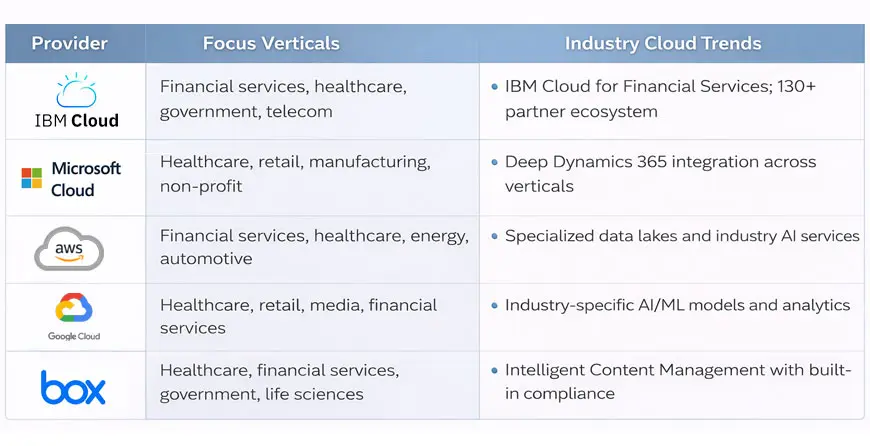
Beyond hyperscalers, specialized providers like Salesforce (CRM verticals), Comidor, and sector-specific ISVs continue to expand the ecosystem with focused, niche offerings.
Different industries are extracting very different value from purpose-built cloud platforms. What’s common is the shift from “build everything yourself” to “start with what your industry already needs.” Here’s how that plays out in 2026:
What’s driving adoption: HIPAA compliance, patient data security, interoperability mandates
Key applications:
The difference:
A healthcare industry cloud treats data as Protected Health Information (PHI) by design which is embedded across all the access controls, audit trails and retention policies. It’s not just storage but a compliance-aware infrastructure.
What’s driving adoption: PCI DSS compliance, fraud prevention, real-time analytics, CX expectations
Key applications:
The difference:
The financial industry clouds function with security protection at the transaction level and they use intelligence systems that include pre-existing fraud detection models. This is developed using financial behavior patterns thus eliminating the need for multiple months of custom software development.
What’s driving adoption: Supply chain visibility, predictive maintenance, IoT integration, quality control
Key applications:
The difference:
Manufacturing clouds natively handle both IT and OT data, with built-in support for edge computing and industrial IoT—bridging factory floor operations with enterprise systems.
What’s driving adoption: Personalization, demand forecasting, omnichannel experience
Key applications:
The difference:
The retail industry cloud solution provides complete business systems through its pre-built integration that enable rapid large-scale personalized marketing solutions.
Industry cloud isn’t just about infrastructure—it’s about embedding domain intelligence directly into the platform, so businesses spend less time adapting technology and more time driving outcomes
If you’re in a regulated industry: You no longer have to choose between cloud benefits and compliance. Industry clouds were built for your constraints.
What This Means for Your Business
Whether you’re just starting your cloud journey or looking to optimize an existing multi-cloud environment, industry cloud platforms change the calculus in several ways:
Key characteristics to consider:
Industry cloud has become the standard operating environment for businesses because it has replaced existing cloud platforms. The era of one-size-fits-all cloud is ending. Organizations are now adopting specialized platforms which provide solutions that match their operational needs and market development goals.
Every industry sector which needs specific solutions now has access to cloud solutions which satisfy their requirements. Your organization needs to implement a particular solution, but your organization needs to expedite that process because your competitors already have operational advantages.
Ready to explore cloud solutions for your business?
Talk to Our Cloud Experts