Due to geopolitical tensions and market fluctuations, global manufacturers are trying to navigate a period of unprecedented complexity. Despite the recent digital advancements in modern manufacturing enabling industrial revolution 4.0, many still find themselves trapped in reactive chain of operations rather than the proactive ops which is the required in the modern era of digital advancements and artificial intelligence led manufacturing.
Due to critical operational flaws and external issues, supply chains often remain fragile. Additionally, labor costs are mounting, and sustainable production is no longer a choice, but it has become a survival requirement.
Most of these modern manufacturing challenges can be solved by harnessing real-time insights generated by floor operations and various production and operational processes. Commonly, manufacturers usually struggle with disconnected data that contains thousands of unstructured IoT sensor signals and legacy ERP systems. That fails to provide real-time sensor signals and legacy ERP systems. If these operational bottlenecks are not addressed through a streamlined data strategy, the impact on business continuity will be severe.
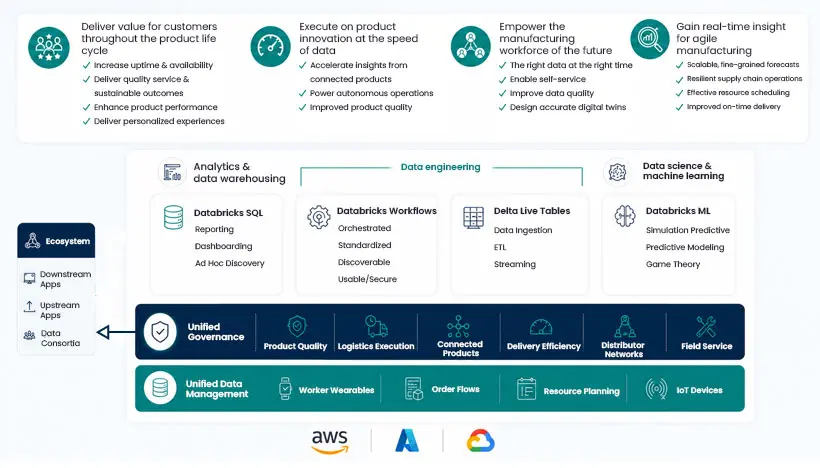 Bridging the Gap: The Databricks Lakehouse for Manufacturing
 Gartner predicts that through 2026, 65% of manufacturers will experience digital transformation fatigue if they do not unify their data ecosystems to support AI. According to Deloitte, unplanned downtime costs industrial manufacturers $50 billion annually which can be avoided by a unified data ecosystem that sparks real-time insights.
 Progressive executives are turning to the Databricks Lakehouse for manufacturing to convert raw data into a strategic advantage. By bringing analytics and AI into a single architecture, Databricks in manufacturing allows teams to finally merge high-velocity sensor data with their structured business records. This creates the reliable foundation needed to tackle three of the industry’s most persistent headaches.
1. Mastering Predictive Maintenance at Scale
Disintegrated and inconsistent data integration often hides early signs of equipment failure. Usually, for large-scale manufacturing companies, the complex challenge isn’t predicting one failure but enabling an infrastructure that can optimize that capability across thousands of assets and processes globally to prevent devastating failure catastrophic downtime.
2. How to Reduce the “Bullwhip Effect” in Supply Chains
Data siloes or disconnected data is the root cause of the “Bullwhip Effect,” this is triggered when the even a small shift in consumer demand becomes the cause for massive ripple effects upstream. Databricks in manufacturing plays a crucial role in mitigating the Bullwhip Effect by helping modern manufacturers establish a Single Source of Truth by unifying various data platforms for real-time visibility and intelligence.
The Solution: The Databricks Lakehouse uses advanced demand forecasting with machine learning and AI. By using pre-built AI models to forecast at the store/item level, this results in reducing the time required to run stimulation by 50% or more.
The Proof: IDC research shows that AI-enabled, unified supply chain platforms are the secret sauce to the significant efficiency gains by 2026 for manufacturers. While some reports predict that it can even improve fulfillment rates by 10% while reducing inventory costs by 15%.
3. Closing the Loop on Quality Assurance
Manual inspections are the ultimate bottleneck. In high-speed environments, a microscopic defect can result in entire batches being scrapped before a human even notices a problem.
In manufacturing, these technical shifts turn out to have real financial payoffs. For instance, a global automotive supplier moved away from slow, traditional data processing to a Databricks Lakehouse for manufacturing. This wasn’t just a technical upgrade; it revolutionized how they deal with production errors. When their AI detected a defect, it didn’t just send an alert it automatically adjusted the upstream supply chain. This cut their response time from a disastrous 48-hour window down to just 15 minutes, saving the company an estimated $1.2 million every single quarter by preventing costly recalls.
We see a similar success story with a major beverage producer that focused on energy efficiency across its 50 bottling plants. They used Databricks to match the manufacturing industry standards for refrigeration requirements to up-to-date weather information and managed to reduce their carbon footprint by 12% in the first year alone. This is a great example of how modern data tools can help to make climate commitments tangible in day-to-day operations.
In the industrial landscape of today, the “Smart Factory” can’t just be a line item on a future roadmap; it must be a living, breathing part of your day-to-day operations to truly succeed. The real transformation begins when leadership moves beyond simply collecting mountains of data and starts to truly interrogate it for meaningful insights.
As a Registered Databricks Consulting Partner, Beyond Key is well-positioned to excel in this space. We don’t believe in just “installing” software; we believe in the complex journey of integrating a Databricks Lakehouse for manufacturing into the core of your production floor. Our goal is to ensure your AI tools are fully integrated, specifically designed to eliminate the bottlenecks unique to your business.
At the end of the day, the core value of Databricks in manufacturing is simple: it helps you build better products with substantially less friction. When you anchor your AI strategy in a unified, reliable data foundation, you’re doing much more than just putting out today’s fires you’re creating a resilient, self-optimizing business that’s ready for whatever the next decade throws at it.
1. What is Databricks Lakehouse for Manufacturing?
Databricks Lakehouse for Manufacturing is an industry-specific data and AI platform that helps manufacturers unify operational technology (OT), IoT, ERP, MES, and supply chain data in a single environment. It supports advanced analytics, AI, and real-time decision-making across manufacturing operations.
2. How does Databricks help manufacturers reduce downtime?
Databricks enables predictive maintenance by analyzing machine sensor data, historical maintenance records, and operational metrics. This helps manufacturers identify potential equipment failures before they occur and reduce costly unplanned downtime.
3. Can Databricks integrate IoT and factory data?
Yes. Databricks can ingest and process data from IoT sensors, production equipment, MES systems, ERP platforms, and other manufacturing applications. This creates a unified view of operations for real-time monitoring and analytics.
4. What are the top Databricks use cases in manufacturing?
Common use cases include predictive maintenance, quality control, supply chain optimization, demand forecasting, digital twins, production monitoring, and inventory optimization.
5. How does Databricks support Industry 4.0 initiatives?
Databricks helps manufacturers connect data, analytics, and AI across factories and supply chains. This enables smart manufacturing capabilities such as automated decision-making, real-time monitoring, predictive maintenance, and intelligent production planning.
6. Can Databricks improve manufacturing quality control?
Yes. Manufacturers can use Databricks to analyze production data, sensor readings, and computer vision outputs to identify