Data teams today are under more pressure than ever. Modernize analytics, support AI initiatives, control spiraling costs, and untangle fragmented data stacks, all at once. That’s exactly where the Databricks vs Microsoft Fabric debate lands.
Both platforms support data engineering, analytics, and AI. But they solve those problems from fundamentally different directions. In this guide, we compare capabilities, pricing, and best-fit use cases so you can stop debating and start planning.
 What Is Databricks?
 Databricks is a cloud-based lakehouse platform engineered for teams requiring end-to-end data engineering and data science capabilities.
Where other platforms abstract infrastructure away, Databricks exposes it. This gives engineers the control to tune every job, cluster, and pipeline to meeting requirements.
Core capabilities include:
Launched in 2023, Microsoft Fabric is a fully managed, end-to-end SaaS analytics platform that consolidates everything an organization needs for data work into a single, integrated environment.
Fabric unifies previously standalone Microsoft services: Azure Synapse, Azure Data Factory, Power BI, and Azure Data Lake Storage, under one roof.
One Lake – A single, organization-wide data lake. Every Fabric workload reads from and writes to the same storage layer. No data duplication, no ETL between services.
Adopting Microsoft Fabric was not just about improving our data analytics. It was about empowering our people with the right tools to make smarter, data-driven decisions daily.”
Irfan Khan, Head of Data & Analytics at Melbourne Airport.
30% Increased performance efficiency across data-related operations
1. Architecture and Platform Design
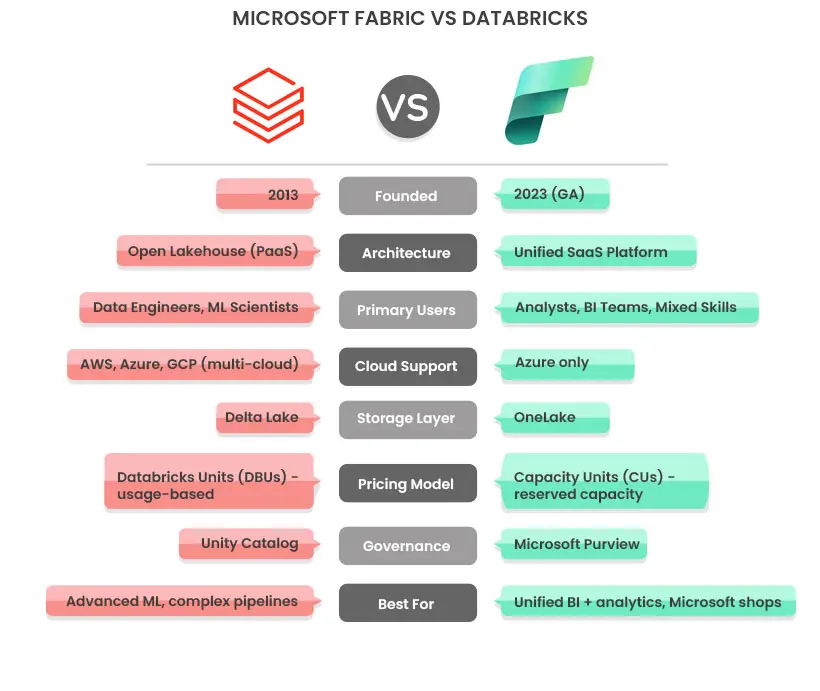
Databricks operates as a PaaS (Platform as a Service) Lakehouse. Engineers control cluster configuration, compute tuning, and pipeline orchestration. Power users thrive here.
Microsoft Fabric is a SaaS (Software as a Service) platform. It hides infrastructure complexity. Analysts and mixed-skill teams can prioritize insights over system management.
2. Data Engineering Capabilities
Fabric includes Data Factory-style pipelines and supports Spark notebooks, but its ETL/ELT capabilities are still evolving relative to Databricks. For organizations with lighter or standard engineering workloads, Fabric is entirely sufficient.
3. AI and Machine Learning Features
Databricks offers mature MLOps: experiment tracking, advanced model training, the Feature Store for ML-ready datasets, and heavy compute support. It is the dominant choice for organizations building production-grade ML systems.
Fabric integrates AI through Copilot experiences across the platform—well-suited for AI-assisted BI, natural language querying, and data exploration. For teams where ML is “something we’ll do next year,” Fabric’s current capability avoids the overhead of managing Databricks.
4. Business Intelligence and Visualization
This is Fabric’s clear advantage. Power BI’s Direct Lake mode delivers near-real-time BI performance without the traditional import process. For BI-first organizations, this integration is unmatched.
Databricks has no native BI layer. It pairs effectively with Power BI, Tableau, and Looker but that adds integration complexity. Notably, Power BI remains the industry leader for visualization regardless of which Lakehouse you choose.
5. Governance, Security, and Compliance
Unity Catalog is used in Databricks. It offers best-in-class security policies for cloud providers and provides table-level access control.
Fabric uses Microsoft Purview for centralized governance. One important caveat: as of early 2026, OneLake Shortcuts do not yet fully enforce the security policies of source systems, a governance gap that Unity Catalog handles more completely.
6. Integration Ecosystem
Databricks is cloud-agnostic. Deploy on AWS, Azure, or GCP based on your compliance needs, cost requirements, or existing contracts.It integrates with virtually all major data tools.
Fabric is Azure-native. Its integrations are deepest within the Microsoft stack. If your organization runs on Azure, Microsoft 365, and Teams, Fabric’s ecosystem advantages are real. For multi-cloud or non-Microsoft shops, those advantages disappear.
7. Scalability and Performance
Databricks has a longer track record at extreme scale—processing petabytes reliably for the world’s largest data teams. Its usage-based model allows granular compute sizing per workload.
Fabric scales through capacity tiers (F SKUs).For organizations with consistent, predictable workloads, this model delivers solid performance. For highly variable or burst-heavy workloads, Databricks’ on-demand scaling is typically more efficient.
 Licensing Considerations
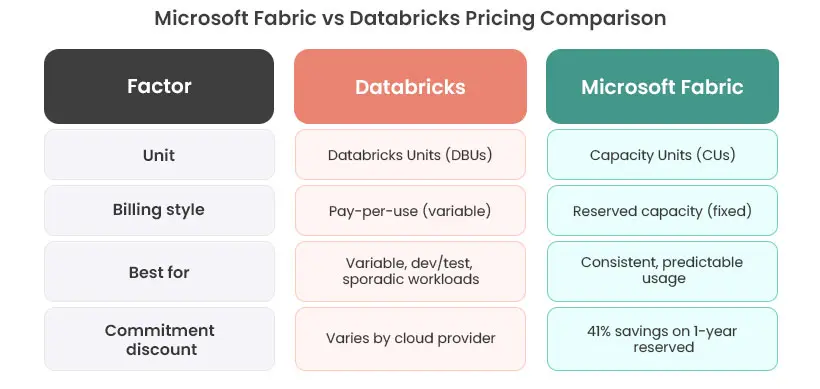
Databricks pricing is consumption-based. You pay for computing when you use it. This is cost-effective for development, testing, and irregular workloads. For large-scale continuous operations, costs can escalate without careful governance.
Fabric uses capacity-based pricing. You purchase an F-series SKU (F2 through F2048) that provides a shared pool of Capacity Units across all workloads. This creates predictability, but also a hidden variable that many organizations miss.
Hidden Cost Considerations
The most common Fabric pricing mistake: organizations budget for the F SKU, calculate the consolidation savings, and completely miss the Power BI licensing cost sitting beneath it.
For Databricks, the hidden costs are typically in cluster management overhead, engineer time spent tuning compute, and cloud egress fees across providers
Choose Databricks if your workloads are variable, your team is engineering-heavy, and you need granular compute control.
Choose Fabric if your usage is consistent, your team is BI-led, and you’re already paying for Microsoft 365. The right question isn’t “which is cheaper?” It’s “which pricing model fits how we actually work.
“Moving to Azure Databricks has transformed the data culture at AT&T. Instead of people analyzing data on their own laptops and saving the results locally, they’re all coming to the cloud to collaborate in one place.”
Praveen Vemulapalli, Director – Data & Gen AI Architecture, Chief Data Office, AT&T
Source: https://azure.microsoft.com/en-us/products/databricks
Data Engineering Teams
Databricks win here. Complex pipelines, Delta Live Tables, Auto Loader, and granular Spark tuning make it the mature choice for engineering-led organizations building production-grade data infrastructure.
Fabric is catching up, but its ETL/ELT tools are still evolving. For standard pipelines without extreme volume requirements, Fabric is workable.
For BI and Analytics Teams
Fabric wins here. Power BI’s Direct Lake mode, Dataflow Gen2 for no-code transformation, and native Copilot integration make Fabric the most accessible analytics platform for business users.
Teams without deep engineering resources will deploy faster and sustain Fabric more easily than Databricks.
For AI and Machine Learning Projects
Databricks wins here. MLflow, the Feature Store, mature experiment tracking, and heavy compute support are purpose-built for ML teams shipping models to production.
Fabric’s AI capabilities are growing. Copilot integration is genuinely useful. But for serious ML workloads, Databricks is the stronger foundation today.
For Microsoft-Centric Enterprises
Fabric wins here. If your organization runs Azure, Microsoft 365, Teams, and Power BI, Fabric’s integration advantages compound, security, and identity management are already aligned with your existing stack.
For Multi-Cloud Environments
Databricks win here. True multi-cloud deployment across AWS, Azure, and GCP gives you vendor flexibility and data residency control. Fabric is Azure-only.
Are you still confused about which is better: Databricks vs. Microsoft Fabric? While Databricks provides excellent advanced analytics and multi-cloud flexibility, Fabric offers analytics capabilities within a unified Microsoft ecosystem for businesses already using the Microsoft platform.
Beyond Key is a leading data management and analytics service providers that have helped a number of Fortune 500 companies with modern dashboard development and consulting services. You can get in touch with us here. We are Microsoft Solutions Partner with 100% client-centric approach.
Our team’s certifications: Microsoft Certified: Power BI Data Analyst Associate (PL-300), Microsoft Certified: Azure AI Fundamentals (AI-900), Microsoft Certified: Azure Fundamentals (AZ-900), SOC 2.
You can view our notable work by downloading these case studies.
|
Check how we helped them with interactive KPIs with visualizations to analyze financial data and maximize efficiency. See how we helped Breg increase visibility by 35% and reduce analysis time by 60%. |
See how a renowned North American manufacturer for exceptional architectural hardware products streamlined their data analytics tasks with Beyond Key. Read in detail about multiple dashboards developed for granular insights. |
1. What is the main difference between Databricks and Microsoft Fabric?
Databricks is a lakehouse platform designed for advanced data engineering, AI, and machine learning workloads.
Microsoft Fabric is a unified analytics platform that combines data integration, warehousing, analytics, and Power BI in a single SaaS experience.
2. Which is better: Databricks or Microsoft Fabric?
The better platform depends on your requirements. Databricks is often preferred for large-scale data engineering, AI, and multi-cloud environments, while Microsoft Fabric is ideal for organizations heavily invested in the Microsoft ecosystem and Power BI.
3. Is Microsoft Fabric replacing Databricks?
No. Microsoft Fabric and Databricks serve different use cases and can even be used together. Many organizations use Fabric for analytics and reporting while leveraging Databricks for advanced data engineering and AI workloads.
4. Can Databricks and Microsoft Fabric work together?
Yes. Organizations often integrate Databricks and Microsoft Fabric to combine Databricks’ AI and machine learning capabilities with Fabric’s reporting, analytics, and Microsoft-native experience.
5. Is Databricks better for AI and machine learning than Microsoft Fabric?
Databricks generally offers more mature AI, machine learning, MLOps, and model lifecycle management capabilities, making it a preferred choice for advanced AI initiatives