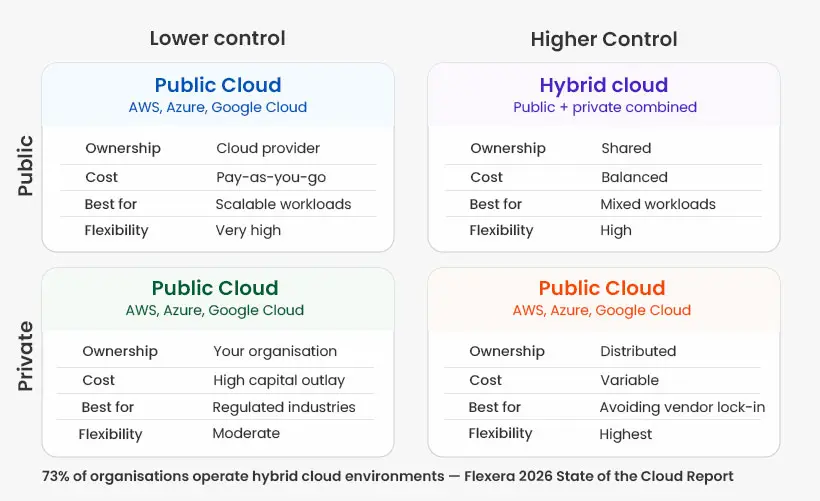
According to the Flexera 2026 State of the Cloud Report, 73% of organizations are running hybrid cloud environments today, but 85% of them say managing cloud spend is the biggest challenge.
In this blog, we will explore the major challenges organizations face during cloud migration and how to overcome them effectively. We will also look at practical strategies, real-world examples, and best practices to ensure a smooth and cost-efficient transition.
What is cloud migration?
Cloud migration is the process of transferring an organization’s data, applications, workloads, and IT infrastructure from on-premises environments to cloud platforms. Organizations usually select from 4 models based on their needs:
The reasons are the same: on-demand scalability with no capital investment, lower TCO, and greater business continuity for distributed teams. For organizations with aging infrastructure, cloud migration also opens the door to modern security tooling, real-time analytics and AI-ready data pipelines that legacy systems simply can’t support. The strategic case is obvious, but execution is where most organizations fall down.
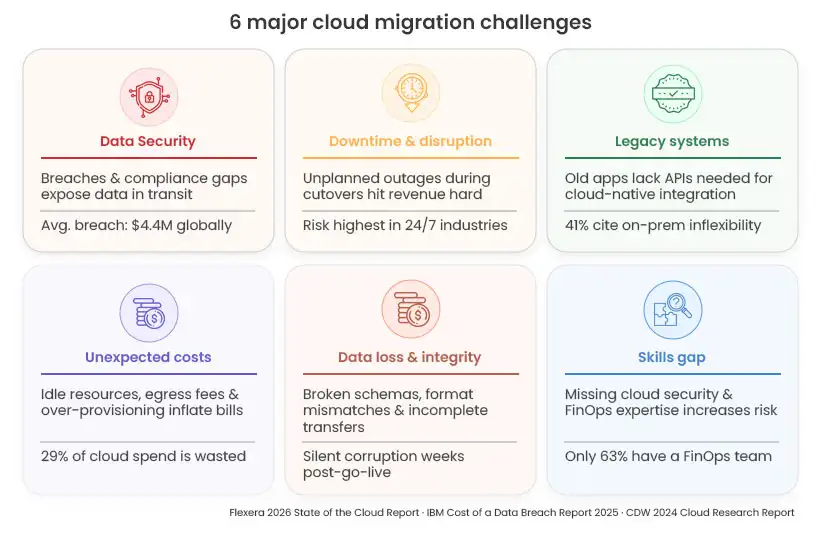
When data moves across environments, risk moves with it., IBM’s Cost of a Data Breach Report 2025 highlights that data breaches across multiple environments, such as public cloud, private cloud and on-premises, that cost organizations an average $5.05 million. In the U.S., that rose to a record $10.22 million per incident. Add compliance obligations like GDPR, HIPAA, and SOC 2, and it’s easy to see why security is where migrations fail most often.
Solution:
No business can afford to go dark in the middle of migration. In industries such as healthcare, finance, and retail where systems are expected to be up 24/7, a missed dependency, a poorly timed cutover, or an untested rollback plan can bring operations to a halt.
Solution:
The older systems were not built for the cloud. Databases, applications and integrations running for years often use infrastructure that does not translate to modern cloud environments. According to CDW’s 2024 Cloud Computing Research Report, 41% of organizations cite inflexibility in their on-premises setup as a top barrier to cloud adoption.
Solution:
Budgets rarely survive first contact with a real migration. The Flexera 2026 State of the Cloud Report finds that wasted cloud spend now represents 29% of total cloud spend, its first increase in five years, largely driven by idle resources, over-provisioned environments and the unpredictable cost profiles of AI workloads.
Solution:
Data doesn’t always move cleanly through migration. Incomplete transfers, broken schema mappings and format mismatches are common problems in data migration that can quietly corrupt reporting, disrupt operations or trigger compliance violations, sometimes weeks after go-live before anyone notices.
Solution:
Most IT teams can manage. Not all of them have extensive cloud migration experience – and that void reveals itself at the worst possible times. Flexera’s 2026 State of the Cloud Report reveals that only 63% of organizations have a dedicated FinOps team. Meanwhile, IBM’s 2025 research found that organizations that used AI-driven security tools saved $1.9 million per breach, on average, a benefit that’s out of reach without the right expertise in place.
Solution:
Working with a Microsoft Solutions Partner that holds SOC 2 Type II compliance and ISO 27001:2022 certification provides organizations with immediate access to governed, secure migration expertise, see Top Cloud Migration Companies: A Buyer’s Guide for a full evaluation framework.
The Problem
Betabrand’s old bare metal servers couldn’t handle sudden traffic spikes. Planning for extra capacity took forever and cost too much. They knew Black Friday would break their site if they didn’t fix things fast.
How Cloud Helped
They migrated to Google Kubernetes Engine (GKE) before the big sales event. First, they ran test migrations to find the right steps. Once live, the cloud auto-scaled during peak loads. Result? Zero outages since the move. Black Friday 2018 ran smoother than ever.
The Problem
Evernote ran its own servers for years. But scaling became painful; maintenance was expensive, and disaster recovery was weak. They needed more flexibility and security fast.
How Cloud Helped
They moved to Google Cloud in phases, not all at once. This lets them test each step and roll back if something breaks. They added extra encryption and used Google’s service accounts for tighter security. In just 70 days, they migrated 5 billion notes and 5 billion attachments. No data loss. Better backup. Less stress.
| Category | Primary Focus | Action Items | Success Indicator |
| Roadmap | Governance | Map phases (Assessment to Optimization); Define RACI & timelines. | Zero scope creep; adherence to budget. |
| Prioritization | Risk Mitigation | Migrate low-risk workloads first; refine processes for mission-critical apps. | Minimal downtime; limited “blast radius.” |
| Monitoring | Visibility | Establish baselines; deploy CloudWatch, Azure Monitor, or Datadog. | Rapid incident resolution; cost anomaly detection. |
| Communication | Alignment | Document dependency maps & configs; update non-IT stakeholders. | Seamless go-live; high stakeholder buy-in. |
| Optimization | ROI & Security | Launch FinOps/CCoE; prune idle resources; automate compliance. | Sustained cost efficiency; hardened security. |
There are many cloud migration challenges, such as security risks, unplanned downtime, legacy compatibility, cost overruns, data integrity concerns, and skills gaps. However, if you have the right strategy, these are all solvable. Good planning, securing every step of the way and working with a certified partner consistently differentiates smooth migrations from stalled migrations.” Organizations that approach cloud migration as an iterative, governed business initiative, instead of a one-time IT project, will be best positioned to scale, innovate and lead in an increasingly cloud-first world.
How Beyond key can Help in smooth Migration Process
With over 350+ technology specialists and 20+ years of experience, Beyond key has deep expertise in every cloud migration journey. As a Microsoft Solutions Partner, and with SOC 2 Type II & ISO 27001:2022 certifications, we focus on making sure migrations are secure, well-governed and cost-efficient from day one.
We don’t just migrate workloads to the cloud, we help you build in security, FinOps discipline and measurable business outcomes along the way.
Contact our team to begin building your cloud migration roadmap.