Artificial Intelligence has significantly improved human efficiency while automating day-to-day tasks. From healthcare to education, IT to finance, every sector uses AI to make faster decisions and enhance efficiency. Artificial Intelligence can identify data patterns but cannot explain the “Why” of an event. It tells you how and what is to be done but not why.
Causal AI evolved after traditional AI. It focuses on cause-and-effect relationships and this new form of AI is known to transform the way organizations operate. In this blog, we will explain the basics of causal AI is, how it works and use cases.
“Stanford’s lab focuses on making causal inference accessible for real-world decision-making across industries.”
Causal AI is a branch of Artificial Intelligence that not only detects patterns in data but also helps users identify and leverage cause-and-effect relationships in organizational data. Instead of analyzing data, causal AI focuses on deeper explanation about why the event happened. It utilizes a core methodology – causal inference to find out the effect and come up with cause-and-effect conclusions.
| The global causal AI market size was estimated at USD 40.55 billion in 2024 and is projected to reach USD 757.74 billion by 2033, growing at a CAGR of 39.4% from 2025 to 2033. |
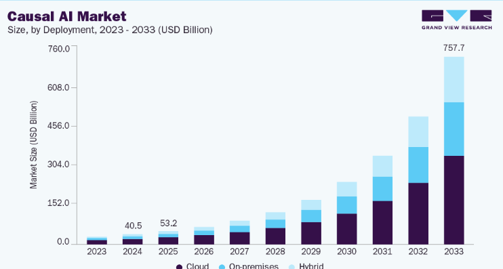
Source: https://www.grandviewresearch.com/industry-analysis/causal-ai-market-report
Black-box models in AI do not provide clear explanations of the events that occur. On the contrary, modern enterprises expect clear insights and transparency. Causal AI uses methodologies such as structural causal models and discovery algorithms to identify cause-and-effect relationships across different domains.
Causal AI is critical for modern businesses because:
According to insights from organizations like Gartner and McKinsey & Company, explainability and decision intelligence are becoming critical for AI adoption.
| The concept of causal AI was raised by Judea Pearl, the Turing Award-winning computer scientist and philosopher, in 2018’s The Book of Why: The New Science of Cause and Effect. |
Causal AI relies on several approaches: Causal Graphs and Models, Structural Equation Modeling (SEM), Do-calculus and Interventions, and Causal Discovery Algorithms. Causal AI drives predictions of future outcomes while addressing nonergodicity. It combines data analysis with causal inference techniques.
Causal AI works in these steps:
1 .Data collection
The initial step includes gathering a large volume of data that states metrics, behaviors, and events. From financial data to operational performance to business metrics, Causal data collects relevant data to process further.
2. Identify relationships
The software identifies the variable relationship. Causal AI algorithms help construct causal models and detect potential relationships between variables.
3. Causal discovery
Causal AI is grounded in methods that represent causal dependencies among variables. With causal graphs and interventions, you can determine the actual cause-and-effect relationship between variables.
4. Identification and estimation
With graph-based techniques and Structural Causal Models, the system finds out the dependencies and correlations between systems.
5. Refutation and validation
Make sure to understand the robustness of the causal assumptions and validate the real-world analysis.
6. Implementation and monitoring
Causal machines can come up with extensions and rehauls. After you get the causal model implemented, make sure to monitor it continuously.
Causal AI is implemented across industries and yet it is not just a terminology. Let us see what the use cases of causal AI are and how will it affect the operations in 2026.
1. Marketing & Customer Analytics
Traditional AI helps companies identify and compare the performance of multiple campaigns. Causal AI also explains why customers are abandoning the purchase of a specific product, which campaigns are responsible for enhancing the brand name and more.
In this way, marketing professionals can generate measurable Roi rather than replying on tentative numbers.
2. Healthcare & Life Sciences
Causal AI helps the healthcare and life sciences sector by analyzing the real cause that is responsible for treating patients. It helps identify which kind of treatment method reduces the time of recovery. Also, causal AI helps professionals identify patients’ behavior. These are just a few examples.
3. Supply Chain & Manufacturing
Causal AI helps the supply chain and manufacturing sectors identify areas for improvement. This includes monitoring the delivery performance, factors impacting the increase in operational cost, and reasons why the production process is being delayed.
4. Financial Management
Causal AI helps finance professionals enhance the decision-making process by helping them detect issues & fraud, monitor compliance, analyze investment performance, and more.
Causal AI methods are better than black-box machines as they are easily explainable, and you can justify them.
Causal AI tools help users to identify cause and effect relationship (data). It is way different from traditional AI tools. Users can create or simulate “what-if” scenarios and optimize interventions by deep diving into why the event happened or is happening. Let’s have a quick look at the causal AI tools:
The objective of these tools is to simulate “what-if scenarios”, measure the direct impact of an intervention, unveil causal relationships from business data, etc.
Enhanced decision-making: Causal AI helps organizations make better and smarter decisions by enabling precise actions and uncovering the exact cause and effect relationships between variables.
Results are explainable: You have the data in hand. With clear reasoning and transparent data models, causal AI aligns well with the achievable results.
Less biasness: Ensure accurate outcomes, and avoid misleading statements. Causal AI ensures actual outcomes in ML datasets rather than superficial correlations.
Adaptability: Ensure accuracy when data is transferred from one platform to another. Understand how different variables influence each other and predict accurate outcomes.
Generative AI and Causal AI represent two very different approaches to intelligence and decision-making. Understanding the distinction is important.
| Feature | Generative AI | Causal AI |
| Focus | Pattern generation | Cause-effect reasoning |
| Output | Text, images, predictions | Explanations, decisions |
| Explainability | Low | High |
| Use Case | Content creation | Decision intelligence |
Here are the key factors driving causal AI market:
Causal AI is transitioning from being into a niche industry to becoming the critical part of all businesses. Here is the future of causal AI in brief:
To learn more about how causal AI can help your business grow, get in touch with us.
How is causal AI different from generative AI?
Causal AI and Gen AI solve different business problems. While Gen AI focuses on analyzing datasets and generating new outputs, causal AI is based on causal inference methods. Its objective is to find out the cause and effect of relationships between variables.
What are the benefits of causal AI for businesses?
Causal AI helps businesses simulate outcomes and provide a clear understanding and reasoning behind those outcomes. For example, it helps businesses identify inefficiencies, and why operations are failing, without taking much time.
Which industries use causal AI the most?
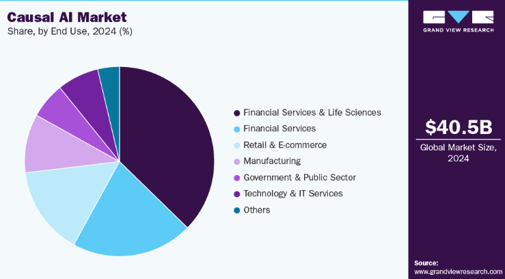
Industries using causal aggressively include healthcare and life sciences, finance, marketing and advertisement, retail and ecommerce and more.
What are the challenges of implementing causal AI?
Major challenges of implementing causal AI are: