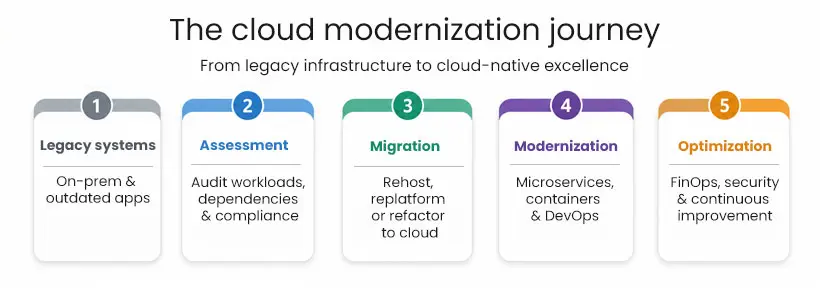
Most IT teams aren’t short on ambition when it comes to the cloud. What they’re short on is a clear Cloud Modernization Strategies approach that bridges where they are today and where they actually need to be.
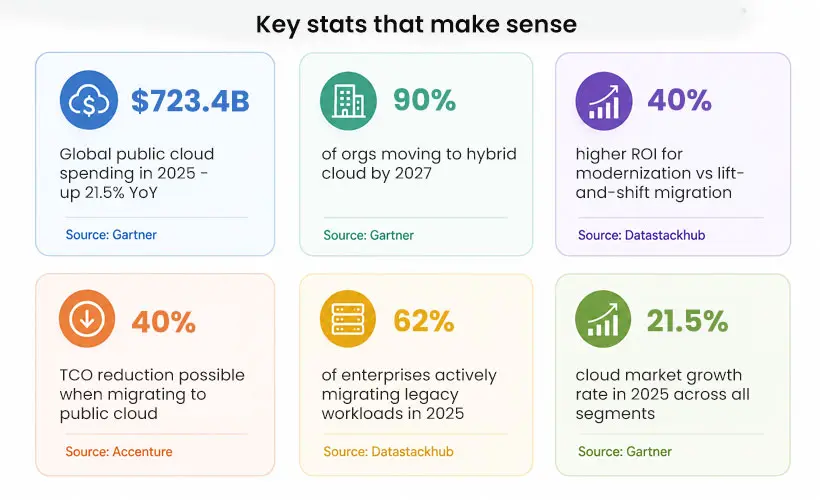
Moving workloads to the cloud is one thing. Modernizing them to unlock real business value is another conversation entirely. According to Gartner, worldwide end-user spending on public cloud services is forecast to reach $723.4 billion in 2025, up 21.5% from $595.7 billion in 2024. That number reflects not just adoption but a fundamental shift in how organizations think about their technology infrastructure.
 What Cloud Modernization Really Means
 There’s a distinction that gets glossed over constantly: migration and modernization are not the same thing.
Cloud migration and modernization often get used interchangeably, but migration is about moving your applications from one environment to another. Modernization is about rethinking how those applications are built, deployed, and maintained, so they actually take advantage of what cloud infrastructure can do.
Lift-and-shift migrations get your workloads off-premises. But organizations that modernize applications during migration see 40% higher ROI than those that simply relocate legacy workloads to the cloud, according to research from Datastackhub’s Cloud Transformation analysis. That’s not a marginal difference.
Legacy application debt is accumulating faster than most organizations acknowledge. The longer you wait to modernize, the more you’ll spend on maintenance costs, security patches and integration workarounds to keep aging systems talking to each other.
Gartner also predicts that 90% of organizations will utilize a hybrid cloud model by 2027. If your applications aren’t designed to operate in hybrid and multi-cloud environments, you’ll be retrofitting them under pressure later, rather than planning it now.
There’s also the competitive pressure from AI. According to the same Gartner forecast, the growth in cloud infrastructure spending is significantly driven by AI workloads. Organizations that haven’t modernized their applications can’t easily integrate AI capabilities into their existing systems; their architecture simply wasn’t built for it.
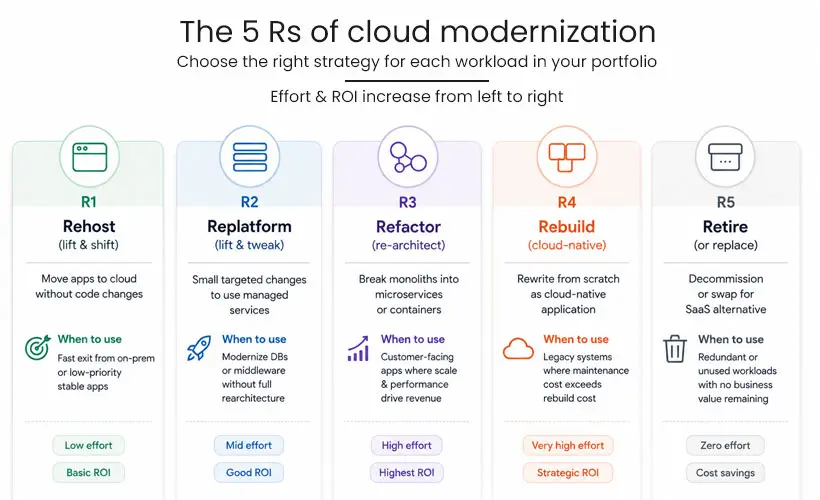
Not every application deserves the same treatment. A thoughtful cloud modernization strategy starts with categorizing your workload portfolio and applying the right approach to each one.
1. Rehosting (Lift and Shift)
This is the fastest path to the cloud, but it’s not really modernization, it’s relocation. Rehosting is useful for applications that are stable, low-priority for innovation, or need to be off on-premises infrastructure quickly. It’s a starting point, not an endpoint.
2. Replatforming
Here you make targeted changes to optimize an application for the cloud without redesigning its core architecture. Migrating from self-managed databases to managed cloud services like Amazon RDS or Azure SQL is a common example. You get cloud benefits, automated backups, scaling, patching, without a full rebuild.
3. Refactoring / Re-architecting
This is where real cloud modernization happens. Breaking monolithic apps into microservices, adopting containerization with Kubernetes, or re-building around serverless functions all fall here. It takes the most effort but yields the highest long-term return, particularly for customer-facing applications where performance and scalability directly affect revenue.
If you’re looking at ERP migration and moving legacy systems to the cloud, re-architecting is often the path that future-proofs the investment rather than just kicking the can down the road.
4. Rebuild
Building cloud-native from the ground up makes sense when the application has become a liability, and the cost of maintenance is greater than the cost of replacement. This is particularly true for organizations for whom a legacy system is the bottleneck to achieving digital transformation goals.
5. Retiring and Replacing
Some applications simply don’t need to make the journey. Part of a sound modernization strategy is to identify workloads for retirement or replacement with SaaS. Carrying unnecessary systems into the cloud adds cost and complexity without value.
 The Cloud Modernization Decision Matrix: Mapping Metrics to Strategies
 | Metric / Indicator | Recommended Strategy | Strategic Justification |
| Tightly-coupled monolith / High traffic spikes | Refactor / Rearchitect | Enables independent scaling and cloud-native agility. |
| Standard multi-tier app / Predictable baseline | Replatform | Replaces local components with managed cloud services without code rewrites. |
| Steady, unchanging workload / Low tech debt | Rehost (Lift & Shift) | Quick infrastructure virtualization with zero code changes. |
| Legacy OS nearing End-of-Life (EOL) | Replatform | Upgrades underlying software and runtimes during migration. |
| Proprietary code / No cloud equivalent | Retain | Avoids high operational risk; keep on-premises. |
| Manual deployments / Slow release cycles | Refactor or Replatform | Integrates workloads into modern containerized CI/CD pipelines. |
| Strict localized data sovereignty laws | Retain (or Hybrid) | Complies with physical location restrictions. |
| Traditional infrastructure team skill set | Rehost | Minimizes operational friction while staff upskills. |
You can re-architect applications all you want, but without the right operational practices, you’ll lose most of the gains. DevOps plays a central role in true cloud modernization. Continuous integration, continuous delivery, infrastructure-as-code, and automated testing are what allow modernized applications to actually move faster and respond to change.
Without DevOps, teams often find that their newly modernized architecture gets managed with the same manual, siloed processes as the legacy systems it replaced. The technology changes; the bottlenecks don’t.
Security can’t be an afterthought in any cloud modernization strategy. According to Flexera’s 2025 State of the Cloud Report, 84% of cloud decision-makers cite managing cloud spend and governance as primary challenges and governance includes security.
Modernization projects that don’t design security from the start tend to accumulate compliance debt quickly. Identity and access management, encryption in transit and at rest, and network segmentation are not optional considerations; they are requirements, especially in regulated industries.
Here’s what separates successful modernization efforts from the ones that stall:
Migrating to the public cloud can reduce total cost of ownership by up to 40%, according to Accenture research cited by CloudZero. But that savings potential depends on doing modernization right, not just moving cost from a data center to a cloud invoice.
The successful cloud modernization solutions are based on good architectural decisions and strong governance, cost management, and continuous optimization. The organizations that see the greatest ROI are those that treat the cloud as a continuous journey rather than a one-time migration event.
A consistent finding across client engagements: page load times, system availability, and developer release velocity all improve significantly when modernization is done with genuine architectural intent, not just relabeled infrastructure.
Cloud modernization isn’t a destination; it’s a continuous discipline. The organizations pulling ahead aren’t necessarily the ones who started the earliest. They’re the ones who’ve been most deliberate about aligning their modernization decisions with actual business objectives.
If your team is working through an application modernization roadmap or evaluating which workloads should move, be refactored, or be rebuilt, the conversation is worth having before the approach is decided.
Talk to our cloud experts to explore what a modernization strategy looks like for your environment.
The depth of expertise your modernization partner brings directly affects outcomes. There’s a meaningful difference between a partner that can execute a migration checklist and one that understands your application architecture, your industry’s compliance requirements, and the cloud-native patterns that will serve you three years from now.
Backed by our 12+ years of cloud migration experience, partnerships with AWS, Microsoft Azure, and GCP, and certifications such as ISO 9001, ISO 27001:2022, and SOC 2 Type II, our cloud consulting services and Azure cloud capabilities are backed by a Microsoft Solutions Partner and Tier 1 Microsoft Cloud Solution Provider team that operates across the entire modernization lifecycle, from initial assessment to post-migration optimization and managed support.
Our Azure Cloud case studies reflect real outcomes: infrastructure migrations that delivered 5x improvement in page load times, conversion rate increases exceeding 20%, and ERP deployments that meet complex regulatory requirements across multiple locations.
1. Cloud migration vs. cloud modernization: What’s the difference?
Migration lifts your apps to the cloud. Modernization changes how they are being built and operated differently today to harness the full benefits of cloud, including auto-scaling, managed services, and serverless computing.
2. What cloud modernization strategy should my organization begin with?
First, take a look at your application portfolio. Choose the right approach for the workload: rehost, replatform, refactor, rebuild or retire. Not every app needs that level of change.
3. Does cloud modernization always require refactoring?
No. Refactoring is good for high value, customer-facing applications that need to scale and move fast. For stable, low-priority workloads, rehosting or replatforming may suffice.
4. What is the role of DevOps in cloud modernization?
DevOps allows for continuous integration, continuous delivery and infrastructure as code. Without this, even modernized architectures can become victims of slow, manual approaches that limit real benefits.