Cloud adoption is not slowing down. Neither are cloud bills. Companies usually underestimate the importance of cloud-cost optimization services. They don’t monitor the cloud usage, still pay for idle resources, and bulky infrastructures.
In 2026, businesses across every industry are spending more on cloud infrastructure than ever before. But without managing cloud infrastructure costs, a large share of cloud spending will be unprofitable. It can drain budgets and hamper business growth.
The good news? cloud spend management and best practices have matured. The tools are better. The strategies are proven. And companies that act now will hold a real competitive edge.
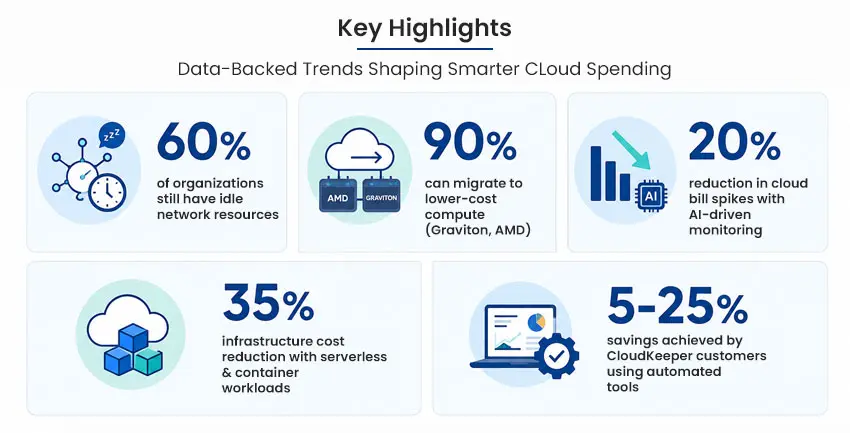
For example, an e-commerce organization has invested in 10 cloud servers and pay on a monthly basis. They didn’t monitor the cloud usage. After analysis, they found that out of 10 servers, 4 are unused, the databases are oversized, and traffic drops during the night hours. After they opted cloud cost optimization services, they have witnessed 35% reduced cost and decent annual savings.
What service did they invest in? This e-commerce company has chosen Beyond Key to got reserved pricing plans, instances and auto-scaling implemented.
Source: Cloudkeeper
Whether you are running workloads on AWS, Azure, Google Cloud, or a multi-cloud setup, this guide gives you ten actionable cloud cost optimization strategies you can implement today.
You cannot cut what you cannot see.
At the initial stage, make sure to have a clear plan about cloud spend optimization. Establish visibility and track spending by using an array of tools: Azure Cost Management, AWS Cost Explorer, Google Cloud Billing, etc., across departments, accounts, and locations. Tagging policies help the organization be accountable by labeling resources based on project, department, or team.
Most teams’ over-provision. They pick large instance types to be safe, and then those instances run at 10–20% utilization. Rightsizing means matching your compute, memory, and storage capacity to actual usage. Cloud providers offer built-in recommendation tools such as Google Cloud Recommender, Azure Advisor, AWS Compute Optimizer and more.
You can analyze your workload history and leverage smaller, more efficient options with these tools. This single practice is among the highest-ROI cloud cost spend optimization solutions available.
According to McKinsey Digital, the results of cloud optimization can be dramatic, allowing technology leaders to “quickly cut as much as 15 to 25% of the costs of their cloud programs while preserving their value-generating capabilities.”
Reserved Instances are pricing models that can be used for cloud optimization in the cloud computing domain. It ensures predictable cost optimization. Organizations can run on mission-critical apps and cut 75% cost.
A few examples of workloads that work well in Spot Instances are CI/CD operations, High Performance Computing (HPC), distributed databases, containers, and microservices. Spot instances have become a powerful element in cloud cost optimization process.
The trade-off is that these instances can be interrupted. For fault-tolerant workloads, that trade-off is very much worth it.
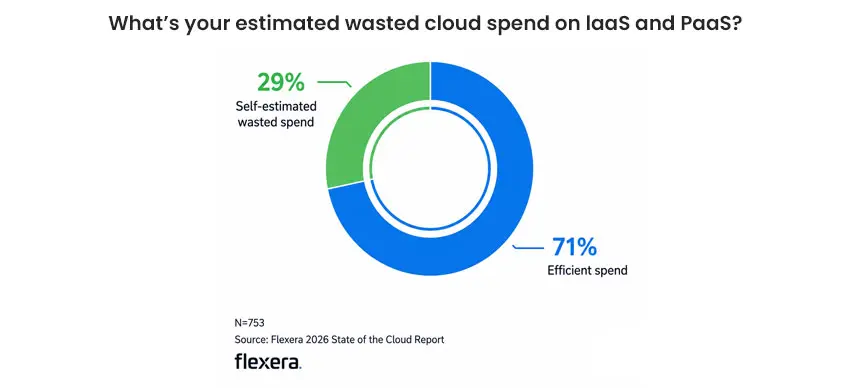
Forgotten test environments. Elastic IPs with no instance attached. These are a few idle resources that are accumulated in active engineering environments. They are easy to miss and costly to ignore. By eliminating idle resources, you can identify inefficiencies.
AWS Trusted Advisor, Azure Advisor, and open-source options like Infracost can flag these automatically.
Source: Flexera
Storage is often the most undermanaged part of a cloud environment. Not all data needs to live in high-performance, always-accessible storage. To match data value to cost-efficient storage classes, businesses should optimize storage tiers and focus on lifecycle policies.
Storage tiers such as S3 Infrequent Access and Azure Cool Blob Storage can help businesses store infrequently used data.
Data transfer fees are a hidden tax on poorly designed cloud architectures.
Moving data between regions, across availability zones, or out to the internet adds up. And unlike compute, these costs are not always visible until the bill arrives.
Audit your data transfer patterns. Keep services that communicate with each other in the same region or availability zone, where possible. Use Content Delivery Networks (CDNs) for user-facing assets to reduce egress charges. This is a crucial element of sustainable cloud cost optimization solutions.
Turning cloud cost principles and policies into code that’s integrated into the engineering process could generate almost $120 billion in value.
Sources: Microsoft
FinOps practices unite finance, technology, and business teams to maximize the business value. By including FinOps services, organizations can clearly reduce costs, improve accountability, and enhance cloud efficiency.
FinOps practices help the organization evaluate cost per customer, cost per API call, cloud spend as a percentage of revenue, and unit economics by workload.
Cloud Cost Governance with Policy-as-Code includes Machine-Readable code, financial guardrails, and strategies to avoid cloud overspending. Governance involves setting clear budgets and automated tagging rules, limiting unused resources, and reducing cloud wastage.
As technology evolves, cloud environments continue to change. Cloud cost strategies also change with technology. The FinOps team should be open to communication. They should encourage cross-team communication to track unit economics, cost per transaction/user and feature.
The primary objective of adopting cloud cost optimization is to control cloud costs. Here are the reasons why you should invest in it:
Cloud cost optimization is a strategic process to reduce cloud spending in an organization while improving business efficiency. Given the complexity of cloud pricing models, controlling costs can be tricky. From identifying unused/idle resources to investing in rightsizing and auto-scaling tools, there are many cloud financial management best practices to follow.
Beyond Key is a leading cloud cost optimization company with more than 20 years of experience in IT consulting. With a team of certified cloud architects who are well-versed with AWS, Azure, and GCP platforms’ intricacies, we focus on a FinOps-driven services to keep burn rate in check. We support organizations with cloud optimization assessments, FinOps implementation, and workload modernization strategies across AWS, Azure, and GCP environments.
From identifying hidden cloud wastage to implementing technical fixes and aligning cloud investment with enhanced business efficiency, our cloud cost optimization services are worth investing in. You can get your cloud optimization assessment here.
Please check our real-world case studies and see how Beyond Key helped organizations across the globe operating in multiple industries achieve their cloud objectives.
1. What is cloud cost optimization?
Cloud cost optimization is the process of managing and reducing cloud spending while ensuring performance, scalability, and reliability of cloud resources.
2. Why is cloud cost optimization important in 2026?
With increasing cloud adoption and AI workloads, businesses are facing higher infrastructure costs. Optimization helps control waste and improve ROI.
3. What are the best practices for cloud cost optimization?
Best practices include right-sizing resources, removing unused instances, using reserved pricing models, automating scaling, and continuously monitoring usage.
4. What is FinOps in cloud cost management?
FinOps is a financial operations framework that helps teams collaborate on cloud spending, improve visibility, and make cost-efficient decisions.