Microsoft 365 gives your teams powerful tools to work from anywhere. But every new user, device, and app also opens a door. Microsoft Secure Score is the number that tells you how many of those doors are still unlocked.
Identity attacks are not slowing down. According to Microsoft’s 2025 Digital Defense Report, identity-based attacks jumped 32% in just the first half of 2025, and password spray now accounts for 97% of them.
At Beyond Key, an assessment does more than provide a score. It identifies security gaps across identities, devices, apps, data, and cloud workloads. It also highlights the most important issues to fix first.
Microsoft Secure Score is a built-in measurement inside the Microsoft Defender portal. It reviews your Microsoft 365 environment. It checks which recommended security controls are enabled. It then gives you a score based on Microsoft’s recommendations.
Think of it less as a report card and more as a map. It shows you:
The score recalculates roughly every 24 hours, based on your current configuration, per Microsoft Entra’s Identity Secure Score guidance. That makes it a living picture, not a one-time snapshot. This is what separates measuring security from improving it. A score by itself changes nothing. Acting on the gaps behind it does.
Each recommended action inside Secure Score carries a point value. That value reflects how much risk the action removes, not just whether a box is checked. Enabling MFA for admin accounts greatly improves security. It has a bigger impact than changing minor app settings. At Beyond Key, we help clients understand which security actions matter most. This helps teams focus on high-impact improvements instead of chasing easy score increases.
Secure Score groups these actions into categories that map to how attackers actually move:
Here is something most organizations get wrong: chasing a higher number is not the goal. Some recommendations will not fit every business. A hospital and a law firm do not share the same risk profile. The real goal is closing the gaps that matter most to your environment, not maxing out every category on the dashboard.
There is no universal passing grade. A “good” score depends on your industry, your risk tolerance, and what data you handle. In our experience, most organizations start with low or average Secure Scores. Many have important security gaps. With the right remediation plan, they can significantly improve their security posture.
| Microsoft Secure Score Range | Security Posture | Recommended Action |
| 0-50% | Vulnerable | Prioritize critical security improvements |
| 50-60% | Okay | Strengthen security controls |
| 60–80% | Good | Optimize existing policies |
| 80-100% | Excellent | Maintain continuous monitoring |
A high score can still hide a real gap if it comes from low-impact settings. A lower score is not automatically dangerous if the missing actions carry little weight. The number is a starting point for a conversation, not the final verdict. This is also why Gartner’s cybersecurity guidance consistently frames security maturity as a continuous program, not a single benchmark to hit and forget.
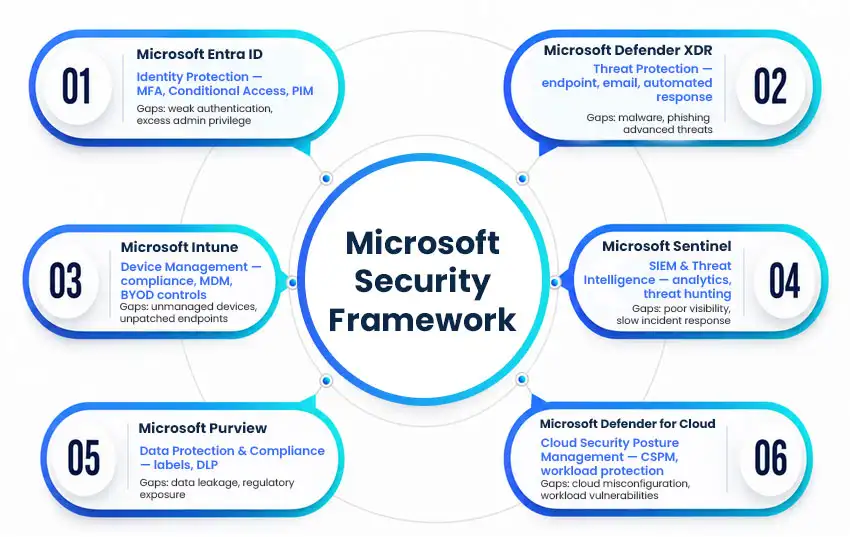
Improving Secure Score takes more than working through a checklist. Organizations need an architecture that connects identity, devices, apps, data, and cloud protection into one working system.
During Microsoft 365 security assessments, we regularly see MFA enabled for regular staff but missing for privileged accounts, the exact users attackers want most. Microsoft’s own threat research backs up why this matters so much: phishing-resistant multifactor authentication can block over 99% of identity-based attacks, yet many tenants still leave gaps in exactly the accounts that would benefit most.
Here is how the six core layers fit together, and where we most often find gaps during a Microsoft Secure Score Assessment:
 The business case for getting this right is not abstract. IBM’s Cost of a Data Breach Report found that organizations with a mature Zero Trust approach saved an average of $1.76 million per breach compared with those without one. That single figure tends to get budget conversations moving faster than any dashboard screenshot.
During one client engagement, we found legacy authentication enabled on a few mailboxes. The team disabled it to close the security gap. This improved the organization’s identity score within a few weeks. It also blocked a common attack method that cybercriminals still use.
Beyond Key runs Microsoft Secure Score Consulting engagements built around this same architecture-first approach. Our team delivers:
Beyond Key is a Microsoft Solutions Partner with ISO 27001:2022 certification. The team has experience in Microsoft security, cloud, and AI solutions. This includes Microsoft Copilot governance and security consulting. We do not just point at a dashboard. We help you fix what it shows, and we stay involved as your environment and your score evolve.
If your Secure Score has been sitting untouched, that is worth a closer look. Contact our Microsoft security consulting team for a security assessment. We will help you understand your current security posture.
Microsoft Secure Score identifies where your Microsoft 365 environment is exposed. But a higher number alone does not make you secure. Strong security requires the right architecture, governance, and ongoing improvements. A Secure Score alone is not enough. Microsoft security experts help turn Secure Score into an action plan. This helps strengthen your security over time.