TL;DR -Connect Dynamics 365 with Outlook for a unified workflow.
-Track emails, appointments, contacts, and tasks directly from Outlook.
-Access customer and CRM information without switching apps.
-Keep data synchronized using server-side synchronization.
-Improve productivity, collaboration, and customer visibility.
-Use the modern Dynamics 365 App for Outlook instead of the legacy add-in.
In this blog, we'll explore how Dynamics 365 integration with Outlook helps enterprises flourish.
Built on Microsoft’s open-source framework, .NET, Microsoft Dynamics 365 is a leading business management system that organizations use every day. As shared by Bryan Goode , Dynamics Business Central supports 50,000 global corporate customers.
Today, many organizations use both the Microsoft 365 suite and Dynamics 365 apps. Both are important. But without integration, they can create chaos and hamper productivity. That’s why integrating Microsoft Dynamics 365 and Outlook (M365) is crucial. It creates a connected work environment and gives users a bird’s-eye view of operational data and customer information.
Dynamics 365 integration with Outlook connects Microsoft Dynamics 365 customer engagement data with Outlook so users can view CRM information, track emails and appointments, associate communications with customer records, and manage relevant CRM activities without constantly switching applications. The modern approach uses Dynamics 365 App for Outlook together with server-side synchronization.
Dynamics 365 App for Outlook is an Outlook add-in, not a separate desktop program. Once it’s added to a mailbox, a Dynamics 365 icon appears in the Outlook ribbon. Selecting it while an email or appointment is open launches a task pane alongside the message that shows:
Behind the scenes, server-side synchronization moves the data between Exchange (or Microsoft 365) and Dynamics 365. The add-in is the interface; synchronization is the plumbing. Microsoft’s documentation confirms that the modern app supports Outlook on the web, desktop, and mobile, so the same experience follows a user across devices.
Once the app is deployed and a mailbox is enabled for server-side synchronization, users can:
These two names get used interchangeably in a lot of older documentation and internal wikis, but they’re different products with different support statuses. Knowing which one your organization is actually running matters, especially if a team still references setup steps written before 2020
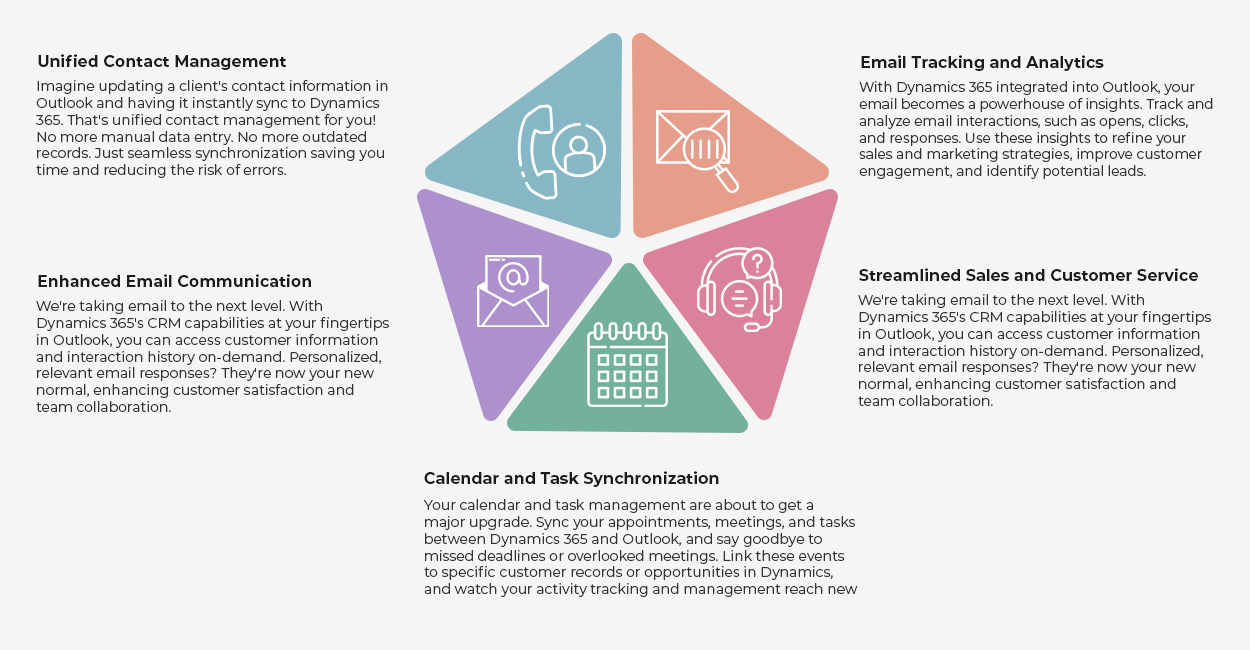
But what does this mean for your business? Let’s delve into the transformational benefits of Outlook integration with MS Dynamics 365.
The case for integration comes down to fewer handoffs and cleaner data. In practice, teams tend to see improvement in six areas:
Reps track prospect emails against the right opportunity, see deal stage and past correspondence before replying, and avoid re-asking questions a prospect already answered.
Agents link incoming emails to open cases, see case history and SLA status inline, and reduce the back-and-forth of pulling up a separate CRM tab mid-conversation.
Account owners get a consolidated view of every touchpoint: meetings, emails, tasks (tied to an account), useful heading into renewal or QBR conversations.
Managers get more reliable activity data for pipeline and service reporting, since tracking happens where the work is done rather than as separate step reps skip.
Server-side synchronization is the Microsoft-managed process that moves email, appointments, contacts, and tasks between a Dynamics 365 environment and an Exchange Online or Microsoft 365 mailbox. It runs without a desktop client, which is what makes App for Outlook workable across web and mobile. Administrators enable it at Settings > Administration > System Settings, then set Process Email Using to Server-Side Synchronization before enabling individual mailboxes for testing.
Server-side synchronization handles four Exchange item types, and Microsoft’s documentation describes this as bidirectional synchronization; changes flow both ways rather than one system simply exporting to the other.
Data synchronized through server-side synchronization
| Data type | What syncs |
| Tracked messages appear on the related record’s timeline in Dynamics 365; outgoing email sent from Dynamics 365 delivers through the connected mailbox | |
| Contacts | Contact records stay aligned between Dynamics 365 and the Exchange address book |
| Appointments | Meetings tracked to a record sync between the Outlook calendar and Dynamics 365 |
| Tasks | Tasks created in either system reflect in the other once linked to a record |
Confirm licensing and prerequisites
App for Outlook works with Dynamics 365 Sales, Customer Service, Marketing, Field Service, Project Service Automation, and Dataverse-based model-driven apps. Confirm users hold the right Dynamics 365 license before deploying.
Turn on server-side synchronization
In Dynamics 365, go to Settings > Administration > System Settings > Email, and set Process Email Using to Server-Side Synchronization.
Enable and test mailboxes
Under Settings > Email Configuration > Mailboxes, open the Active Mailboxes view, select the mailboxes to enable, and run the built-in test to confirm the connection.
Deploy the app for Outlook
Assign App for Outlook to users centrally through the app’s deployment settings, or let users self-install by opening Apps for Dynamics 365 apps and selecting Add app to Outlook, if your policy allows it.
Allow time for the add-in to appear
Deployment isn’t instant. Microsoft’s own troubleshooting guidance notes it can take up to 15 minutes before a newly added app shows up, so have users close and reopen Outlook rather than assuming a failed install.
Run an acceptance test
Have a real user open a normal email, launch the Dynamics 365 pane, search for a known record, set it as regarding, and confirm the tracked activity shows up in Dynamics 365. A visible icon isn’t proof the integration actually works end to end.
Beyond Key has spent more than 20 years delivering Microsoft ecosystem projects, with a Dynamics 365 consulting practice that has guided organizations through exactly this kind of transition: moving off the retired Outlook add-in, configuring server-side synchronization correctly the first time, and setting up App for Outlook in a way that holds up across desktop, web, and mobile. Our team handles licensing, security roles, and mailbox configuration so your users get a working integration on day one instead of a partial rollout that needs revisiting.
Explore Dynamics 365 consulting services from Beyond Key or see how our team approaches related work in Dynamics 365 CRM migration and Dynamics 365 Finance and Operations.

Frequently Asked Questions
What is Dynamics 365 integration with Outlook?
It’s the connection between Dynamics 365 customer engagement data and Outlook, built today through Dynamics 365 App for Outlook and server-side synchronization. It lets users view CRM records, track emails and appointments, and manage activities without leaving their inbox.
Is Dynamics 365 for Outlook still supported?
No. The legacy Dynamics 365 for Outlook, also called the Outlook COM add-in, was retired for online customer engagement apps on October 1, 2020, and stopped being available on December 4, 2020. Only Dynamics 365 Customer Engagement (on-premises) customers can still run it, and Microsoft recommends they move to the modern App for Outlook.
What is the difference between Dynamics 365 for Outlook and App for Outlook?
Dynamics 365 for Outlook was a Windows-only COM add-in that required local installation and client-to-server sync. Dynamics 365 App for Outlook is a lightweight, browser-based add-in that runs on Outlook desktop, web, and mobile, and relies on server-side synchronization instead of a local client.
How does Dynamics 365 App for Outlook work?
It runs as an Outlook add-in that opens a task pane next to an email or appointment. From that pane, users can see related CRM records, set a regarding record, track the item, and create or update rows in Dynamics 365 without switching applications. Server-side synchronization keeps the data moving in the background.
Can Dynamics 365 integrate with Outlook 365?
Yes. Dynamics 365 App for Outlook is designed for Microsoft 365 mailboxes and works with Outlook on the web, Outlook desktop, and Outlook mobile once server-side synchronization is configured for the mailbox.