Key Takeaway
A data lake is a central storage system that holds large amounts of raw data. It keeps the data in its original format. You do not need to clean or shape it first.
The data can be:
The purpose is simple. A data lake gives you one place to keep all your data. You can decide how to use it later.
This model is called schema-on-read. You apply structure when you read the data, not when you store it. That makes a data lake fast to load and flexible to use.
The term “data lake” was coined by James Dixon, then CTO of Pentaho, over a decade ago. The idea has matured since. Today, data lakes sit at the core of most modern data platforms.
What Are Data Lakes Used For?
Organizations use data lakes to:
In short, a data lake supports both today’s reports and tomorrow’s AI.
So, what is data lake architecture? It is the design that defines how data enters, lives in, and leaves your lake. A good architecture keeps data organized, secure, and easy to find.
A modern data lake infrastructure has six core layers.
1. Ingestion layer that ensures that data is moved in efficiently from SaaS apps, files, databases and IoT devices.
2. Storage layer leverages less expensive object storage and examples include Amazon S3, Google Cloud Storage and more.
3. Processing layer is responsible for cleaning, enriching and transforming data. Here the work is done on Databricks, Azure Synapse and Apache Spark.
4. Catalog and metadata layer tells you from where the data came and what’s it status.
5. Governance and security layer controls access, safeguards sensitive data, and tracks lineage. It supports GDPR, HIPAA, and other compliance standards.
6. Consumption layer ensures the people are actually using the data. From data scientists to BI developers, they use notebooks, apps, and BI tools.
If you want to learn more about Snowflake or Databricks consulting, feel free to connect with your experts.
Most teams organize storage into zones. This is often called the medallion pattern.
| Zone | What it holds | Who uses it |
| Raw (Bronze) | Data exactly as received | Data engineers |
| Cleaned (Silver) | Validated, deduplicated, standardized data | Data engineers, data scientists |
| Curated (Gold) | Business-ready, modeled data | Analysts, BI users, executives |
This structure improves quality step by step. It also makes data easier to trust.
Types of Data Lakes
You can deploy a data lake in four main ways. The right choice depends on cost, control, and compliance needs.
Cloud data lake
The lake runs on a public cloud such as Azure, AWS, or Google Cloud. It scales on demand. You pay for what you use. Most new data lakes start here.
Best for: fast setup, elastic scale, and lower upfront cost.
On-premises data lake
The lake runs in your own data center. You own the hardware and manage it. This option often uses Hadoop-based tools.
Best for: strict data residency rules or existing hardware investments.
Hybrid data lake
This model mixes on-premises and cloud storage. Sensitive data stays on-site. Other data moves to the cloud.
Best for: regulated industries that still want cloud flexibility.
Multi-cloud data lake
The lake spans two or more cloud providers. This reduces vendor lock-in. It also adds complexity.
Best for: large enterprises with teams or acquisitions on different clouds.
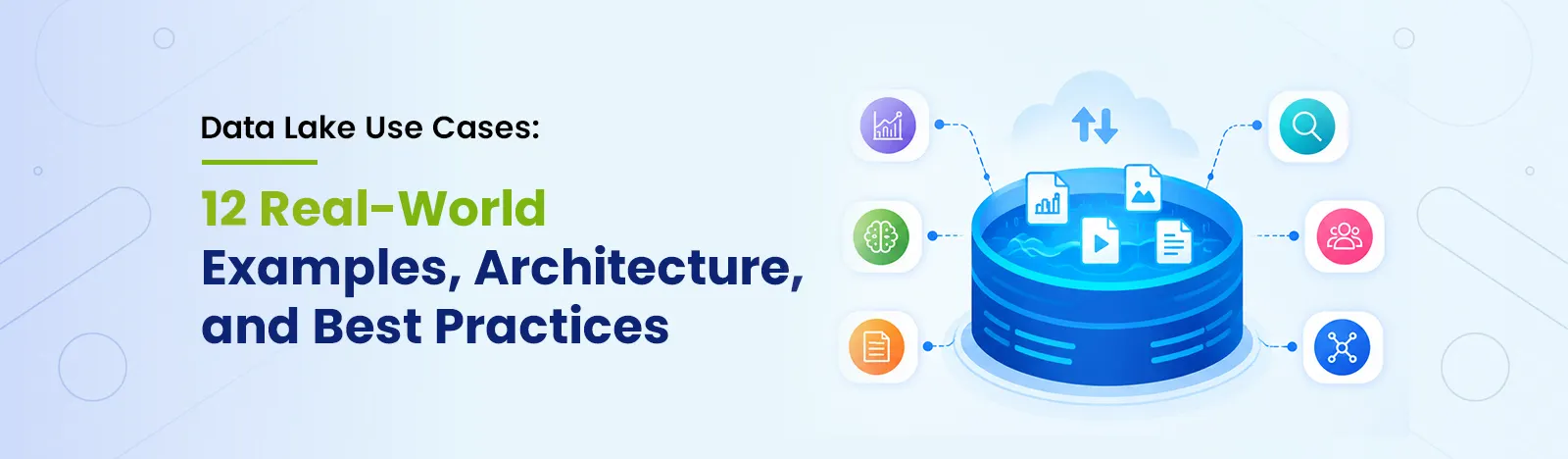
Here are the 12 data lake use cases that deliver the most value.
A data lake can keep detailed historical data from past years. Data analysts can explore it, identify trends, and summarize the tables.
For example: A retailer studies five years of transaction data to find seasonal buying patterns.
ML models need large volumes of raw, varied data. A data lake stores it all in one place. Data scientists can pull the exact features they need.
Example: There’s a firm that trains AI models to forecast delivery delays happening because of weather, traffic or other factors. This is useful for logistics industry.
Customer data lives in many tools. A data lake brings CRM, web, email, support, and purchase data together. Teams get one complete view of each customer.
Example: It helps marketing department analyze purchase history and browsing behavior for customized offers.
IoT devices create huge streams of data. A data lake can ingest and store it cheaply and this helps teams with analysis of faults or patterns.
Example: A manufacturer collects machine sensor data to predict equipment failure before it happens.
A lake can take in live data from apps, clicks, and transactions. With this data, users can act on it in real-time.
Example: An e-commerce site tracks live cart behavior to trigger timely offers.
Fraud signals are often hidden in large, mixed datasets. A data lake lets you combine transaction logs, device data, and behavior history. Models can then flag unusual activity.
Example: A bank scans transaction streams and past patterns to flag suspicious payments.
Many industries must keep records for years. Object storage is far cheaper than a data warehouse. A data lake is a smart home for long-term, auditable data.
Example: A healthcare provider archives patient records and access logs for audits.
Data scientists need room to test ideas. A lake gives them raw data and compute without affecting production systems.
Example: A team tests five churn models on the same raw dataset before choosing one.
Application, server, and security logs grow fast. A data lake stores them at low cost. IT teams can search them for performance and security insights.
Example: A SaaS company analyzes app logs to find the cause of slow response times.
A data lake can act as a landing zone when you move off legacy systems. You can copy old data first and refine it later.
Example: An enterprise moves data from an aging on-premises warehouse to a cloud lake as step one of modernization.
A curated layer of a data lake can feed tools like Power BI. Business users get fast, trusted data. They do not need to wait on IT for every report.
Example: A finance team connects Power BI to curated lake data for live revenue dashboards.
A data lake connects data coming from multiple sources (ERP, sensors, supplier and more) in the supply chain.
Example: A distributor combines inventory, demand, and supplier data to cut stockouts.
Here are well-documented examples of data lakes at work.
Netflix: Netflix built a large data platform on Amazon S3. It supports analytics, personalization, and content decisions. The company also created Apache Iceberg, an open table format now used across the industry.
Uber: Uber runs a big data lake to support pricing, safety, and operations. It created Apache Hudi to handle fast updates in the lake. The project is now open source.
Airbnb: Airbnb uses a cloud data lake to support search ranking, pricing guidance, and experimentation.
Illustrative scenario (manufacturing): A mid-size manufacturer has data in an ERP, a CRM, and factory sensors. Reports take days to prepare. The team builds a cloud data lake on Azure. They load all three sources into the raw zone. They clean the data and build a curated layer. Power BI dashboards then show production and sales data together. Leaders see issues sooner and act faster.
Data Lake vs. Data Warehouse: Which Is Right for Your Business?
Choosing the right data architecture is key to maximizing your data’s value. Read our guide to Data Lake vs. Data Warehouse to make informed decisions and build a smarter data strategy.
These three terms are often confused. Here is how they differ.
| Feature | Data lake | Data warehouse | Data lakehouse |
| Data type | All types, raw | Structured, processed | All types |
| Schema | Schema-on-read | Schema-on-write | Both |
| Primary users | Data engineers, data scientists | Analysts, business users | All of them |
| Best for | ML, exploration, archiving | BI and reporting | Unified analytics and AI |
| Storage cost | Low | Higher | Low |
| Data quality | Varies without governance | High | High, with table formats |
| Flexibility | Very high | Moderate | High |
Data lake: Flexible and low-cost. Best for raw data and data science.
Data warehouse: Fast and reliable for structured reporting. Less flexible with new data types.
Data lakehouse: A newer design. It adds warehouse features like transactions and fast queries on top of lake storage. Delta Lake, Apache Iceberg, and Apache Hudi make this possible.
Which should you choose?
Many organizations use more than one. The goal is to match the tool to the job.
The main data lake benefits and advantages are:
Data lakes are powerful. They are also easy to get wrong. Here are some common challenges with data lake.
Data swamps
Without structure, a lake fills with unlabeled, duplicate, or stale data. Nobody trusts it. Fix this with a catalog, clear zones, and ownership.
Weak governance and security
Raw data may include sensitive information. You need access controls, encryption, and audit trails.
Poor data quality
Schema-on-read means bad data can slip in. Add validation checks at ingestion and in the silver layer.
Slow query performance
Raw files can be slow to query. Use columnar formats, partitioning, and a lakehouse layer to speed things up.
Skills gaps
Data lakes need data engineering and cloud skills. Many teams lack them. Training or an experienced partner can close the gap.
Cost surprises
Storage is cheap. Compute, data movement, and unused data can add up. Track costs and set lifecycle policies.
Unclear business goals
Some teams build a lake with no use case. Start with one clear business problem.
Ready to unlock the full potential of your data? Partner with Beyond Key for expert Data Lake Consulting Services to streamline data management, gain actionable insights, and drive smarter business decisions. Get started today!
The best data lake platform depends on your tools, skills, and goals. Here is how the main options compare.
ADLS Gen2 combines object storage with a hierarchical file system. It is built for big data analytics. It works with Azure Synapse, Azure Databricks, Azure Data Factory, and Power BI.
Microsoft Fabric adds OneLake, a unified lake for the whole organization. It stores data in open Delta Parquet format. This helps teams share data across workloads without copying it.
Use cases: Power BI analytics, enterprise reporting, Microsoft 365 and Dynamics 365 data integration, governed analytics on Azure.
S3 is one of the most widely used storage services for data lakes. AWS Lake Formation helps set up security and governance. Amazon Athena and Redshift Spectrum can query data in place.
Best use cases: large-scale analytics, log analysis, ML with Amazon SageMaker, archiving.
Google Cloud Storage holds the raw data. BigQuery and BigLake let you analyze it with SQL. The platform is strong for analytics and AI.
Best use cases: marketing analytics, large-scale SQL analytics, AI workloads.
Databricks pioneered the lakehouse model. It uses Delta Lake for reliable tables on top of cloud storage. It runs on Azure, AWS, and Google Cloud.
Best use cases: data engineering at scale, ML and AI, streaming pipelines, unified analytics.
Snowflake started as a cloud data warehouse. It now supports external tables and Apache Iceberg tables over data lake storage.
Best use cases: BI and reporting, data sharing, mixed warehouse and lake workloads.
| Platform | Strength | Good fit for |
| Azure (ADLS Gen2 + Fabric) | Deep Microsoft integration | Power BI and Microsoft-first teams |
| AWS (S3 + Lake Formation) | Mature, wide ecosystem | Large-scale analytics and ML |
| Google Cloud (GCS + BigQuery) | Strong SQL and AI | Analytics-first teams |
| Databricks | Lakehouse and ML | Data engineering and AI |
| Snowflake | Ease of use and sharing | BI-heavy and mixed workloads |
Use these steps for a smooth data lake implementation.
Pick one or two high-value use cases first. Define what success looks like. Expand after you prove value.
Set up raw, cleaned, and curated layers. Agree on naming rules and folder structure before data arrives.
Record what each dataset is, who owns it, and how fresh it is. A catalog is your best defense against a data swamp.
Define who can see what. Classify sensitive data. Encrypt data at rest and in transit. Track lineage.
Parquet and Delta are columnar and compressed. They cut cost and speed up queries.
Validate data when it lands. Flag nulls, duplicates, and unexpected changes. Fix issues in the silver layer.
Partition large tables. Avoid thousands of tiny files. Use caching and a lakehouse layer when needed.
Set lifecycle rules to move old data to cheaper tiers. Monitor compute use. Delete data you no longer need.
Every dataset needs an owner. Owners answer questions and keep quality high.
Give business users safe access to curated data. Pair it with tools like Power BI. Offer training so they use it well.
Treat your lake as a product. Review it often. Retire what no longer helps.
A simple roadmap looks like this:
1. Assess: Review your data sources, goals, and current tools.
2. Choose: Select a data lake platform that fits your stack and skills.
3. Design: Plan architecture, zones, security, and governance.
4. Build: Set up ingestion, storage, and processing pipelines.
5. Pilot: Deliver one use case end to end.
6. Scale: Add sources, users, and use cases.
7. Optimize: Tune cost, speed, and quality over time.
This is where an experienced partner saves time. The right data lake consulting services help you avoid costly rework. They bring proven design patterns, security know-how, and platform skills.
Data lake use cases span analytics, AI, IoT, fraud detection, compliance, and more. The value is clear. A data lake gives you a flexible, low-cost foundation for all your data.
Success depends on the basics. Start with a business goal. Design clear zones. Add governance early. Choose the platform that fits your team.
Done right, a data lake turns scattered data into a lasting advantage.
Need help planning or building yours?
Contact our team to get started.A data lake is only as good as the value it delivers. We help organizations design, build, and manage modern data lakes and lakehouses. Our team works across Azure, Microsoft Fabric, Databricks, and Power BI. We focus on clear business outcomes, strong governance, and fast time to value.