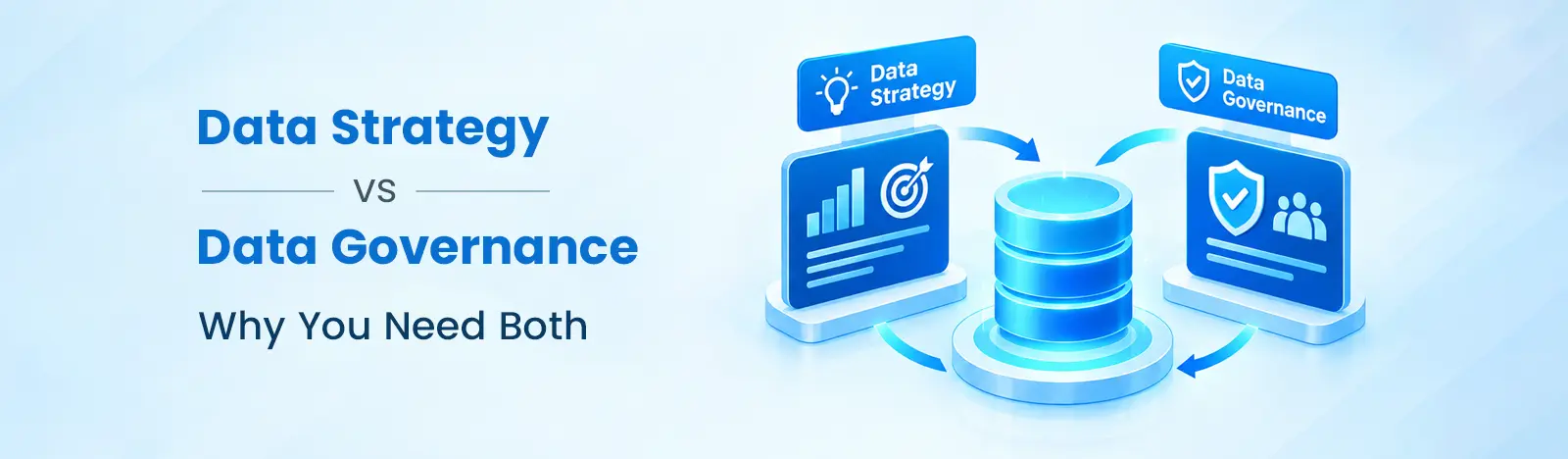
Data strategy is the plan for what your business wants data to do: which problems to solve first, in what order, and on what architecture. Data governance is the daily discipline that keeps that data accurate, consistent, and properly controlled. Strategy sets the destination. Governance decides whether you can trust the data to get you there. Skip either one and the other gets affected. When you ask ten leaders what separates data strategy from data governance, you'll get ten different answers. Many will tell you they're the same thing. This guide explains the difference between data strategy and data governance in plain terms. It also shows how each one fails on its own and where to begin if you have neither one, or a mix of both.
Quick Answer:
A data strategy is a plan for how your organization will use data to reach specific business results, usually over three to five years. It is not a tool list. Picking a platform is a technology decision that serves a strategy. It isn’t the strategy itself.
A working strategy answers four questions:
Take a look at our data strategy assets:
Step-by-Step Guide to Creating a Successful Data Strategy Roadmap in 2026
How to Conduct a Successful Data Strategy Assessment in 2026
Data governance is the operating system that keeps data accurate, consistent and appropriately controlled for every team that touches it. It isn’t a one-off project, and it doesn’t end when the audit does. In practice, it covers five things:
How much of this you need depends on how messy your sources are. Older ERP systems, years of custom fields, and several connected platforms mean undocumented meanings and inconsistent setups.
In those environments, governance isn’t a nice extra. It’s the difference between a report people use and one they quietly work around.
| Factor | Data strategy | Data governance |
| Core question | What should data do for the business? | How do we keep data trusted along the way? |
| Usually driven by | CDO and business leadership | Data owners, stewards, architects, compliance |
| Time horizon | 3 to 5 year direction, reviewed yearly | Continuous, day to day |
| Typical output | Priorities, roadmap, target architecture, success measures | Owners, definitions, quality rules, access policies, lineage |
| Fails alone as | Pipelines and dashboards nobody trusts | Tidy documentation with no business impact |
Picture a company that sets out to build a 360-degree customer view. Engineers build the pipeline. Analysts build the dashboard. Six months in, “customer” means three different things: one system counts contacts, another counts accounts, a third counts billing entities. The dashboard exists. The customer view doesn’t.
The pipeline wasn’t the problem. Nobody agreed on a definition before the first line of code. A governed customer record has one definition, one source of truth and a written rule for when systems disagree. That reconciliation is restrained work. It’s also the whole difference between a dashboard and an answer.
The scale of this problem is not small. In Salesforce’s State of Data and Analytics research, 84% of data and analytics leaders said their data strategies need a complete overhaul before their AI ambitions can succeed.
Now flip it. A team spends a year building a beautiful data catalog. Every dataset is documented, owners are assigned, quality scores are published. Then an executive asks a fair question: which of these datasets drives a decision?
The honest answer is “not many.” With no strategy, nobody decided which domains mattered most or which governance work would unlock the most value. The catalog is accurate. It just doesn’t connect to anything the business cares about.
Say the strategy is to improve order-to-cash performance. Governance responds by picking the relevant domains first, naming owners for orders, billing, and fulfillment, setting completeness rules, and agreeing on one definition of net revenue before any report is built. The result is a pipeline running on data people believe.
Strategy tells governance where to focus. Governance tells strategy what’s realistic. The best teams treat that as an ongoing conversation, not two projects that bump into each other once a quarter.
A wrong number on a dashboard usually gets questioned. Someone spots it, checks the source and raises a ticket. A wrong number fed to an AI assistant gets turned into a confident, well-written, wrong answer. Nothing looks suspicious, so nobody checks.
Industry analysts see the same risk. Gartner has predicted that through 2026, organizations will abandon 60% of AI projects that aren’t supported by AI-ready data. If a key metric is defined three ways, an AI summary of performance will be wrong in ways that are hard to spot and easy to act on.
It works the other way too. AI can help build governance by scanning source systems for undocumented fields, flagging definition clashes and watching pipelines for drift. People still make calls on definitions, priorities and ownership. AI just takes on more of the discovery and monitoring work.
In Microsoft environments, this shows up fast. Power BI models, Microsoft Fabric lakehouses and Microsoft Purview all work best when definitions and ownership are settled first. Tools can enforce governance, but they can’t invent it.
Don’t try to do both at once. Write a short, honest strategy, two pages instead of sixty slides. Answer three questions. Which business problem will data help solve in the next twelve months? What data do we need? What capability are we missing? Get leadership to sign off, then build governance around that scope only.
Find the data problem that’s hurting the strategy most. It might be a revenue figure two teams read differently, or a KPI calculated three ways. Govern that one thing, show the result, then expand.
Audit what your governance program is protecting. Which governed datasets feed real decisions, and which are running on habit? Use that to make the case for a strategy conversation: here’s where governance creates value, and here’s where it doesn’t
Data strategy and data governance are major pillars of data management. The first one provides direction while the second one ensures that the data is reliable and consistent.
Not sure which one you’re missing?
Beyond Key’s data and analytics team can review where you stand and recommend a practical starting point. Contact our experts to learn more about data governance and strategy.