The healthcare industry depends on accurate, centralized, and unified data. This data helps them perform better and meet the compliance standards. The data volume has been growing aggressively. From insurance claim documentation to electronic health records (EHRs), there is a pool of datasets to manage.
Managing data across multiple sources creates many interoperability challenges. There are many systems to manage: claims systems, Electronic Medical Reports (EMR), external directories and more. Across many data sources, the healthcare industry struggles with fragmented data systems, underdeveloped analytics, and limited visibility into critical data. Here comes the role of Databricks.
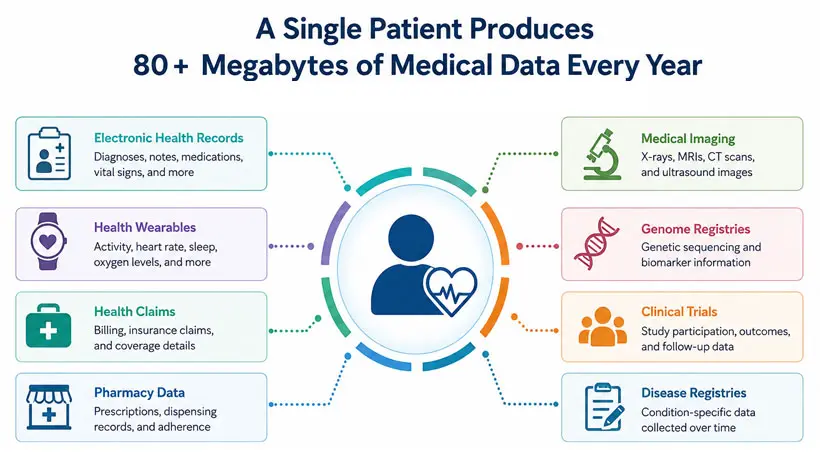
Databricks for healthcare is an intelligent, AI-powered data platform that helps in unifying complex datasets in the medical industry. Databricks integrates structured and unstructured data from EHRs, wearables, imaging platforms, genome sequencers, and other sources. This delivers a complete view into patient health so that timely decisions can be made.
Databricks Named a Leader in the 2025 Gartner® Magic Quadrant™ for Data Science and Machine Learning Platforms
Source: Databricks
Healthcare organizations need Databricks to eliminate data silos and create a unified data ecosystem to improve collaboration. Here are some issues that Databricks for healthcare can solve:
1. Centralized data management
Databricks brings together data from all sources into one intelligent platform. From structured, unstructured, and semi-structured data, all types of data from lab reports, claims, etc., are unified in a platform.
2. Real-time analytics
The platform supports FHIR (Fast Healthcare Interoperability Resources) for uninterrupted data exchange processes. It ensures real-time data ingestion from IoT devices and EHRs, to help support critical clinical decisions.
3. Adhere to strict compliance
Healthcare companies should be strictly compliant with HIPAA. Databricks supports strict encryption and GDPR compliance, ensuring data privacy. With strict governance and security capabilities, healthcare companies can focus on providing high-quality services and products.
4. AI-first and machine learning ready
Users can leverage AI platforms to build and deploy machine learning models. This can facilitate disease detection at the primary stage and help analyze patient data.
Source: Databricks
Challenge: As we mentioned above, disconnected healthcare information is one of the problem areas across the industry. As data is managed on multiple platforms, lab systems, billing systems, and EHR platforms, it creates confusion for the management while making decisions. Unstructured data includes image data. This is important to monitor the disease (oncology, immunology, and neurology) and its status.
It is essential to have the patient’s information in a centralized system. Without it, there is a lack of clarity about the patient’s health.
How Databricks Helps:
Databricks provides a unified platform that is embedded with end-to-end analytics and AI tools. Databricks also supports multiple programming languages – such as SQL, R, Python, and Scala. Clinical informaticists, data scientists, physicians, and engineers can collaborate in real-time on healthcare data modeling, analysis, and visualization.
Challenge: Traditional data management methods are not modeled to conduct robust predictive analysis. Legacy systems are not secure, and critical patients’ data is not private. Without deep learning techniques, complex patterns cannot be detected, leading to slower disease analysis.
How Databricks Helps:
Databricks connects data. With clinicians who can create, train, and deploy ML models, they can identify early-stage diseases more effectively than existing methods. Professionals can analyze notes, high-risk patients, and historical lab results for early intervention.
Databricks for the healthcare industry allows physicians to predict patient deterioration rate, detect chronic diseases, lower treatment costs, and offer better preventive care strategies.
Clinical trials can be defined as research done to test new surgical interventions on human volunteering. The objective is to develop a new device, drug, or tool to treat a disease.
The challenge that healthcare organizations face is the inability to process large datasets. It creates a challenge in managing data compliance and accuracy. Life sciences organizations struggle to process large datasets from multiple trial systems while ensuring data accuracy and compliance.
How Databricks Helps: Databricks is driven by Delta Lake, an open-source data management layer that gives your data performance a strong edge. Databricks is driven by connectors for domain-specific data types like electronic medical records and genomics.
Databricks is also driven by built-in features that help in data caching and indexing. This is important to accelerate data processing speeds. Healthcare research organizations can use Databricks to enable AI-driven trial analytics and centralize clinical trial data, reducing confusion and speeding up the process.
The outcomes are better research accuracy, quicker drug/tool development, and, of course, reduced costs and time savings.
Challenge: Healthcare organizations worldwide process a large volume of financial transactions, claims, and insurance bills each year. From registering the patient to collecting payment and detecting anomalies, there are many issues faced by admin team in the healthcare organization. And here, data is the key. Inaccurate or missing data can create a larger mess.
How Databricks Helps: Databricks supports AI/ML models. It can identify unusual billing patterns and data inaccuracies. With structured data, organizations can streamline reimbursement cycles and automate claim analysis, leading to better financial performance and reduced losses.
Databricks helps the team analyze historical data to find out denials, if any. Databricks supports Agentic AI, which helps learn payer behavior.
Precision medicine relies on analyzing complex genomic and clinical datasets to create individualized treatment plans.
The Challenge
Genomic data is extremely large and difficult to process using traditional infrastructure.
How Databricks Helps
Databricks supports scalable analytics for genomic sequencing, biomarker discovery, and personalized treatment recommendations.
Databricks is an intelligent data platform that focuses on handling the complex healthcare facility by building a single source of truth. Databricks promotes Agentic AI which can plan, decide and act and help achieve business objectives without humans providing the prompt. Autonomous agents provide seamless execution and persistence.
Forrester research shows that AI-driven automation can significantly improve healthcare operational efficiency and patient experiences.
Databricks Genie enables clinical operations leaders to interrogate their full trial data environment in natural language.
Databricks enables healthcare AI by combining scalable data engineering, analytics, governance, and machine learning within a single platform. Healthcare organizations are also exploring AI-powered assistants for clinical documentation. Gen AI helps them with AI agents for patient engagement and admin operations.
Databricks democratizes and centralizes large volumes of data and eliminates data silos. It gives you the ability to leverage Unity Catalog for unified, strict governance. Databricks allows organizations to adopt Lakehouse architecture for their data. This helps in breaking the cycle of vendor lock-in.
Beyond Key, as a globally acclaimed IT consulting company serving clients from last 20 years is a Databricks certified partner. We provide services such as data engineering, ML integration, real-time analytics and more. Our team takes time to understand your business and its objectives and then create step-by-step strategy to support your stack.
Download our case study to understand how we, as a Databricks consulting partner helped a leading pet insurance and wellness provider unify their fragmented data, optimize analytics, and enhance customer satisfaction. Download it here.
1. What is Databricks for healthcare?
Databricks for healthcare is a cloud-based data and AI platform that helps healthcare professionals centralize patient’s clinical and operational data. It integrates complex datasets such as lab results, medical imaging, EHR etc., into a single HIPAA compliant environment.
2. Can Databricks integrate with EHR and EMR systems?
Yes. Databricks can integrate with electronic health records (EHR) and electronic medical records (EMR) systems. It allows professionals to have a unified view of patients’ information.
3. What are the benefits of Databricks for healthcare professionals?
Databricks for healthcare helps the industry eliminate data silos, accelerate analytics, reduce operational cost, and support AI-driven innovation across administration and clinical departments.
4. How does Databricks support healthcare AI and machine learning?
Databricks offers an integrated platform for training, deploying, monitoring and developing AI and ML models. Professionals can use these models for patient risk scoring, disease prediction and more.
5. What is Patient 360 in Databricks?
Patient 360 in Databricks is a unified patient view created by combining data from EHRs, claims systems, laboratory records, wearable devices, and other sources.