Insurance agents face a constant challenge. Too many manual tasks. Too little time with customers. Growing pressure to do more with the same team.
Unlike basic automation that only handles simple rules, AI for insurance agents acts as a true digital teammate. It answers customer questions. It pulls policy details. It helps with renewals. It flags potential fraud. And it does all of this while the agent focuses on building relationships and closing deals.
This guide explains what AI for insurance agents really means, how it works, and how agencies can start using it today to work smarter, not harder.
The insurance industry is changing fast. Customers expect instant responses. They want quotes in minutes, not days. They compare options online before ever talking to an agent.
The conventional agency system faces difficulties in maintaining operational efficiency. Agents dedicate multiple hours to complete data entry tasks and processing documents and conducting manual research activities. The activities which need their attention for business growth and customer service provision take up all their available time.
The use of AI for insurance agents establishes a new operational framework. The system takes care of all repetitive tasks which enable agents to concentrate on their most important customer interactions. The system delivers immediate solutions to customers which means they do not need to wait. The system operates continuously throughout the day, which ensures that agencies maintain constant business potential.
Key findings: 68% of agencies plan to increase AI use in the next 12 months, yet only 8.29% are using AI regularly and strategically. 56% have no written AI policy.
Insurers who adopt AI for insurance agents gain a clear advantage. They respond faster. They operate more efficiently. And they deliver a better customer experience.
Implementing AI agents for insurance delivers measurable results across the agency. The system improves its cross-selling and upselling capabilities through its analysis of customer information. The AI system examines customer profiles to recommend products which match the available information.
AI agents for insurance follow a simple but powerful workflow.
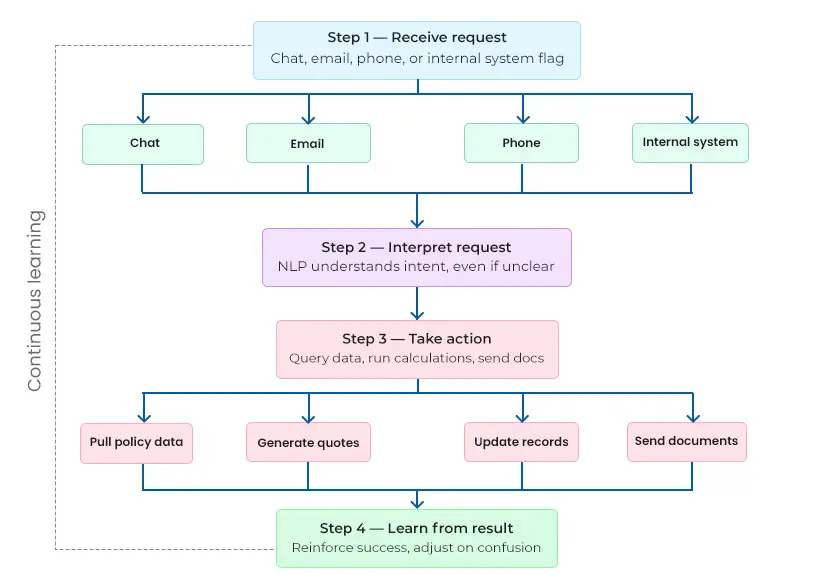
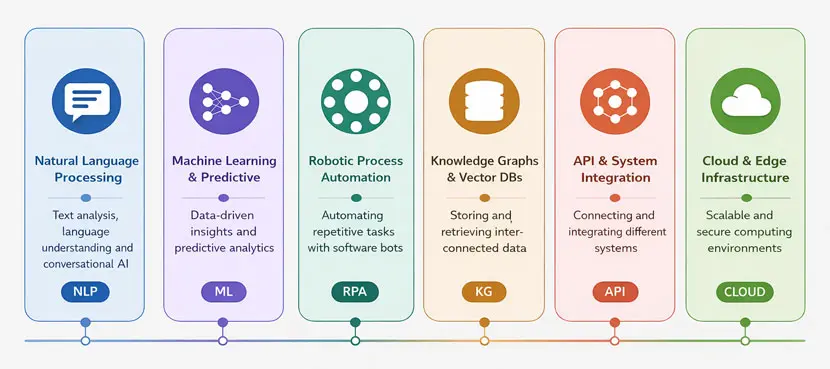
Over time, it becomes more accurate and more helpful without any manual updates. Several technologies work together to make AI agents for insurance possible.
| Without AI | With AI (Powered by These Technologies) |
| Customers repeat themselves | Natural language processing gets it the first time |
| System never improves | Machine learning gets smarter every day |
| Agents guess what they can approve | Decision engines provide clear boundaries |
| Systems don’t talk to each other | Integration APIs connect everything |
| Compliance is manual and risky | Security layers handle it automatically |
 Common Use Cases of AI for Insurance Agents
AI for insurance agents works across many everyday agency tasks.
| Task | What the AI Does |
| Customer inquiries | Instant answers without hold time. |
| Quote generation | Real time quotes. Review and send. |
| Policy changes | Updates addresses or coverage instantly. |
| Renewal processing | Reviews policies. Agents approve. |
| Document management | Finds any document in seconds. |
| Appointment scheduling | Sends invites, sets meetings, handles changes. |
Fraud costs the insurance industry billions every year. AI agents for insurance help detect and prevent it.
This approach detects more fraudulent activities at an earlier stage while it decreases the number of false positive results that consume time from agents.
Implementing AI agents for insurance comes with real hurdles. Knowing them upfront helps agencies plan better.
Not every AI agent for insurance delivers the same results. Here is what agencies should look for when evaluating options.
A successful implementation follows these best practices.
Complete workflow processing will operate through automated systems. The AI system will manage all customer interactions between initial contact and insurance policy establishment and claims processing with only minor human involvement. ISG Provider Lens- “Global Insurance Services – Strategic Capabilities Report.” December 2025
Agencies that embrace these trends will thrive. Those that wait will struggle to keep up.
Insurance agents cannot afford to waste hours on manual tasks. Customers expect speed. Competition expects excellence. And the old way of working is no longer enough. AI for insurance agents fixes this. It handles repetitive work. It answers customer questions instantly. It processes policy changes without delays. It flags fraud before it costs money.
This is not about replacing agents. It is about empowering them. Beyond Key builds AI agents for insurance that deliver real results. We make the technology simple so agents can focus on what they do best.
Ready to start? Talk to Our AI Insurance Experts