SAP is powerful. For a Fortune 500 manufacturer with 40 legal entities, complex intercompany transfer pricing, and a decade-long SAP investment, that power is justified. For the overwhelming majority of mid-market companies, manufacturers, distributors, retailers, and professional services firms running $10M–$500M in revenue, SAP’s power comes packaged with a level of cost, complexity, and consultant dependency that actively works against business agility.
The search for credible SAP alternatives has intensified since SAP announced the end of mainstream support for ECC in 2027, effectively forcing every remaining ECC customer into a migration decision. S/4HANA migration, SAP’s preferred answer is effectively a full re-implementation at enterprise pricing. For mid-market companies, that cost and timeline is increasingly difficult to justify when modern, cloud-native alternatives deliver. According to a survey conducted by Gartner, 75% of ERP strategies are not strongly aligned with overall business strategy, leading to confusion and lack of results.
This guide evaluates the best alternatives to SAP across the full SAP product family SAP ECC, S/4HANA, SAP Business One, SAP Commerce Cloud, and SAP ByDesign with a focus on Microsoft Dynamics 365 Business Central as the primary alternative, backed by a 14-capability comparison table, migration analysis by SAP product, and a practitioner-grade decision framework from a certified Microsoft Solutions Partner with 80+ SAP-to-Dynamics migration engagements on record.
| NOTE | Audience: IT leaders, CFOs, and operations directors at companies with 50–2,000 employees currently on SAP or evaluating SAP, seeking a credible alternative. Estimated reading time: 8 minutes. |
SAP’s total cost of ownership is routinely underestimated in initial platform evaluations because the proposal captures licensing but not the structural costs that accumulate over the system’s lifetime. Understanding these costs is the first step in evaluating any SAP alternative objectively.
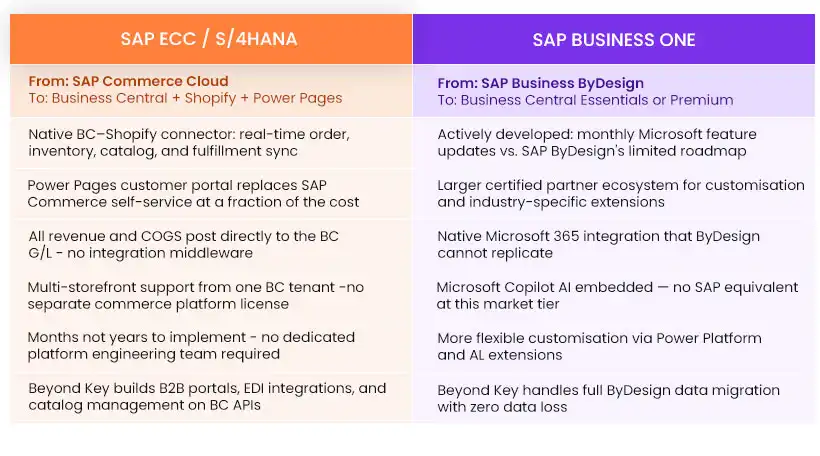
There is no single SAP alternative; the right replacement depends on which SAP product the organization is running, its size, operational complexity, and the Microsoft ecosystem investment already in place. The four SAP products most replaced by Beyond Key’s clients are SAP ECC/S/4HANA, SAP Business One, SAP Commerce Cloud, and SAP Business By Design. Each has a distinct replacement profile.
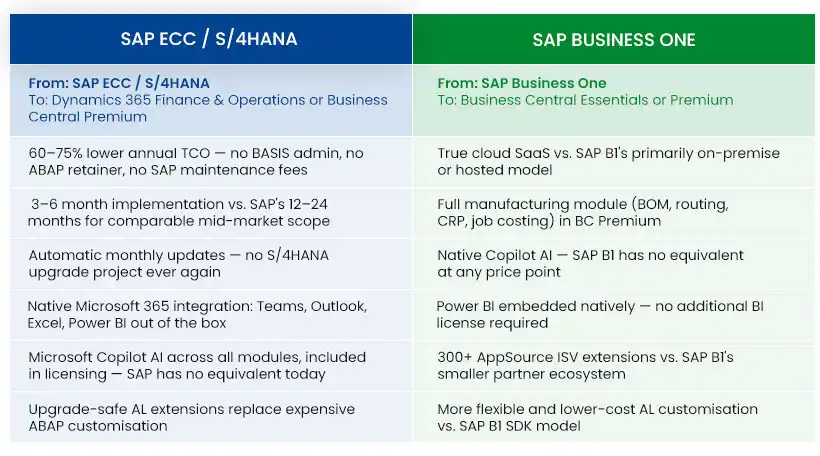
The table below compares Microsoft Dynamics 365 Business Central, the primary recommended SAP ERP alternative for mid-market companies against SAP ECC, SAP Business One, and SAP S/4HANA Cloud across 14 dimensions that determine platform suitability, implementation risk, and long-term cost.
| Capability | SAP ECC | SAP B1 | SAP S/4HANA Cloud | Business Central |
| Cloud-Native (SaaS) | On-premises | Hosted | ✓ Cloud | ✓ 100% Azure SaaS |
| Microsoft Copilot AI | — | — | Add-on/BTP | ✓ Native, included |
| M365 / Teams Integration | Middleware req. | Limited | Partial | ✓ Native, zero-config |
| Power BI Embedded | SAP BW/BO extra | — | Extra license | ✓ Native, no extra cost |
| Manufacturing (BOM/Routing) | ✓ Deep | Basic | ✓ Full | ✓ Full — Premium license |
| Warehouse Management | ✓ SAP EWM | Basic bins | ✓ Full | ✓ Full WMS — included |
| Multi-Entity / Multi-Currency | ✓ Enterprise | Limited | ✓ Enterprise | ✓ Automated consolidation |
| Customization Without ABAP | ABAP required | SDK required | ABAP/BTP req. | ✓ AL + Power Platform |
| Automatic Monthly Updates | Upgrade project | Periodic | Quarterly | ✓ Monthly, MS-managed |
| Implementation (mid-market) | 12–24 months | 6–12 months | 12–18 months | ✓ 3–6 months |
| Annual License (50–200 users) | $150K–$500K+ | $30K–$80K | $100K–$300K+ | Predictable per-user SaaS |
| Shopify / E-Commerce Native | SAP CC or custom | 3rd-party | Requires SAP CC | ✓ Native Shopify connector |
| AppSource ISV Ecosystem | Enterprise SIs | Moderate | Growing | ✓ 300+ certified connectors |
| 5-yr TCO (mid-market) | Very High | Moderate | High | ✓ Predictable, lowest TCO |
Discover how Microsoft Dynamics 365 Business Central can streamline your operations, reduce costs, and give you real-time visibility across your business.
Book your free consultation today!Three results in the table warrant specific commentary. SAP ECC and S/4HANA’s manufacturing depth advantage applies specifically to complex multi-plant global manufacturing at enterprise scale not to the majority of mid-market manufacturers with one or two facilities and standard discrete or process production. The SAP EWM advantage in warehouse management is similarly enterprise-tier; Business Central’s included WMS covers directed put-away/pick, lot traceability, mobile warehouse, and cycle counting at mid-market scale without additional licensing.
To learn more about the difference between SAP Business One and Dynamics 365, you can check out this blog!
The shift to cloud-based ERP is one of the most consequential technology decisions a mid-market company can make, and it is where SAP’s legacy architecture creates the most significant competitive disadvantage for companies evaluating cloud-based alternatives to SAP ERP.
SAP S/4HANA is available in cloud deployment models, but the term ‘cloud’ covers a wide spectrum. S/4HANA Cloud Public Edition is a true multi-tenant SaaS but with significantly restricted customization. S/4HANA Cloud Private Edition is essentially managed hosting of the on-premises codebase, with the infrastructure moved to a data Centre but the underlying software complexity unchanged. RISE with SAP wraps these options in a subscription bundle but does not simplify the implementation, upgrade, or administration burden.
Microsoft Dynamics 365 Business Central is built as a cloud-native SaaS application from the ground up on Microsoft Azure. This architecture difference has concrete operational consequences:
| “The companies that come to us from SAP didn’t leave because SAP couldn’t do the job, it almost always can. They left because of the structural cost of keeping SAP running consumed resources that should have been growing the business. For a $60M manufacturer, spending $250,000 a year on ERP licensing, ABAP development, and BASIS support is not a technology expense; it is a competitive disadvantage.”
— Milin Dholakia, Chief Operating Officer (COO), Beyond Key | |
SAP Commerce Cloud (formerly Hybris) is one of the most expensive and complex e-commerce platforms on the market and one of the least appropriate for mid-market US businesses. It was designed for enterprise retailers with 20-person platform engineering teams and seven-figure implementation budgets. For the vast majority of US manufacturers, distributors, and specialty retailers seeking an SAP Commerce Cloud alternative, Microsoft Dynamics 365 Business Central combined with Shopify and Power Pages delivers comparable commercial capability at a fraction of the cost and complexity.
Business Central includes a native, Microsoft-built Shopify connector, not a third-party integration that provides bi-directional synchronization between the Shopify storefront and Business Central’s ERP. Orders placed in Shopify appear in Business Central as sales orders in real time. Inventory levels in Business Central update the Shopify storefront automatically. Product catalog, pricing, and variant management is mastered in Business Central and published to Shopify. Fulfillment status and tracking numbers flow back to the Shopify customer automatically.
For B2B commerce scenarios customer-specific pricing, account-based ordering, credit limit enforcement, quote-to-order workflows, Beyond Key builds customer portal solutions on Power Pages, Microsoft’s low-code portal platform, connected directly to Business Central via API.
SAP Business One occupies an awkward market position. Designed for small businesses, it has significant gaps in cloud-native capability, Microsoft ecosystem integration, and manufacturing depth that become acute as companies grow past 50–100 users or expand into multi-entity, production, or complex warehousing operations. The best SAP Business One alternative for companies at this inflection point is Microsoft Dynamics 365 Business Central, and the functional comparison is largely one-sided.
In 2026, the most significant differentiator between Microsoft Dynamics 365 and every SAP alternative including SAP’s own S/4HANA is Microsoft Copilot. Copilot is embedded natively across every Business Central module, included in standard licensing, and available in production today. No other SAP ERP alternative at the mid-market price point matches its depth or breadth of AI capability.
Natural language ERP queries: Ask “What are my overdue invoices over $10,000?” in plain English, Copilot generates the answer from live Finance data instantly, without report building, SQL, or IT involvement.
Sales order creation from email: Forward a customer purchase order email to Business Central. Copilot reads the request and drafts the sales order with items, quantities, and pricing ready for one-click approval. SAP requires manual SD order entry for the same workflow.
Bring AI into your business operations with Microsoft 365 Copilot
See Copilot in actionMigrating from SAP regardless of product is a significant undertaking. The data complexity, customization inventory, and integration dependencies accumulated over years of SAP operation require a structured, risk-managed approach. Beyond Key’s six-phase SAP migration methodology has been refined across 80+ engagements.
The best alternative to SAP for most mid-market companies is not a question of whether a credible alternative exists; it is a question of which migration path matches the organization’s operational complexity, timeline, and Microsoft ecosystem investment.
Microsoft Dynamics 365 Business Central delivers the right answer for small and mid-sized companies, that need cloud-native ERP with full manufacturing, supply chain, and financial management capabilities, built-in Copilot AI, native Microsoft 365 integration, and a predictable SaaS cost model. For companies at the larger enterprise tier global conglomerates with highly complex regulated manufacturing, or a deep internal SAP team, S/4HANA may remain the correct answer, and Beyond Key will say so honestly before any engagement begins.
The companies that most consistently achieve rapid ROI on their SAP migration are those that treat the transition as a business process to redesign opportunity, not just a technology swap. The goal is not to replicate SAP in Business Central, it is to eliminate the manual workarounds, Excel compensations, and integration duct-tape that accumulated over years of working around SAP’s limitations, and replace them with a platform that improves every month without asking for a new upgrade budget.
Beyond Key is a certified Microsoft Solutions Partner based in Chicago. We specialize in SAP-to-Business Central migrations across manufacturing, distribution, and professional services. We begin every engagement with a no-cost SAP assessment, reviewing your current configuration, identifying the right migration path, and outlining a delivery roadmap before any licensing commitment is made.
Ready to Explore Your SAP Alternative?
Beyond Key offers a no-cost Business Central assessment — we will review your current configuration, map your requirements, and give you an honest platform recommendation and migration roadmap before any licensing commitment.
Schedule your free consultation now!