For years, artificial intelligence has been a trending topic across sectors in Australia. Companies have experimented in running autopilots, but many were still hesitant about AI adoption primarily until now.
However 2026 is appearing to be a pivotal year for artificial intelligence in Australia as companies are finally transitioning from small-scale AI trials to broad, large-scale, organisation-wide initiatives. This shift isn’t just theoretical; it will directly affect operating costs, compliance, and customer expectations.
The Australian Public Service’s APS AI Plan (2025) highlights this shift, which sets out how the public service will harness AI and commits to leadership, capability uplift and governance across federal agencies. Crucially, the plan establishes Chief AI Officers in agencies, formal training and secure internal AI tools for staff – a clear signal that AI adoption will be coordinated, governed and scaled across the public sector.
The Australian Government quotes, “The National AI Plan is about making sure technology serves Australians, not the other way around.”
But why now? Because advancements in technology, policy, expertise, cloud infrastructure and business priorities are converging like never before.
In this blog, I’ll break down the real reasons 2026 will become a milestone year for AI adoption in Australia – and what this shift means for your organisation, your teams, and your customers.
Let’s begin!
Australia has always been a strategic technology adopter. Most Australian IT companies and enterprises already use some form of automation, such as chatbots, analytics dashboards, machine learning models or cloud services.
But for the majority, AI adoption has been fragmented rather than integrated.
Today Australian organisations are mostly:
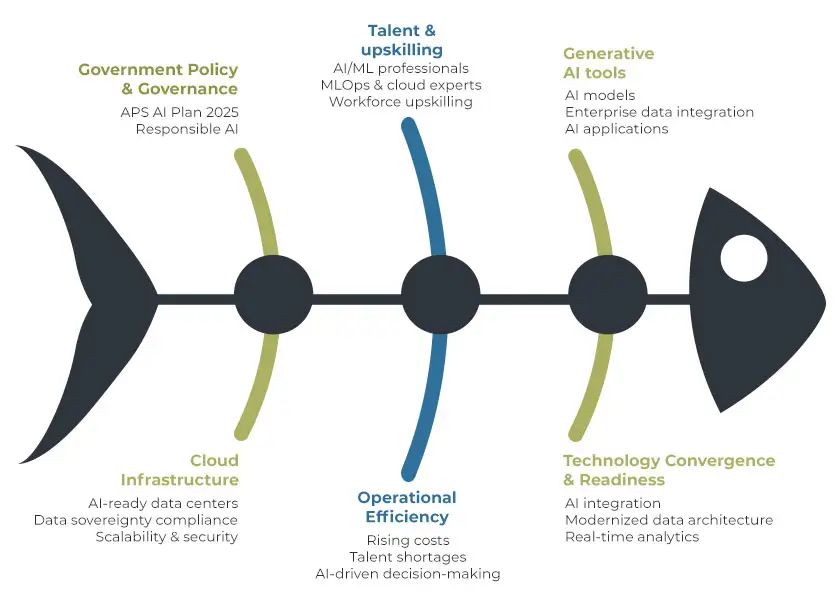 Several factors are considered that change the environment for 2026 AI adoption in Australia:
1. Safe and Responsible AI Policies Take Shape
The Australian Government has introduced formal guidelines for safe and responsible AI, privacy, and data protection – giving clarity to regulated sectors like BFSI, healthcare, government, construction, mining, and education.
“The federal government has also published Guidance for AI Adoption, setting essential practices for responsible governance and adoption — a framework private sector leaders will almost inevitably mirror as regulation and procurement follow. “
With governance and compliance clearly defined, companies finally feel safe scaling AI into their businesses.
2. Cloud Infrastructure is Reaching Peak Capability
Australia’s cloud ecosystem is expanding rapidly, with more AI-ready data centres that comply with data-sovereignty laws, enabling:
3. Talent Upskilling is Rising Towards Maturity
Between 2023 and 2025, thousands of Australian professionals across Australian AI companies upskilled in machine learning, GenAI, data engineering, MLOps and automation. This created a sustainable workforce to drive AI operations rather than relying solely on niche specialists.
4. The Push for Efficiency is Stronger Than Ever
Economic uncertainty, talent shortages, and rising operational costs in Australia are forcing Australian businesses to rethink how they achieve more with fewer resources.
AI has emerged as the strategic solution to reduce costs, improve decision-making, and improve customer experience and operational resilience.
5. Generative AI (GenAI) is Trustworthy
Early GenAI tools created amazing content, but they often produced wrong facts, inconsistent responses, or answers that changed each time you asked the same question. The good news is that the models have now evolved to create accurate responses and are easier to integrate with enterprise data.
1. AI Automation Across the Enterprise
2026 will witness automation moving from simple workflows to deep, cognitive automation, powered by AI for:
Companies will automate not just routine, repetitive tasks, but entire decision-making processes and ecosystems.
2. Data Modernisation and AI Boosting Real Transformation
AI is powerful, but only when fed with high-quality, modernised data. That’s why Australian companies are shifting to:
This is the foundation of AI adoption in 2026.
3. Industry-Trained AI Models
Generic AI is fading out. Businesses are shifting towards industry-trained, domain-specific AI models that understand the unique language, workflows, and risks of each sector differently.
Examples Include:
These models deliver great value for companies with AI as they are tailor-built on industry-specific data, making output relevant and actionable.
4. AI-Augmented Workforce Tools
2026 is becoming the year where AI assistants are soon becoming standard for every employee, irrespective of role or industry.
A few use cases include:
This is reshaping productivity across Australian AI companies and enterprises in working faster, making better decisions, and removing manual efforts from workdays to concentrate on their core business strategies.
5. Cyber Security Automation and AI
With rising cyber threats, AI enables:
Cyber AI is set to become an integral part of Australia’s digital safety framework in 2026.
1. Banking & BFSI
By 2026, AI deployment in banking and BFSI will help with:
2. Construction
3. Healthcare and Aged Care
4. Mining & Resources
5. Retail and eCommerce
6. Nonprofits (NPOs)
Here are the major challenges faced by businesses in AI adoption:
1. Legacy systems slowing integration
Many organisations still rely on large, outdated architecture, making it hard to:
2. Data quality issues
AI thrives on clean and reliable data. Some common challenges faced by many Australian organisations are:
3. Change Resistance
Employees often feel uncertain and worried by AI, including:
Without structured change management, AI adoption and engagement will most likely stall.
4. Skills Gaps
Effective AI adoption requires specialised roles such as:
However, this talent is still limited in Australia, creating a workforce capability gap.
5. Higher ROI and expectations
Boards and leadership teams often expect rapid AI-driven results, but many organisations lack the foundations, processes, and skills to deliver those results.
Prepare your business for scalable, governed AI adoption by 2026
Talk to an Expert1. Build a Clear AI Strategy
Most Australian businesses rush into pilots, only to realise later their purpose of using AI. A strong AI strategy answers one question: Where can AI create disproportionate value for us?
Organisations and management must clearly define:
2. Data Modernisation
The AI strategy is 70% data work and 30% modelling. It cannot succeed without modern, scalable data foundations. To succeed, businesses must strengthen their data backbone through:
3. Begin with High-Value Use Cases
Start with use cases that deliver fast and measurable impact, such as:
4. Upskill Employees
AI tools can be purchased, but without widespread AI literacy, organisations will end up with expensive tools nobody uses. The future depends on companies that empower people and not just deploy systems.
5. Build Governance Early, Not After a Crisis
AI governance is no longer a compliance checkbox; it is a business risk-control mechanism. Every organisation must have clear guidelines for:
6. Partner with the Right AI Solutions Partner
AI maturity is peaking for businesses in Australia. The fastest-growing AI companies in Australia rely on partners who bring the industry and technical know-how with proven frameworks, robust engineering capabilities, and global best practices.
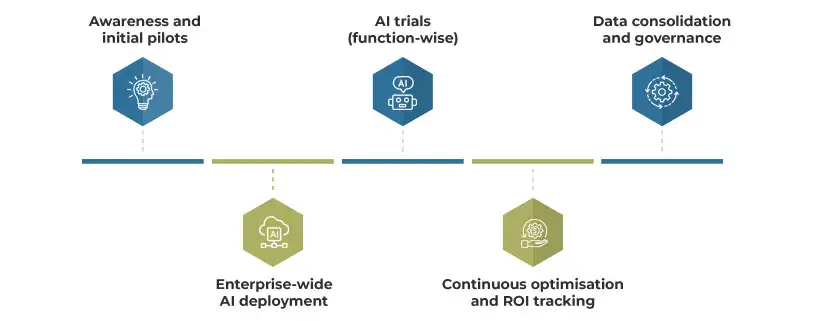
AI adoption is difficult to navigate alone, as it requires strategy, engineering depth, and continuous refinement. Beyond Key works as an enabler, helping Australian organisations move from early experimentation to scalable, enterprise adoption.
We Support Clients Through:
 Conclusion: Act Now to Shape your Future
 2026 is the year – the future of artificial intelligence in Australia starts to show up in day-to-day operations, government services, and customer experiences. The policy scaffolding is in place, the technology is maturing, and organisations that prepare their data, governance, and people will be the ones rewriting the rules of competition.
The question is not on how your organisation will be involved, but on how it will lead.
1. What is AI adoption?
AI adoption includes implementing artificial intelligence and automation into core business operations. It is not just another technology upgrade but making your daily operations smarter and more efficient, so your teams can focus on the things that really matter.
2. How do I implement AI in my business in Australia?
Starting with AI implementation in Australia begins with a clear business strategy. First, you should set your achievable goals. Next, consolidate fragmented data and move towards a cloud-first setup. Lastly, align with the APS AI plan and responsible AI guidelines to ensure local trust, compliance, and long-term success.
3. How can AI improve customer experience in business?
AI helps businesses with better customer service by offering 24/7 support, understanding customer preferences, and responding. in a more personalised way at every opportunity. With AI-powered systems in place, every interaction feels relevant and timely, turning them into lasting relationships.
4. How does AI improve efficiency and reduce costs in business?
AI reduces costs through automation of redundant manual data work. This allows businesses to operate faster and save money by cutting down unnecessary work hours.
5. What are the biggest challenges to AI adoption in Australia?
Outdated legacy systems, skills gaps, internal change management, and fragmented data remain technical blockers for achieving high AI results. With the use of the right strategy tools, strategy, and support, AI can become a game changer for your business.