In today’s funding environment, Australian not-for-profits (NFPs) are under a lot of pressure from both public and private funders. Funders want more than just mission-based results. They want proof that NFPs can manage funds in a clear and responsible way. That’s why grant management has turned from a back-office task to a strategic governance job.
These days, it’s common for Australian NFPs to manage multiple grants simultaneously. Without the right tools, teams have a hard time keeping track of deadlines, milestones, and reporting requirements. They spend hours looking for information in spreadsheets, emails, and disconnected files, which doesn’t leave much time to work on their core programs.
To reduce these bottlenecks, NFPs are using grant management programs and grant management software to centralise processes. These platforms don’t just organise data. They make sure that compliance is followed, repetitive tasks are automated, and grant portfolios are shown in real time.
In this blog, I’ll outline how a modern CRM solves grant management from administrative headaches to strategic assets by reducing operational oversights and increasing the program’s impact.
Many Australian NFPs still use traditional tools such as spreadsheets, emails, and shared folders to manage grants. While these methods seem to work at first, they often fail to scale when the volume goes up.
Funders want reports on time, clear audit trails, and the assurance of risks being controlled and managed. Boards also ask tough questions about transparent oversight, accountability, and possible gaps in governance.
| Funder’s expectations | NPO operational challenges |
| Clear audit trails | Many funding organisations have different reporting requirements |
| Consistent and timely reporting | Limited capacity across teams and functions |
| Compliance in daily functions | Boards ask specific questions about risk and oversight |
| Confidence that risks are understood and managed | Staff members spread knowledge and processes. |
There are several factors for this, including grants that last for multiple financial years and different reporting frequencies for the same data. There may also be some overlap between program milestones and financial acquittals in many organizations. Some summaries include:
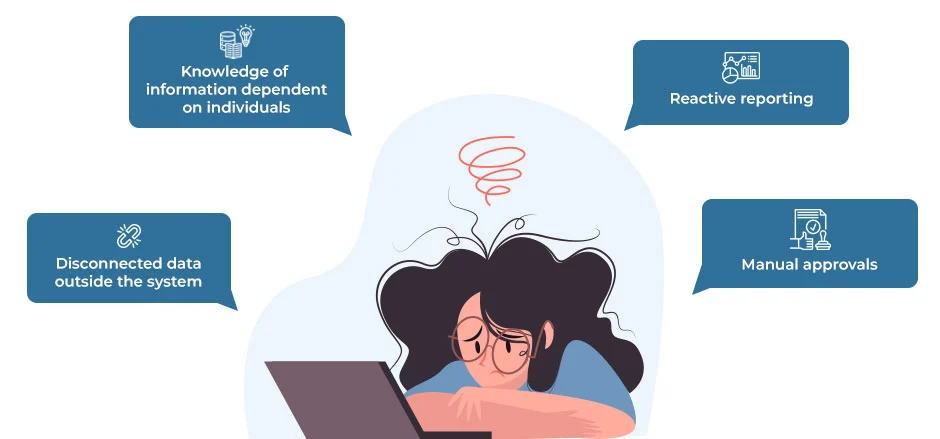 For Example: A healthcare NFP in Melbourne illustrates this situation in the image above. When a funder asked about a delayed outcome, the program’s staff thought that the milestone was met; finance believed it was still pending, and leadership had no system-level visibility. The problem was not non-compliance but a lack of structural alignment, which highlighted the need for a unified CRM approach.
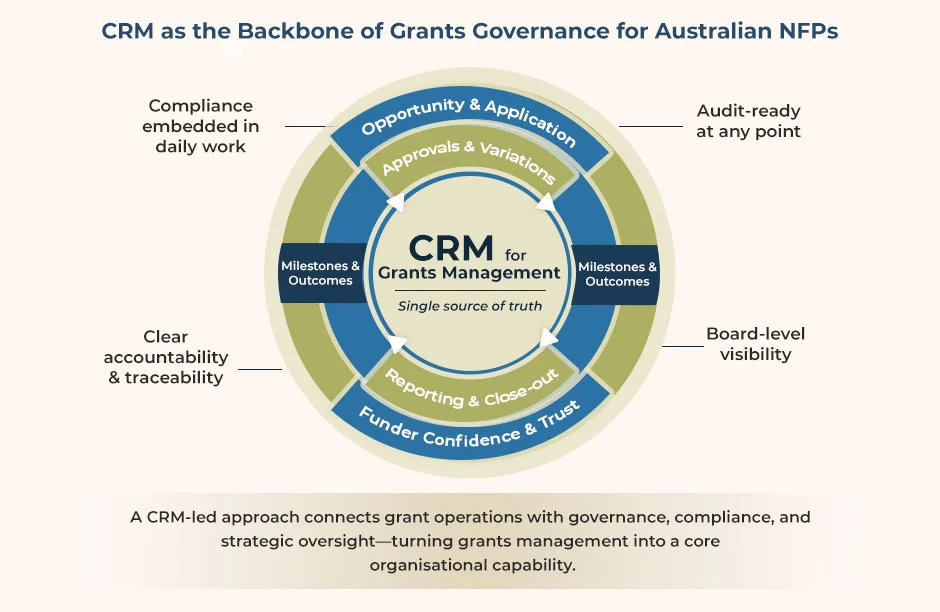 There are 3 core pillars that make up good governance: structure, traceability, and visibility. CRM enabled grants management treats grant as structured entities instead of piles of documents and deadlines. This changes how the government works.
The question of “Who has the latest version of information?” no longer arises. organizations can answer questions like “What stage is this grant at?”, “What decisions have been made?”, “What risks emerge?” and “What evidence already exists?”
With CRM:
By integrating CRM with financial systems, program evaluation tools, and stakeholder engagement platforms, Australian NFPs can get a 360-degree view of each grant’s lifecycle and make smart strategic decisions.
There is a provision to group repetitive and high-risk tasks into workflows, which reduces manual effort and human mistakes.
Some common automated workflows include:
When NFP leaders can trust their data, they are able to focus on their mission. High-quality insights are an early warning system that flags a delayed milestone or a compliance hurdle before it becomes a crisis. This foresight enables leadership to swiftly shift course and allocate resources appropriately.
Compliance is now an integral part of day-to-day operations, no longer limited to audits. CRM systems help in it by:
When funders or auditors ask for information, teams can respond quickly without having to recreate old data. This level of reporting and audit readiness for funders makes NFPs more trustworthy and credible.
Technology cannot ensure effective governance. When Australian NFPs successfully use grant management software, they focus on:
Employees will start using CRM regularly and for a long time if it helps them to relax instead of adding to their compliance burden.
A nonprofit organization (NFP) can set up a CRM platform to manage its grants in two ways: it can either choose a customized CRM platform or a tailored, purpose-built solution that is made specifically for the NFP sector.
Generic CRMs are flexible, but they often need a lot of customization to make sure they meet reporting, compliance, and governance needs. This can make setup and upkeep take longer and cost more, which is a lot for NFPs with limited IT resources.
The purpose-built NFP grant management system is designed around specific areas such as multi-year funding, outcome reporting, acquittals, and complex stakeholders.
Beyond Key’s Right Cause and other grant management software are built on Microsoft Dynamics CRM for nonprofits. They are designed to support governance-heavy use cases. They simplify and speed up value by combining relationship management, grant lifecycle tracking, compliance workflows, and reporting on a single platform.
For Australian NFPs on these Platforms, Some Strategic Considerations to Keep in Mind are
Choosing a platform that is designed for that purpose lets NFPs focus on governance and impact instead of constantly changing technical settings. Beyond Key combines technology implementations with NFP consulting to reduce operational risk while supporting long-term sustainability.
Real-life Benefits for Australian NFPs
CRM-led grants management leads to measurable results in healthcare, community services, education, and advocacy organizations, such as
CRM-enabled grant management takes care of administrative tasks for teams, so they can focus on achieving their mission goals.
As Australian NFPs mature in their use of CRM, the emerging trend is around intelligence-driven governance, which incorporates:
For boards and executive teams, this entails knowing the answers to crucial questions such as the “highest operational risks,” “over-dependencies on specific funding,” or “programs under funding constraints.” CRM then becomes not just a system of recording but a system of insight that supports decision-making at both operational and strategic levels.
For Australian NFPs, CRM for grants management solutions is not an option but is a foundational governance capability. By embedding structure, visibility, and accountability in their daily operations, CRM enables NFP organizations to reduce risk, strengthen compliance, and demonstrate maturity. In a funding environment where trust and transparency are as important as impact, not just for grant management, CRM becomes a strategic asset to the existing ecosystem.
Explore how CRM-led grant management can support governance, compliance, and funder reporting for Australian NFPs.
Talk to an ExpertFAQs
Q1. Explain the system for managing grants.
The grants management system handles grant end-to-end from application to reporting. It maintains all the data centrally and ensures that compliance is up-to- date.
Q2. What are the most important things to do when managing grants?
Grant management helps keep a track of grants, get approvals, manage workflows, finances and processes.
getting approvals, following compliance with workflows, integrating finances, managing stakeholders, and creating reports.
Q3. What does it mean to manage a grant?
Grant management is a structured workflow that includes applying, getting approval, keeping track of milestones, reporting, following compliances, and closure.
Q4. What is the purpose of a grants management system?
A grants management system centralizes grant data, automate approvals, keeps track of milestones, ensures compliance, and creates dashboards.
Q5. Which CRM is best for non-profits?
Nonprofits can use purpose-built CRMs like Right Cause by Beyond Key or Microsoft Dynamics 365.
Q6. What is the most popular CRM in Australia?
Microsoft Dynamics 365 is a popular choice because it is flexible and helps with compliance. Salesforce can also be another choice.