Interacting with donors and building connections with them is not easy. In this competitive landscape, building relationships with potential supporters requires a strategic approach. A first-time donation needs effort. You, being a part of a nonprofit, should know how to persuade supporters, teach them about your cause, and how they can make a difference in society.
In this blog, we will talk about how you can convert your audience members into first-time donors. And gradually, how these donors can transform into recurring supporters. We understand the importance of boosting the donor retention rate in social causes.
Donor cultivation is the step-by-step process of guiding and informing prospective donors about the motives of your organization. There are different ways to handle this. From social media channels to in-person events, telephones, and emails, a donor cultivation strategy uses multiple means of communication.
Donor cultivation is not just for fundraising or making an ask of prospects. It is a core method for building rapport and establishing trust with potential donors. It focuses more on long-term engagement rather than pitching them for monetary benefits for your nonprofit’s mission.
1. Know your supporters at the ground level.
2. Enhance donor retention rate, which is as important as converting a donor for the first time.
3. Practicing a cultivation strategy helps build trust in the market and increases visibility.
4. Turn donors into advocates and ambassadors, and in this way, they can help you expand your reach.
1. Understand and segment your donors
The first step to initiate donor cultivation is to segment your donors. If you have a donor list, you can segment donors by donation amount, contribution frequency, location, interest area, and more. Gain insights into the research that your organization is doing for prospects. Understanding your prospects can help you identify their areas of interest. Some might want to donate to healthcare while others to political causes.
2. Convey how their contribution can make a difference
It is important to clearly communicate to your prospects where their money will be spent and how it will make a difference in society. Make it part of your strategy and guide them with demonstrations of your nonprofit organization and its future initiatives.
3. Streamline your communication
It is important to maintain regular communication with prospective clients. Nonprofits can escalate their donor cultivation strategy with effective communication. From newsletters and program updates to impact reports and emails, all channels can help improve understanding and communication.
4. Personalization in the donor cultivation plan
Once you create a common plan for all donors, you can start customizing it based on their unique requirements or budgets.
-Customize invitations for events according to their charitable interest. Whether they are interested in contributing to public shelters or an orphanage, invitations should be customized.
-Track their engagement and send them emails for better response.
5. Engage donors to ensure retention
Deeper engagement with donors can lead to higher future donations. You can plan many ways to connect with your donors after their one-time donation. From social media to webinars, fundraising events, and more, nonprofits have many ways to connect with donors.
Peer-to-peer (P2P) fundraising strategy involves supporters making an ark for nonprofit cause by communicating with their peers. They can do this by creating fundraising portals where people can offer donations. Volunteers can monitor this.
It takes time to build a long-standing, deep-rooted relationship with your donors. The timeline for donor cultivation depends on many factors and can range from a few months to many years. But once you end up with long-term donors, your hard work will pay off.
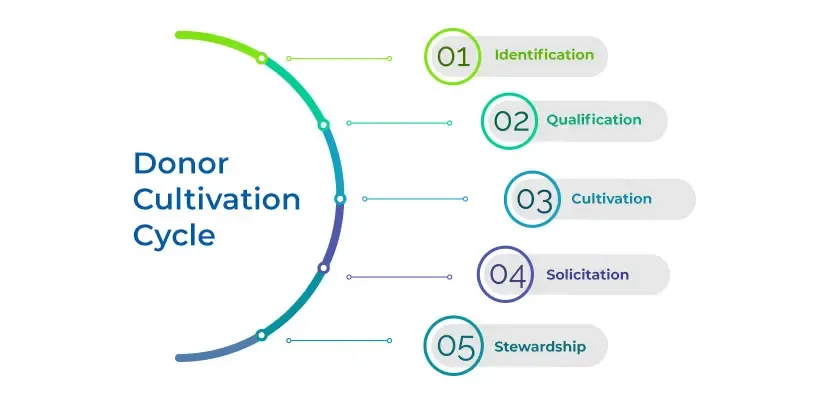
The donor cultivation cycle comprises four steps.
1. Identification
This is the first step: identifying the most promising donors. This can help you identify their capacity to donate, so you can prioritize supporters who can donate more. You can segment donors by wealth, first-time or recurring, program interests, and engagement level.
2. Qualification
Analyze your prospects’ philanthropic history, background check, and business affiliations to understand their potential interest in your mission. Focus on the effort and the right people.
3. Cultivation
Before making an ask, build a relationship with your prospect. Reach out to them by scheduling meetings, calling, or inviting them to events. Personalized communication fosters emotional connection, which can convert prospects into donors.
4. Solicitation
Once you are aligned with the prospect, make a well-researched and timely request. Ask them about what amount they can donate and what do they have in mind about it. Focusing on the right person, at the right time with the right message can make a huge difference.
5. Stewardship
Once they have made a donation, it is important to acknowledge their support. Take time to thank the donor while demonstrating how they have helped society so that they can be your long-term donor. This will help non-profit organizations convert first-time donors into recurring donors.
The global nonprofit CRM market is growing strongly, with forecasts suggesting a market value of several billion USD by the 2030s and growth rates (CAGR) of ~6 – 8 % depending on the source.
A donor CRM software can help organizations manage donor profiles and update them with detailed information. You can filter and segregate these profiles based on data. Most CRMs help companies export their data and use it in reports. When choosing CRM for a nonprofit, ensure it integrates with external tools.
Your potential donors might expect a different flavor of interactions from you. As competition grows in the nonprofit sector, you should invest in CRM software that can allow you to personalize content in all domains so that it has a better impact on your prospects.
Real-time dashboards enable users to track fundraising activities, manage volunteers, and manage end-to-end operations. It lets you digitize and automate your donor management process in the cloud.
Donor management CRM ensures real-time visibility into system checks, validations, and alerts. It gives you visibility into sub-recipient performance.
Powered by Microsoft Dynamics 365, Right Cause is a CRM for nonprofit organizations. With charity-specific features, it aims to help nonprofits streamline their fundraising efforts. This cloud-based CRM software can help you manage data in the cloud without coding. This low-code software is easy to use and comes with additional capabilities.
Right Cause CRM can help your nonprofit organization run smoothly.
Donor cultivation is critical for building a strong network for nonprofit organizations. It is an ongoing process for engaging, educating, and building relationships with prospects. By following the right strategy, you can achieve your goal of attracting donors and improving donor retention.
If you are seeking the right tool that can help you manage donor cultivation and grant management, we are here to help. Right Cause is a Microsoft-powered CRM tool that helps nonprofits standardize and integrate data across the system and automate workflows.
1. What is ERP for non-profit organizations?
ERP for nonprofits is an end-to-end solution that manages and streamlines operations in multiple departments. From finance to grant tracking, procurement to donor management, ERP for nonprofits is designed to cater to support the motives of nonprofit organizations.
2. What are the benefits of ERP for non-profit organizations?
Here are the benefits of nonprofit ERP software: centralized data management, compliance and reporting, enhanced operational efficiency, better donor trust and relation, and efficient financial management.
3. What features should a non-profit ERP system have?
Non-profit ERP must have these features: procurement and fund management, volunteer management, grant management, financial reporting, donor management, compliance and audia trails and more.
4. How does ERP improve donor management for non-profits?
ERP centralizes donor data, tracks restricted funds, helps create accurate reports, res compliance, and boosts donor retention. It streamlines donor communication, thereby improving donor management.