In the world of IT leadership, we’ve all heard the same pitch a thousand times: “This new AI tool will save your team hours of work.” Usually, that promise falls apart the moment you realize the AI doesn’t understand your specific data environment, or worse, when your security team flags it as a massive privacy risk.
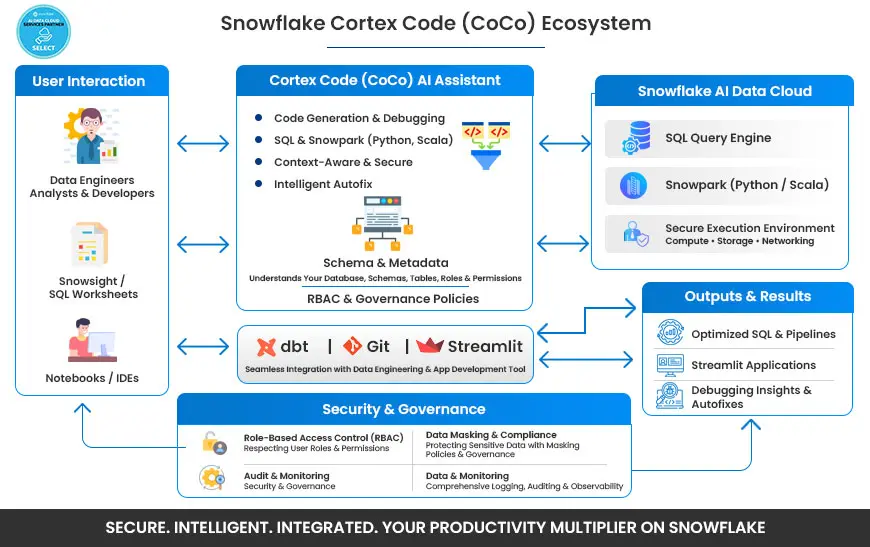
But recently, there’s been a shift. Snowflake Cortex Code (or “CoCo”) has emerged as something different. It isn’t just a chatbot tacked onto a platform; it’s an integrated partner that lives inside your Snowflake environment.
At Beyond Key, we’ve been putting Snowflake Cortex Code (CoCo) through its paces, and the results suggest that we are entering a new era of data engineering, one where “speed to insight” isn’t just a buzzword, but a daily reality.
Most IT leaders are rightfully hesitant about tools like ChatGPT or Claude for core data work. These models are brilliant, but they are “outsiders.” They don’t know your schemas, they don’t understand your RBAC (Role-Based Access Control), and they certainly don’t know your masking policies.
“Gartner noted that by 2027, organizations using context-aware AI in their data workflows will likely see a 40% reduction in manual engineering overhead”.
That’s because tools like Snowflake Cortex Code (CoCo) have “home-field advantage.” It understands your tables, roles, and permissions from the inside out.
As a Snowflake partner, we don’t just look at the technical specs; we look at how these tools solve headaches for our clients. Our experts have been implementing Snowflake Cortex Code into multiple data environments running on a Snowflake-powered data warehouse. Upon successful implementations, what clients usually love about Snowflake Cortex Code (CoCo) is its context aware explanations, insights, and code snippets.
 Here are a few Snowflake Cortex Code use cases where it has been a gamechanger for our clients:
1. The “Big Migration” Rescue: One of our US-based client was troubled by 3,000 lines of complex, legacy stored procedures that needed to be modernized into Snowpark. Normally, that’s a multi-week project riddled with manual errors.
In our experience, CoCo analyzed, refactored, and documented those scripts in minutes. For us it not only copied the code; it interpreted the logic and suggests a more “Snowflake-native” way to do things.
2. The End of the “Messy Prompt” Struggle: Internally we’ve seen our developers getting frustrated when an AI doesn’t “get it.”
We recently tested a scenario where a user gave a vague, slightly messy prompt: “For PBI purposes, can you change all column names in these 40 scripts to their original capitalization?”
One of the most impressive things we were able to observe about CoCo is its interpretive capability. Instead of asking for clarification, CoCo looked straight into the correct repo folder and handled the task pragmatically. It’s that “human-in-the-loop” feels that it makes it a true sparring partner.
If you are managing a data team, your goal is to remove friction. CoCo acts as a productivity multiplier sitting inside the Snowflake Cortex AI ecosystem in three specific ways:
Software is only as good as the strategy behind it. While CoCo is an incredible engine, it still requires an expert hand to ensure it’s being used to its full potential within a complex enterprise architecture.
Snowflake Cortex Code has surely been a powerhouse for teams utilizing it currently, but many data leaders have observed since CoCo runs inside Snowflake, its ease of use can quickly lead to unnoticed credit consumption, making costs harder to control compared to fixed-price tools. This is the role of a certified Snowflake consultant becoming important while trying to keep a close watch on usage and cost.
At Beyond Key, we pride ourselves on being more than just consultants; we are your technical partners. We help organizations bridge the gap between “having” Snowflake and “mastering” it. If you’re looking to cut through the noise and start seeing real time-to-value with your AI initiatives, let’s talk about how we can integrate Cortex Code into your workflow.
1. How does the Cortex Code (CoCo) differ from general AI tools like ChatGPT or Claude?
The short answer is yes; it’s about the “home-field advantage.” While ChatGPT is a generalist, CoCo lives inside your Snowflake account. It knows your schemas and security roles, which means you aren’t stuck copying and pasting code into a third-party window. It’s context-aware in a way external tools simply can’t be. Is our data safe when using an AI coding assistant like CoCo?
2. Does it only work for SQL, or can it handle Python too?
It’s actually quite versatile. Beyond just SQL, we’ve used it to help teams navigate Snowpark (Python) and build out Streamlit apps. Whether you are refactoring old stored procedures or debugging a new data pipeline, CoCo acts as a technical translator that handles heavy lifting across multiple languages.
3. Will this replace my senior data engineers?
Not a chance. Think of CoCo as a “sparring partner” rather than a replacement. It’s incredibly fast at tedious stuff like documenting 40 scripts at once or fixing syntax errors, but you still need a human-in-the-loop to make the big architectural calls. It just means your experts can finally focus on strategy and other high-level tasks.