Causal Machine Learning is not just another machine learning technique—it’s a fundamental shift from predicting what happens to understanding why something happens. While traditional AI excels at finding patterns (correlations), causal AI uncovers cause-and-effect relationships, enabling organizations to simulate interventions, answer counterfactuals, and make optimal decisions.
Key distinction:
In real-world business environments, correlation is unreliable for decision-making. A model may predict accurately today but fail completely after a pricing change or a supply chain shock because it never learned the underlying causal structure.
What causal learning does that traditional ML cannot:
| Traditional ML | Causal Machine Learning |
| Finds correlations | Finds cause & effect |
| Optimizes prediction accuracy | Optimizes decision impact |
| Requires large n datasets | Works with smaller, structured data |
| Cannot answer “why?” | Explains “why” and “what if” |
| Fails under policy changes | Robust to interventions |
Good read: Beyond Correlations: The Necessity and the Challenges of Causal AI
Vinod Kumar Chauhan, Devendra Singh Dhami, Boyan Gao, et al.
University of Strathclyde / TechRxiv Preprint, 2025
What it answers:
“What is the effect of changing one business variable on profit, while controlling other related variables?
In your project, it answers questions like:
Backdoor Linear Regression causal graph showing the relationship between treatment (discount), outcome (profit), and confounders (demand, quantity sold, cost, price).
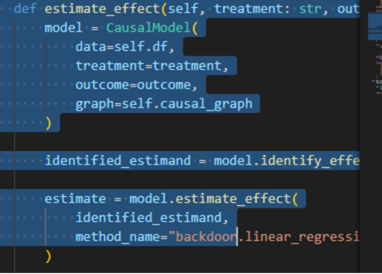
It means: “Before estimating the effect of one variable on profit, we control for other variables that may confuse the relationship.”
Example – Discount → Profit:
Model controls for:
Why this matters:
Because profit is not only affected by discount. If demand is high, profit may change. If cost is high, profit may change. So instead of just checking correlation, the model estimates: “What is the impact of discount after adjusting for other important business factors?”
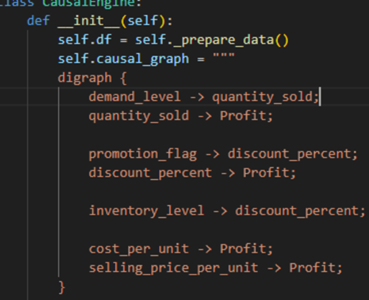
Causal discovery tries to find:
The PC Algorithm is one of the most common causal discovery algorithms.
What it does:
PC Algorithm causal learning graph discovery output showing directional relationships between business variables.
What it does:
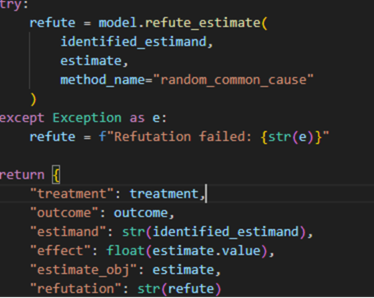
It checks whether your causal result is stable.
If you add a random common cause (a simulated confounder) to the model, the causal effect estimate should not change significantly. If it does, your original model may be unreliable.
Random Common Cause Refutation Test results showing stability of causal effect estimates.
| Component | Method Used |
| Framework | DoWhy (Python causal inference library) |
| Main Estimation | Backdoor Linear Regression |
| Validation | Random Common Cause Refutation Test |
| Causal Discovery | PC Algorithm |
| Treatment Variables | Discount %, Promotion Flag, Cost per Unit |
| Outcome Variable | Profit |
Causal Inference And Machine Learning is powerful but not magical:
| Use Causal AI when you need: | Use Traditional ML when you need: |
| Cause & effect explanation | High-accuracy prediction |
| Intervention simulation | Forecasting (sales, demand) |
| Decision support (“which action?”) | Classification or pattern recognition |
| Root cause analysis | Scalable pattern learning from large data |
Final takeaway: ML tells what is likely to happen. Causal AI explains why it happens and what action should be taken.
The previous sections covered how causal AI works. This section goes further—into the expertise that separates a causal AI practitioner from a true decision intelligence leader.
Most data scientists understand confounding in theory. Few actively hunt for it in business data.
Example from the case study:
The traditional ML model saw: Discount ↑ → Sales ↑ (correlation).
The causal model revealed: Demand ↑ → Both Discount ↑ and Sales ↑ (demand was the confounder).
Beyond expertise insight:
The most dangerous confounders are not in your dataset. They are unmeasured—seasonality, competitor actions, weather, employee morale. Causal Machine Learning forces you to make these assumptions explicit, which is uncomfortable but necessary.
Strategic takeaway:
If you cannot name at least three potential unmeasured confounders for your key business metric, you are not ready for Causal Machine Learning.
Judea Pearl’s “Ladder of Causation” defines three levels:
| Level | Capability | Typical Business Tool |
| 1. Seeing | Observing correlations | SQL, BI dashboards, ML prediction |
| 2. Doing | Simulating interventions | Causal AI, A/B testing |
| 3. Imagining | Counterfactual reasoning | Advanced causal AI, human judgment |
Beyond expertise insight:
Most organizations never leave Level 1. They invest millions in predictive ML but cannot answer: “What would profit be if we had not launched that promotion?”
Causality Machine Learning is the only bridge from Level 1 to Level 2 and 3. Without it, you are stuck describing the past instead of engineering the future.
This is rarely discussed but critically important.
If your causal model is wrong, an intervention based on it can cause real harm:
Beyond Key’s insight:
Causal AI practitioners have an ethical responsibility to:
A confident but wrong causal model is more dangerous than no model at all.
Technical skills alone will not make causal AI successful in your organization. You need:
| Readiness Factor | Why It Matters |
| Domain expertise integration | Causal graphs require business knowledge, not just data |
| Tolerance for uncertainty | Causal estimates have confidence intervals; executives must accept them |
| Decision accountability shift | From “what does the data say?” to “what action do we take based on causal insight?” |
| Investment in refutation | Validation takes time; it cannot be skipped |
Beyond Key’s insight:
The most sophisticated causal model will fail in an organization that:
The next frontier is not causal AI alone; it is causal generative AI.
Imagine:
Beyond Key expertise insight:
Organizations that master causal AI today will be the ones that successfully integrate it with generative AI tomorrow. Those that don’t will be left with “prediction-only” models in a world demanding explainable, actionable, and intervenable intelligence.
To leadership:
Stop asking “Which model has the highest accuracy?” Start asking “Which model helps us make better decisions?” That is causal AI’s only metric that matters.
To practitioners:
Causal AI is not a library you import. It is a discipline of assumptions, graphs, refutations, and business collaboration. Master the tool and the mindset.
To organizations:
The ROI of causal AI is not better forecasts. It is avoiding costly wrong actions that correlation-based models confidently recommend. In a world of A/B testing limits and policy changes, causal AI is not nice to have. It is a competitive necessity.
Causal AI is not a replacement for traditional machine learning—it is its necessary intellectual completion. For years, businesses have been misled by spurious correlations, optimizing for proxies instead of true drivers, and making decisions that looked good in dashboards but failed in the real world.
A traditional ML model can tell you with 95% accuracy that sales will increase next month. But it cannot tell you why—and without “why,” you cannot confidently act. Should you increase discounts? Launch a promotion? Improve delivery speed? Cut costs? Each action has different consequences, and only a causal model can simulate those consequences before you spend real money.
The application of DoWhy (Explore an end-to-end library for Causal Inference here), backdoor linear regression, PC algorithm for causal discovery, and random common cause refutation provided the business with something traditional analytics never could:
Any organization still relying solely on correlation-based models for strategic decisions is flying blind. Causal Machine Learning provides the instrument panel.
If you want to learn more about implementing Causal ML for your business—profit driver analysis, pricing strategy, or decision intelligence—get in touch with Beyond Key at contact@beyondkey.com
Let’s build decisions that matter.