Cloud Migration Strategy: Steps, Challenges, Best Practices & Trends
Let’s be honest, migrating to the cloud can feel overwhelming. You’ve got years of custom applications, databases full of customer data, and systems that somehow all depend on each other in ways no one fully remembers. The thought of moving it all? That keeps IT leaders up at night.
Cloud migration strategy isn’t just about moving servers anymore. It’s about giving your business room to grow, responding faster to customers, and stop throwing money at aging hardware that’s past its prime. When done thoughtfully, it unlocks real value. When rushed? That’s when you get budget blowouts, angry users, and frantic weekend firefights.
Most companies move to the cloud expecting instant savings and magical performance. The reality check? According to Gartner, over 85% of organizations will be cloud-first by 2025. But Flexera’s 2024 report found that nearly 28% of cloud spend is completely wasted—often because of poor planning and not managing things properly after the move.
The difference between “this was a great decision” and “what did we just do to ourselves?” comes down to one thing: a solid, well-thought-out cloud migration strategy.
So, What Actually Is a Cloud Migration Strategy?
Think of it as your cloud migration roadmap. A cloud migration strategy is simply a plan for moving your cloud application migration, cloud data migration strategy, and infrastructure from wherever they live now to the cloud—whether that’s public cloud, private cloud, or a mix of both.
But here’s what makes it different from a typical IT project: it answers real questions your CFO and CEO care about:
- Which applications do we move first?
- Do we just lift and shift everything, or is this our chance to finally fix that clunky old system?
- How do we keep our data secure and stay compliant while we’re mid-migration?
- What’s this going to cost—and when do we start saving money?
- Who’s responsible for keeping things running smoothly after we’re done?
The 7 Rs: Choosing the Right Path for Each Workload
Not everything needs to be handled the same way. Here’s a framework that helps you decide what approach makes sense for each part of your environment:
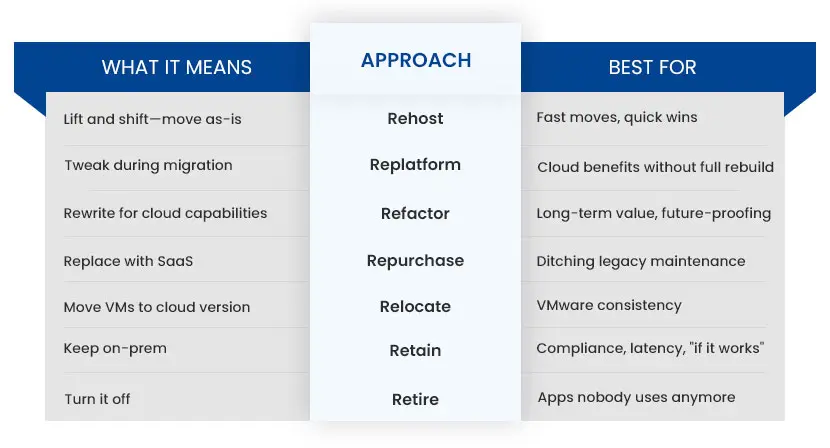 There’s no single right answer. The best approach depends on how critical the system is, what it’s going to cost, and where you want to be five years from now.

Cloud Migration Planning: A Step-by-Step Technical Guide
Before moving anything, you need to know what you’re working with.
- Application inventory: List every workload—including the ones no one remembers
- Dependency mapping: Document how services talk to each other (because something always connects to something else)
- Data classification: Tag what’s sensitive, what’s regulated, and what can’t leave certain geographies
- TCO analysis: Compare what you’re paying now (hardware, licenses, power, people) against cloud pricing models
- Performance baselines: Record current latency, throughput, and resource usage so you know if things actually improve post-migration
What you get: A migration readiness report that tells you what moves, what stays, and what gets turned off.
Migration Planning & Roadmap
Turn strategy into an actionable plan with clear ownership.
- Wave planning: Group workloads by dependency and criticality. Low-risk stuff first.
- RACI matrix: Who’s responsible, accountable, consulted, informed. No ambiguity.
- Cost modeling: Use AWS/Azure/GCP calculators to estimate real monthly spend
Workload Migration Execution
Now the actual move happens—carefully.
Migration method: Choose the right 7-R approach per workload (rehost, replatform, refactor, etc.)
Data transfer: Use AWS DMS, Azure Migrate, or GCP Transfer Service. Validate checksums.
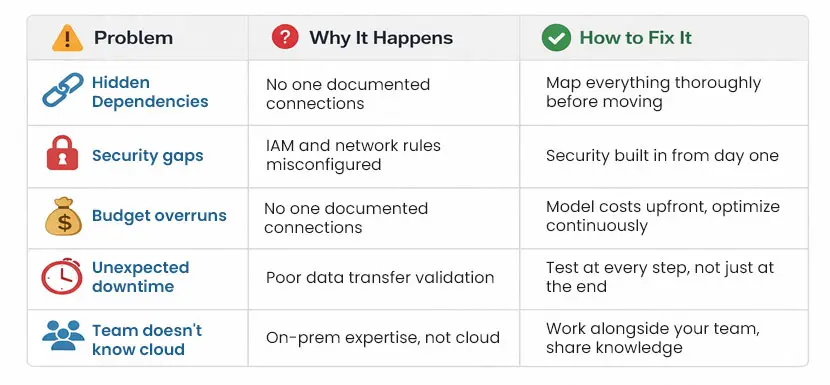
Common Headaches (And How to Avoid Them)
Even good teams hit snags. Here’s what we see most often:
 Best Practices for Cloud Migration Planning That Deliver
These cloud migration best practices make complex migrations smoother:
- Map dependencies first – You can’t move what you don’t understand
- Start small – Low-risk first, learn, then tackle the hard stuff
- Automate everything – Infrastructure as Code prevents “oops” moments
- Control costs early – Tagging, budgets, alerts from day one
- Least privilege access – No one gets permissions they don’t need
- Assign governance ownership – Someone must be responsible
- Run dry runs – Catch problems before they hit users
- Keep monitoring – Baselines help spot trouble early
Hybrid and Multi-Cloud: When One Cloud Isn’t Enough
More companies are using multiple clouds or mixing clouds with on-prem. It gives you flexibility, but it adds complexity. A good enterprise cloud migration strategy accounts for:
- What goes where and why
- How things talk to each other across different environments
- Keeping governance consistent across providers
- Understanding what you’re spending across multiple bills
- Making sure you can move data if you need to switch providers
Hybrid setups give you options. But they need discipline.
What’s Changing in Cloud Migration Management
Cloud migration isn’t the same beast it was five years ago. The smart moves today:
- AI helps you decide – Better tools that analyze your environment and tell you what should go where. Less guessing.
- Costs front and center – Nobody likes bill shock. Teams are watching from day one, not after the first invoice lands.
- Upgrade and Improvise – Why just move old code to the cloud when you can make it better along the way? More companies are modernizing, not just relocating.
- Green matters now – Turns out where you run things and how you build them has a real carbon impact. Smart teams are factoring that in.
- Containers are everywhere – Kubernetes has basically won. Workloads are more portable, less locked in.
- Less manual work – Automation means fewer late nights fixing things that should have worked the first time.
Mistakes We Keep Seeing
- No cost model – That first bill hurts
- Forget data is heavy – Moving it costs real money
- Skip performance tests – Users will let you know
- IT-only project – Business needs a seat at the table
- No owner after – “We’ll figure it out” never works
- Skip training – Your team isn’t mind readers
- Optimistic timelines – Everything takes longer
Conclusion: Move Forward with Confidence
At Beyond Key, we don’t treat cloud migration strategy as a one-time activity. We treat it as something to build carefully, step by step. We help you figure out what needs to move when, map out a path that makes sense (cloud migration roadmap), handle the actual move without breaking things, and keep everything running smoothly after you’re live.







 Non Profit