Understanding Data Orchestration: An essential inclusion to vitalize enterprise data ecosystem
In the era of digital evolution, organizational data is expanding at a rapid pace. Modern businesses receive this data from a variety of sources. After a while it becomes impossible for businesses to collect, curate and interpret crucial information from this vast pool of data.
This is where an effective data orchestration strategy can set up an imperative roadmap for modern businesses to handle overwhelming volumes of data and utilize it for strategic decision-making.
According to Gartner, “data stored across silos leads to inconsistency and integration challenges”. These silos often lead to the development of fragmented data environments that lead to ineffective data utilization and underperforming BI & Data Analytics frameworks that lack consistency and often struggle to integrate a disconnected data ecosystem.
Data orchestration tools have the potential to significantly improve the speed and efficiency of data pipelines, which is critical in improving data quality for BI & analytics initiatives as organizations scale end-to-end data initiatives for the future.
What is Data Orchestration?
Data orchestration is the process that involves automation, coordination, and management of data workflows across various systems and tools that ensure smoother access to organizational data for quick analytics and improved decision-making. This process can streamline multiple tasks and processes into data extraction, transformation, ETL, and integration.
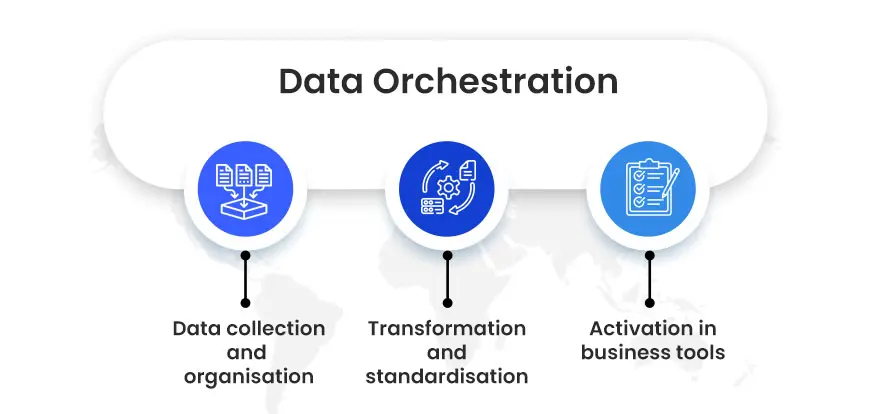 Why do organizations need Data Orchestration?
Organizational data volumes are exploding at an exponential rate. Multiple data systems manage and maintain this information. Smoother transformation of this data can become a bottleneck especially when the data is residing under disparate data sources siloed across disintegrated systems.
Some of the common data problems enterprises are experiencing:
- Inundated data volumes: Without a structured approach, data management and utilization becomes challenging especially when you’re receiving this data from disparate data sources.
- Real-time data intelligence: In critical market situations, businesses require quick data intelligence for making informed business decisions.
- Compliance regulations: Global data privacy laws and policies require stringent control over data processing and handling.
- Operational Inaccuracies: Manual data processing can lead to errors and inaccuracies. Which is why automation is necessary.
How can Data Orchestration help you streamline these complex data challenges?
Inside modern businesses data comes from diverse data sources like databases, cloud storage, and APIs. Unfortunately, this abundant data is received & collected in raw format, leaving companies with limited data insights.
This is where data orchestration assists organizations by improving data integration and quality, enhancing operational efficiency and scalability, and ensuring access to real-time data processing and analysis.
Data orchestration also ensures better decision-making, higher data security, stricter compliance, and robust governance to develop a data infrastructure for the future.
Why modern enterprises need Data Orchestration:
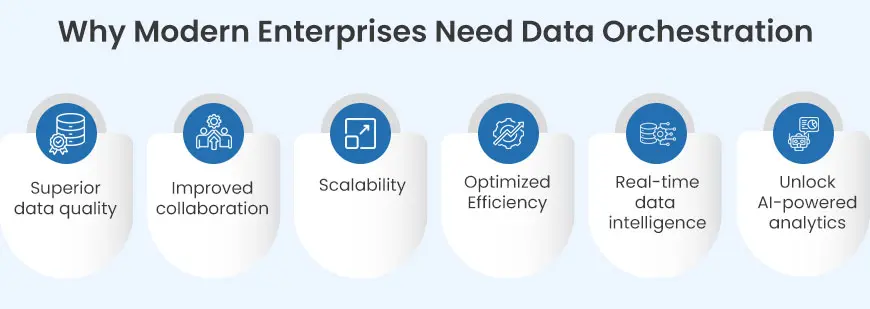
- Superior data quality: Workflow & process automation harnessing modern data orchestration tools reduce the chances of inaccuracies and errors caused by manual data handling. This ensures that data is accurate and ready-to-use.
- Improved collaboration: With centralized data workflows, multiple teams can share, administrate and utilize organizational data. Increasing collaboration amongst fragmented data teams.
- Scalability: A well-planned data orchestration infrastructure can help you combat future business needs by creating a scalable data infrastructure.
- Optimized efficiency: By defining an automated data management framework organizations can free up time on manual data operations and allocate resources on important tasks and processes.
- Real-time data intelligence: Well-organized data infrastructure provides access to real-time analytics & insights, empowering quick access to real-time decision making to make impactful business decisions.
- Unlock AI-powered analytics: Data orchestration acts as a centralized energy hub that powers your entire AI infrastructure by streamlining the complexities of multiple data processes like data collection, transformation, and delivery. Additionally, it breaks down siloed information which ensures your AI systems are receiving consistent, accurate, timely inputs that guarantee the smooth running of AI models to achieve futuristic AI Analytics.
With the help of data orchestration organizations can modernize their existing data frameworks to meet the demands of future, introduce innovation, automation, and even artificial intelligence. The possibilities are infinite with data orchestration.
Challenges that can lead to Dysfunctional Data Orchestration Strategy
Despite a promising data strategy manufactured on top of the data orchestration framework there are a few challenges that should be considered before planning any implementation. Let’s discuss:
- Complexities with data integration: Unifying disintegrated data sources can be challenging especially when you’re handling vast amounts of data coming in from multiple data systems.
- Governance & Compliance: Enterprise data governance isn’t a trend anymore it has become a necessity. With increasing global compliance and risk of cyber threats a robust data governance infrastructure is required to develop a successful data strategy.
- Resource Management: Efficient allocation of computing resources is tricky especially when you’re dealing with larger datasets.
- Scalability & Performance: “Global data creation is imploding at a rapid rate, with an estimated 2.5 quintillion bytes generated daily”. Managing all this information can just be overwhelming with a traditional data orchestration set-up. Therefore, orchestration frameworks must be scaled efficiently to avoid technological bottlenecks experienced because of an outdated infrastructure.
- Cost Management: An inefficient data orchestration framework can burden your existing systems with unnecessary computational costs resulting in complete exhaustion of your IT budgets.
What is Orchestration in Data Engineering?
In data engineering, orchestration is all about automating and coordinating data workflows basically making sure different data tasks run in the right order, at the right time, and with the right dependencies.
Enabling orchestration data engineers and analysts can ensure the smooth running of the following areas:
- Maintaining reliable data pipelines that can run consistently without any downtime and delays.
- Superior scalability while handling growing data volumes
- Orchestration offers agile data workloads that guarantee faster time-to-insight
- Better control and compliance for trustworthy governance
- Reduced manual efforts for optimized costs and high efficiency of data teams.
Let us evaluate some of the best Data Orchestration Tools
Data orchestration tools are the solutions that are responsible for automating, scheduling, and monitoring complex data pipelines. These tools ensure seamless data movement and transformation between multiple data sources and destinations.
According to a recent survey, data orchestration tools are experiencing rapid adoption in the modern era. The need to harness these data orchestration tools is driven by the need to manage complex data setup, cloud agnostic data environments and the surge in adopting AI led advancement for the future.
“The market is projected to grow from USD 1.3 billion in 2026 to USD 4.3 billion by 2034, growing at a CAGR of 12.1%”
Let us discuss some of these enterprising data orchestration tools that can make a significant impact on your existing data strategy roadmap:
1. Azure Data Factory (ADF): It is a fully managed, serverless cloud ETL and data integration tool used to create, schedule, and orchestrate complex data workflows. ADF enables data movement from our 90+ built-in sources (cloud/on-premise) to diverse destinations, allowing space for code-free data transformation initiatives for data transformation and pipeline automation.
Where can ADF fit into your data orchestration strategy?
- Cloud Data Warehousing: Moving your data from multiple sources into cloud data warehouses like Azure Synapse Analytics, Snowflake, and Amazon Redshift can be challenging. ADF facilitates this transformation by simplifying data ingestion, preparation, and transformation.
- ETL/ELT Pipelines: It can help in transforming data using Spark clusters for analytics. It acts as a low-code/no-code and scalable solution for building data pipelines running on a pay-as-you-go pricing model.
- SSIS Lift & Shift: ADF enables lifting on-premises packages to Azure SQL Database. By doing this it manages deployments via SSDT, and scheduling execution with ADF pipelines. Assisting development teams in migrating ETL workloads and data modernization initiatives.
2. Databricks Workflows: Databricks is a unified data intelligence platform with the ability to manage big volumes of data harnessing an AI-led architecture. If your existing data infrastructure is sitting inside a Databricks-led ecosystem, then Databricks Workflows (recently rebranded as Lakeflow Jobs) can be the right data orchestration solution for your organization. Databricks Workflows offers robust managed orchestration especially for Spark-based data pipelines, AI, and ML.
How can Databricks Workflows assist you in your data orchestration journey?
- Advanced Data Engineering: By unifying data engineering tasks such as notebooks, SQL queries, Delta Live Tables into a single Directed Acyclic Graph (DAG) with an amazing uptime availability of up to 99.95%.
- Cost-effective for Databricks-driven enterprises: If you’re running on Databricks-heavy workloads where tight integration with Spark and Delta Lake is required, Databricks Workflows can assist you reduce operational overheads while ensuring data reliability harnessing ACID transactions, and simplified data governance.
- Superior Data Orchestration: Unlike traditional schedulers such as Airflow, the Databricks Workflows solution provides a “Lakehouse Orchestrator” which comes deeply embedded in the platform, reducing the need to switch between separate orchestration and processing tools.
3. Apache Airflow: An open-source platform ideally used by data engineers to programmatically author, schedule and monitor complex data pipelines using Python.
It is a highly scalable tool which uses message queues to manage large number of tasks making it an ideal choice for simple ETL as well as complex enterprise-grade jobs and data workflows.
Key benefits of Apache Airflow for Data Engineers?
- Separation of Concerns: It keeps the orchestration logic (when and how the work is done) and the data processing logic (where the work is done) apart.
- Idempotency: An essential component of dependability is Airflow’s ability to guarantee that using the same pipeline with the same data repeatedly yields the same outcome.
- Data Lineage: It aids in monitoring data flow, improving data governance, and tracking back upstream modifications that might have resulted in problems downstream.
Why considering any of these platforms consider evaluating your workflow definition as platforms such as Apache Airflow runs on Python offering code-as-code capabilities while Azure Data Factory (ADF) promises to provide low-code/no-code capabilities for data orchestration.
Whereas Databricks Workflows is best for Spark-heavy tasks and data team is responsible for handling heavy volumes of data.
Conclusion:
Increasing data volumes often lead to development of complexities into existing data systems. Building reliable and scalable data pipelines harnessing data orchestration can help modern data teams in streamline issues with their data pipelines.
To modernize the traditional approach modern data teams require the help of advanced data engineering consultants like Beyond Key, that can assist in introducing the expertise, tools, and best practices required to develop data pipelines which function efficiently, offer scalability without burning your IT budgets.
If your team is finding it difficult to manage or scale data workflows, you may be ready for a smarter approach. Schedule a free consulting session with our data engineering experts to learn how we can streamline your pipelines, enhance performance, and provide a scalable alternative to maintaining complex in-house systems, so you can concentrate on deriving value from your data, not on managing its complexity.






 Non Profit