An in-depth analysis of Databrick’s AI potential centered on Vector Search, Unity Catalogue, and its fundamental AI features beyond the “AI-hype”
“Artificial intelligence” was the topic of immense discussion, debate, and discourse in 2025. Everyone wanted to leverage this AI advantage with board members and executives anxiously waiting for their IT teams to establish an AI system that promises automation, cost-effectivity, and greater scalability. Well, it’s not as simple as it seems, as we’re about to welcome the year 2026. AI looks promising but maybe our current infrastructure is not ready for it. Challenges such as data quality and bias, governance, and difficulties in integrating AI systems with existing setups can’t be ignored.
As IT teams’ approach 2026 and continue to face similar challenges in incorporating AI into their internal systems, let’s take a moment to look at some of the exciting new AI features from Databricks that could empower modern IT teams to utilize AI effectively in 2026. Let’s dive deep.
While it has become a key point of conversation in corporate discussions and board member meetings, in 2025 generative AI remains a distant reality for most executives.
Aggressive investments and budgeting on AI-driven automation have led executives to ponder upon one simple question “When will we be able to unlock seamless automation and have our own AI chatbot like ChatGPT”?
With enthusiastic developments and advancements this still looks like a possibility by early 2026. But the bottom-line still lingers around “in which of our business verticals this AI-driven advancement will fit in”.
Or “can we allow an AI agent to take complete control of one of our business units” without thinking much about security, governance, etc.?
The shifting aspects of enterprise AI promise immense automation and benefits but also alarms us on prospective threats circling around data breaches, bias, etc.
In the past years AI was in an initial stage of prototyping and experimentations, but the next phase of evolution will be more into developing it into a fully governed system that can bypass legal evaluations, cost assessments, and handle production disruptions without much governance.
This is the point at which Databricks becomes relevant.
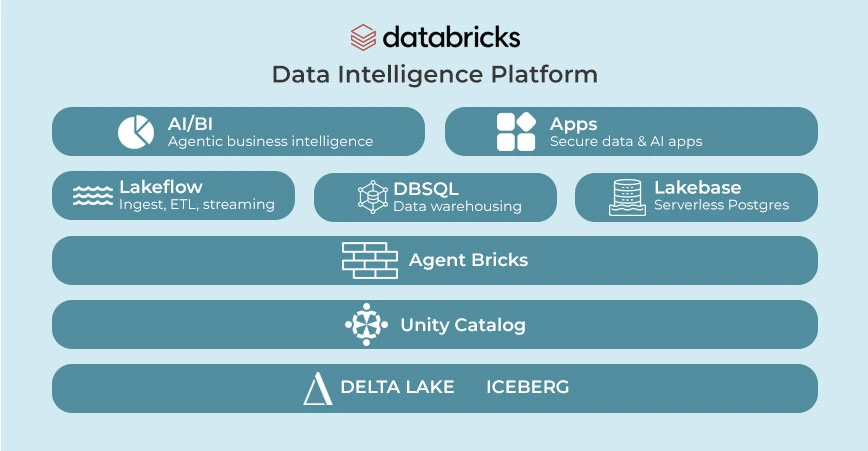
Initially launched as a unified platform for data analytics and engineering, it has gradually expanded into an all-round data intelligence tool with some rare AI features, tools, and capabilities such as Delta Lake, MLflow, AI/BI Genie, etc.
Because of this AI uniqueness, Databricks describes it as a “data intelligence platform” which unifies structured content, unstructured data, models, and agents under a single governance model named Unity Catalog.
Additionally, Databricks AI Gateway use cases offers controlled access to any model, that includes external LLMs & agents.
Meanwhile, Lakeflow Spark™ Declarative Pipelines has become the preferred approach for constructing batch and streaming pipelines in SQL and Python, superseding many tailored jobs that previously supported analytics and machine learning efforts.
Up till now I hope you’re still hooked as in the next phase of this blog we’ll learn about the modern capabilities & features of Databricks that will help enterprises unlock AI 2.0 in 2026.
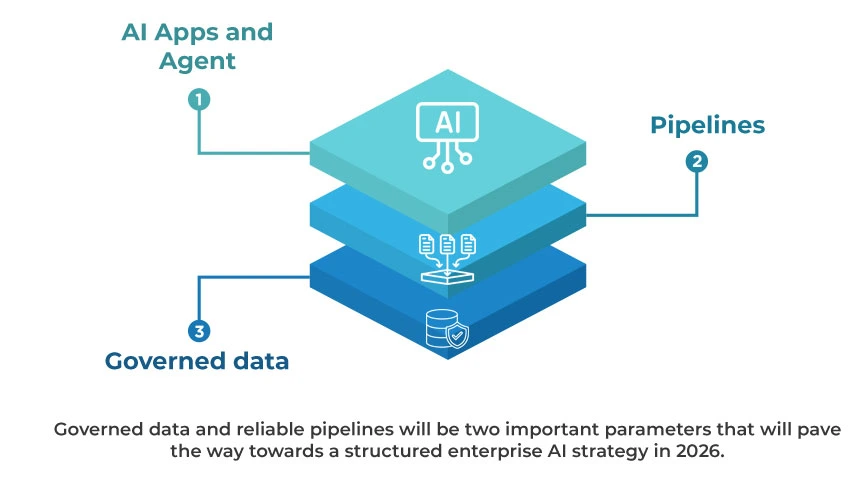
As per a predictive report by Gartner, 60% of AI projects will be abandoned in 2026 due to not been supported by AI-ready data. This highlights the importance of having a readily available data stack to develop a sustainable enterprise AI ecosystem.
To address these challenges, Databricks introduced 5 key Databricks features to help enterprises become AI-ready in 2026 using unified data intelligence.
Let’s dive into the 5 key elements and the significant impact it can have on your upcoming AI strategy for 2026:
Additionally, features such DatabricksIQ an AI engine that powers the Data Intelligence Platform, designed to understand your data’s unique semantics and accelerate workflows, will play a significant role in reshaping enterprise AI strategies.
Also, as a latest addition to the Databricks AI roaster is “Liquid Clustering in Delta Lake 3.0”. Liquid Clustering replaces manual partition design with an adaptive, system-managed clustering approach.
It optimizes data layout automatically based on usage patterns, improves performance at scale, and reduces engineering time spent tuning partitions or managing data skew.
With all these unique features Databricks offers some incredible support, integration capabilities across multiple clouds and trustworthy AI infrastructure for forward-looking organizations that are looking to invest their time, money and important resources on AI-driven technological advancements to achieve seamless process automation in the future.
As a Registered Databricks Consulting Partner, Beyond Key has been helping modern enterprises harness the full potential of their data and AI investments. With a team of certified Databricks experts and business professionals, we’ve helped global enterprises modernize their existing data analytics infrastructures into an AI-powered data intelligence ecosystem utilizing Databricks and its advanced features. If you’re looking to build a strong AI foundation in 2026, contact us today at contact@beyondkey.com.