What Are the Types of Analytics? A Quick Guide
For many decades, data collection from multiple sources to analyze and develop strategies to enhance business productivity was a major challenge. Data management was one of the biggest concerns for businesses worldwide. But as technology evolved, so did data-centric methods.
Data analytics is the process by which organizations analyze, interpret, combine, and visualize data sets to derive actionable insights. It helps decision-makers focus on bigger areas of business to enhance productivity and stay competitive in the volatile marketplace. This guide lets you dive into the four data analytics types – descriptive, diagnostic, predictive, and prescriptive. It’ll help you get better at Business Intelligence (BI) and make smarter decisions
The Four Analytics Types
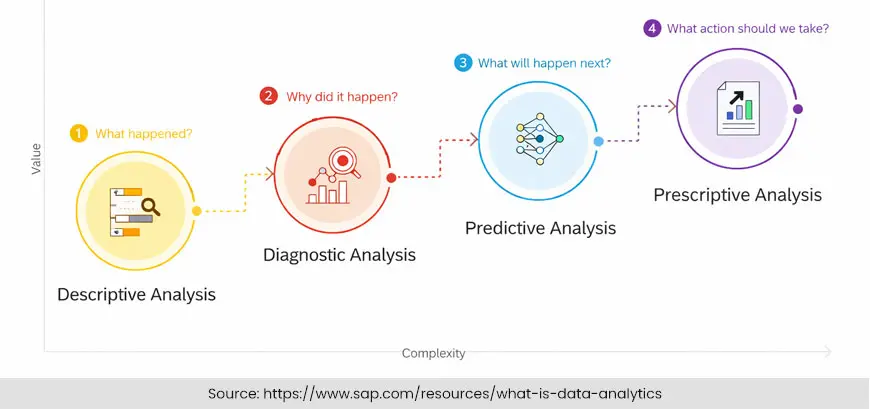
There are four main types of analytics. Each one answers a different question about your data in analytics:
 1. Descriptive Analytics
What is descriptive analytics? It lets you gain insights into reporting and analysis based on historic data and past events. It helps users visualize past data through appealing visualizations (graphs, bars, charts, etc.) on analytical dashboards. Descriptive analytics is a strong pillar of analytics and a must-have. It helps organizations from different sectors understand:
- Sales Reports: What were the highest-selling products? How much did we sell? Which areas did well?
- Productivity Check: What was the team productivity? Did some teams do better than others?
- Customer Loss: How many customers left? What kind of customers were they?
- Website Views: What pages were popular? How long did they stay? How many people visited our site?
- Marketing Results: How many leads did our ads bring in? How many leads were converted into customers? Was it worth the money?
How to begin your descriptive analytics journey?
Before stepping up in the data analytics maturity model, it is crucial for users to work on the core competencies. These include data modeling, aligning data with the right visualization tools, and having minimal dashboard design skills.
The main objective of descriptive analytics is to overcome the concept of repeatability. Descriptive analytics focuses on automating tasks. By following this practice, users can automate tasks such as merging Excel spreadsheets, VLOOKUPs, etc., without human intervention. It focuses on a consistent reporting framework in the organization.
If you’re using basic reports or spreadsheets, you’re already doing some descriptive analytics. Using modern tools like Tableau and Power BI can help businesses transform the way they manage data and enhance productivity.
The next type of analytics is diagnostics analytics, which focuses on “Why” something occurred in the organization.
2. Diagnostic analytics
Diagnostic analytics takes descriptive analytics a step further. It answers questions such as “Why did something happen?” This analytics type bridges the gap between “What happened” and “What will happen”. However, it is one of the most skipped data analytics steps. Diagnostic analytics used cases:
- Sales Drop: Why did sales go down last quarter? Was it competition, customer changes, or just the time of year?
- Customer Loss Increase: Why are we losing more customers? Is it bad service, high prices, or a lack of features?
- Product Success: Why are some products selling so well? Is it a good ad campaign, better features, or a change in the market?
- Website Traffic Decrease: Why did fewer people visit our site last month? Was it a search engine change, a technical problem, or less advertising?
- Bad Ad Campaign: Why didn’t our ad campaign work? Did we target the wrong people or use the wrong channels?
How to begin your diagnostic analytics journey?
If you are in the diagnostic phase, you must have adopted a suite of modern tools with varied analytical capabilities. To address diagnostic analytics use cases, it is advisable to consult a data analytics partner who can assist you with an end-to-end diagnostic analytics journey.
Beyond Key’s diagnostic analytics services can help you go beyond just knowing what happened to understanding why. Our experts can help you use the right tools and methods to find the hidden reasons behind your business results.
3. Predictive Analytics
What is predictive analytics? It is the analytics type that uses machine learning methods and statistical methods to forecast what is likely to happen in the future. It analyses past data and answers the question, “What could happen in the future?” Here are a few ways predictive analytics help companies forecast future outcomes:
- Predict Machine Problems: Predict when machines will break down. This helps you schedule maintenance and avoid expensive downtime.
- Assess Credit Risk: Figure out who is likely to pay back loans and spot fraud. This helps you make better lending decisions and avoid losses.
- Prevent Customer Loss: Guess which customers are hard to retain. This helps you invest in your customer base and build loyalty with them.
- Guess Demand: Predict how much demand there will be for your products. This helps you keep the right amount of stock and avoid running out.
- Forecast Sales: Predict how much money you’ll make in sales. This helps you set realistic goals and use your resources wisely.
How to begin your predictive analytics journey?
Before you start data modeling, make sure you have a good base in descriptive and diagnostic analytics. Moreover, make sure to focus on these elements: identify the problem, define what needs to be predicted, and mention the outcome of adopting predictive analytics.
Predictive analytics starts with data collection, organization, data modeling, data cleaning, quality review, and defining the modeling objective.
4. Prescriptive Analytics
What is Prescriptive Analytics? Prescriptive analytics is an advanced form of analytics that combines insights from descriptive, diagnostic, and predictive analytics and guides you to make data-driven, insight-driven decisions. It lets you get the answer for “What should we do?” after analyzing the data.
To ensure that prescriptive data analytics is on point, the foundation (descriptive, diagnostic, and predictive analytics) has strong competencies. By leveraging optimization and simulation algorithms, prescriptive analytics help you make smarter business decisions. You can use prescriptive analytics in these cases:
- Change Prices Automatically: Adjust prices based on customer demand and other things.
- Target Training: Send employees for extra training based on problems they’ve had. This helps them perform better and avoid mistakes.
- Improve Supply Chain: Enhance your supply chain management and efficiency. This includes managing stock, planning routes, and working with suppliers.
- Personalized Ads: Send personalized ads to customers based on what they like. This attracts your customers to purchase more based on customized ads.
- Manage Risk: Spot and reduce risks to your business. This includes protecting your supply chain, your reputation, and your money.
How to begin your prescriptive analytics journey?
You can’t start with prescriptive analytics without a good base in the first three areas. If you’re ready, focus on identifying the actions you want to take and what will trigger them.
Future Trends in Data Analytics
The data analytics world is evolving rapidly. Breakthroughs in Machine Learning, IoT, and Artificial Intelligence will transform the data analytics process and enable data-driven advanced analytics platforms. This will help users make quicker decisions and gain smarter insights. Strategic data governance and security ensure that data is managed under surveillance and strict compliance.
Descriptive, diagnostic, predictive, and prescriptive analytics are traditional types of data analytics. Generative AI will not just replace these but also optimize and enrich them through seamless integration. Gen AI is based on a machine learning model that not only analyzes existing information but also automates report generation, generates new data, and enables users to perform predictive analytics in plain English.
If you want to level up your data analytics game, Beyond Key can help you build a successful data analytics program that establishes strategic and technical competencies. You can consult here to learn more about data analytics strategies that can help your business grow in this data-powered world.







 Non Profit