What is a digital transformation strategy: 5 pillars of data-driven approaches for enterprises
A digital transformation strategy is not about cloud adoption or migrating trending technologies. It is a business-led, data-driven plan that helps organisations to improve customer experience, operational efficiencies, workforce productivity, and long-term scalability for businesses.
Across Australia, many organisations are investing heavily in enterprise digital transformation across modern CRMs, ERPs, cloud platforms, automation and AI. Yet a large number are still struggling to get a measurable return from it. This is because when technology is implemented without a strategy, it leads to fragmentation, data siloes, rising costs, and limited business impact.
This blog dives into what a digital transformation strategy means, why data is the foundation of success, and the five data-driven pillars Australian enterprises must get to achieve business outcomes.
What does a Digital Transformation Strategy Mean for Enterprises?
A digital transformation strategy is a process that plans an organisation’s use of digital tools and technologies to achieve its business goals. A strong digital transformation brings everything together with:
- Business goals across growth, efficiency, compliance and customer trust
- Technology investments around cloud, CRM, ERP, AI and automation
- Data governance and analytics
- People, processes and culture
In Australia, a digital transformation strategy must also include following:
- Regulatory compliance with privacy, sovereignty and industry regulations
- Workforce enablement across hybrid and distributed teams
- Rising customer expectations on connected digital experiences
- Scalability across APAC, for organisations expanding outside Australia
Without a clear strategy, organisations end up with ‘tool-led transformation’. They modernise individual systems, but get disconnected systems, duplicated data, and limited visibility across the enterprise.
This is why IT digital transformation is not enough. Real transformation occurs when business leaders, technology teams, and data owners work from a shared strategy.
Why is Data the Foundation of Enterprise Digital Transformation?
Modern enterprise digital transformation is centered around data-driven models. Every digital initiative – whether it is a CRM rollout, cloud migration, or digital workplace transformation, everything is dependent on data.
But more importantly, it is Data Analytics that transforms raw data into actionable insights, making it the true engine behind successful transformation.Yet data is the key pain point where many Australian organisations struggle the most. When data is fragmented, inaccurately or poorly governed, all transformation efforts will stall.
We recently worked with a Melbourne-based operations leader who used to say:
We had dashboards for everything, but no one trusted the numbers. That’s when we realised that data quality was holding us back.
Successful enterprise digital transformation depends on how well organisations manage and use their data. When data is unreliable, even the best technological investments fail to give results.
Australian enterprises that succeed in a corporate digital transformation usually:
- Treat data as a strategic asset
- Establish enterprise-wide data standards and ownership
- Invest early in data quality and governance
- use real-time insights to guide decision-making
This is the reason why data maturity decides which organisations scale successfully and those who struggle.
5 Data-Driven Pillars of a Digital Transformation Strategy
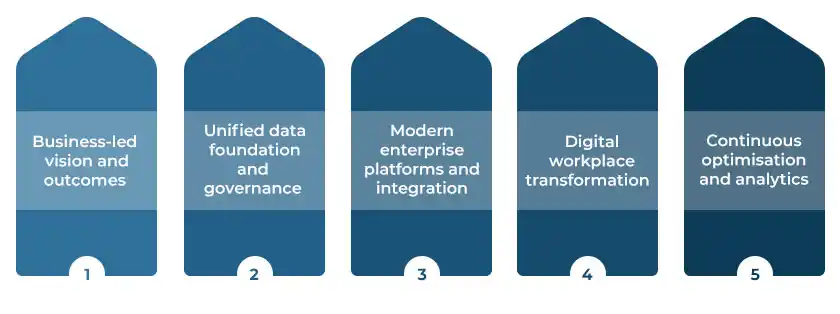 Pillar 1: Business-led Vision and Outcomes
Effective digital transformation strategy must start with clear business objectives. Technology decisions should be taken by outcomes, and not trends. Before investing in platforms or tools, businesses must clearly define:
- What problems they are solving about costs, risks, experience and growth
- How success will be measured like KPIs, ROI and service levels
- Which capabilities need transformation first and which can wait
When business goals are clear, it becomes easier for technology to feel disconnected and deliver measurable results.
Pillar 2: Unified Data Foundation and Governance
A strong data foundation is important for enterprise transformation. Without it, reporting becomes inconsistent and automation becomes risky. Key components of data foundation and governance include:
- A single view of information across systems
- Standardised definitions and ownership for data across functions
- Continuous data quality management processes
- Governance frameworks that are aligned with Australian regulations
Fixing data issues early helps businesses avoid problems later, especially when scaling analytics, AI, and automation.
Pillar 3: Modern Enterprise Platforms and Integration
Technology platforms are an important aspect of digital transformation, and they must be implemented with a plan. Most enterprise digital transformation initiatives include modernising CRM, ERP, cloud infrastructure, integrations, and middleware platforms. It is best not to replace all the systems together. Enterprises will see better results from a structured, phased digital transformation roadmap that focuses on impact areas first.
Integration is also an essential aspect which works on connected business systems for seamless data flow across different business functions like sales, finance, operations, HR, and customer service.
Pillar 4: Digital Workplace Transformation
Digital workplace transformation structures how employees work every day. It focuses on how people access information, collaborate with each other better, making it simpler to get their work done in today’s modern work environments. A modern digital workplace:
- Provides employees with real-time access to information
- Reduces manual tasks through automation
- Supports hybrid and remote work environments
- Improves collaboration across teams
Pillar 5: Continuous Optimisation and Analytics
Digital transformation delivers long term business value only when Australian businesses keep optimise their approach. This means regular reviewing what’s working, where gaps exist, and how to improve with time. This continuous optimisation includes:
- Using analytics and dashboards to see what’s slowing down
- Tracking performances against KPIs and business outcomes
- Regular reviews of processes, platforms, and data models
- Creating a continuous improvement cycle based on usage and insights
Creating a Digital Transformation Strategy Roadmap
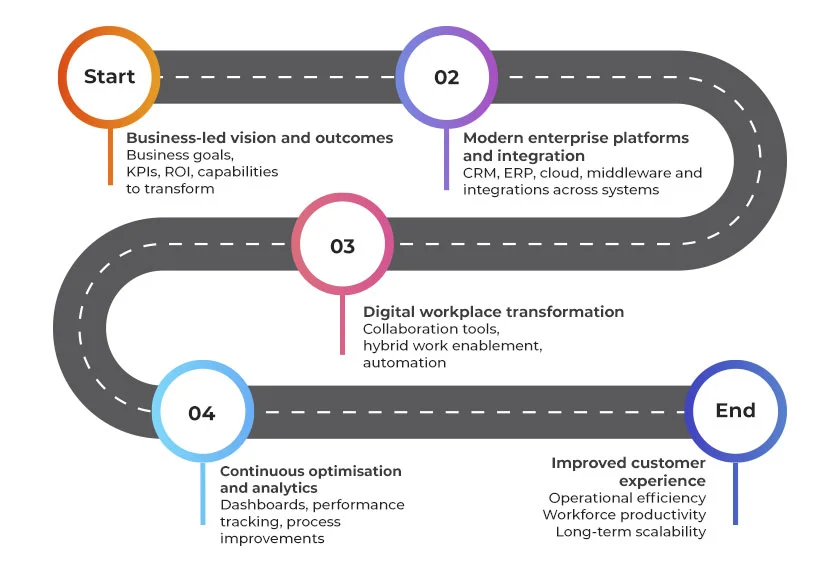
A digital transformation roadmap helps to create a plan on what happens now, what comes next, and how progress will be measured. A successful digital transformation roadmap includes:
- Assessment of business systems and data maturity check
- Identification of priority use cases that can deliver measurable value
- Phased implementation plan that reduces risks
- Governance and change management plans
In the Australia, roadmaps should also consider compliance, data residency, and industry-specific requirements.
Digital Transformation Strategy Examples from Australia
Some examples of enterprises using data-driven approaches are:
- Banking and financial institutions improve risks by unifying data on a single platform
- Healthcare organisations use analytics and automation to enhance patient outcomes
- Education and NFP organisations improve transparency and reporting accuracy
- Professional services firms build stronger client relationships through modern CRM systems
These examples show that successful digital transformation comes with aligned technology, data, and business objectives.
Addressing Key Digital Transformation Challenges
Despite best goals and strategy, enterprises often face challenges such as:
- Legacy systems that are difficult to integrate
- Resistance to change among employees
- Lack of clear ownership between business and IT
- Inconsistent data records across departments
A well-defined strategy gives teams a clearer way to handle disruption and avoid common pitfalls
How Beyond Key Supports Digital Transformation in Australia
At Beyond Key, we work with Australian organisations that want digital transformation to work seamlessly together. We support organisations across strategy, implementation, and ongoing optimisation by improving CRM and ERP platforms, fixing data and reporting issues, analytics, AI, and much more.
What sets our work apart is our expertise in data governance, data quality, and integration. For Australian enterprises navigating compliance requirements, legacy platforms, and change across teams, Beyond Key acts as a strategic technology partner helping them navigate through digital strategy to impact measurement.
Conclusion
A digital transformation strategy is an ongoing effort. It keeps evolving as the business, customers, and teams change.
The organisations that see real value are the ones that focus on improving business operations and keep adjusting with time. When organisations are clear about their goals, collect their data, choose the right platforms, and keep improving over time – digital transformation starts to make a lasting difference.
FAQs
1. What is a digital transformation strategy?
A digital transformation strategy is a plan on how a business uses technology to improve the way it works. It means to create a strategy on utilising tools for better customer experience, smoother operations, and smarter decision-making.
2. What is an example of a digital transformation?
Take an example of a company who will move from spreadsheets and manual reporting to a system with connected data and real-time dashboards.
3. What are the top 3 trends in digital transformation?
The top 3 trends of digital transformation are the use of AI and automation, cloud adoption, and use of real-time data for faster decisions.
4. What are the core elements of digital transformation?
At the core, digital transformation consists of clear business goals, reliable data, right technology, people and processes, and secure governance.
5. What are the 5 main areas of digital transformation?
Digital transformation affects five key areas of a business: customer experience, operations, business models, data-driven decision making, and workforce enablement. These areas help organisations improve value delivery and run operations more efficiently.








 Non Profit