What is DevOps? Principles, Benefits & Trends
Our lives revolve around software solutions. Whether it is a communication app or an e-commerce software platform, everything we do is done through software. Modern businesses rely heavily on devOps services for faster development and release of the software cycle. Small and mid-size organizations are adopting DevOps technology to stand out and stay competitive in the tech-driven landscape.
In this blog, we will learn about the meaning of DevOps, its philosophy, and benefits.
- DevOps definition
- How DevOps works
- DevOps lifecycle
- Benefits for modern organizations
What is DevOps?
DevOps, a shortened form of Development + Operations, is a set of tools and practices that focuses on speeding up the software development cycle. As a modern approach used by software developers, this practice abridges development and operations teams. This helps them deliver applications quickly and more reliably. DevOps services also promote better customer experience.
Organizations that invest in DevOps services can:
- reduce failures
- enhance customer experience
- quicken software delivery
- bring teams and technology together
Before the emergence of DevOps services, developers were restricted with the software development process. Operations team handled deployment and software maintenance. Due to the misalignment in the teams, businesses faced slower releases and miscommunication, followed by manual errors.
What Is the Philosophy Behind DevOps Services?
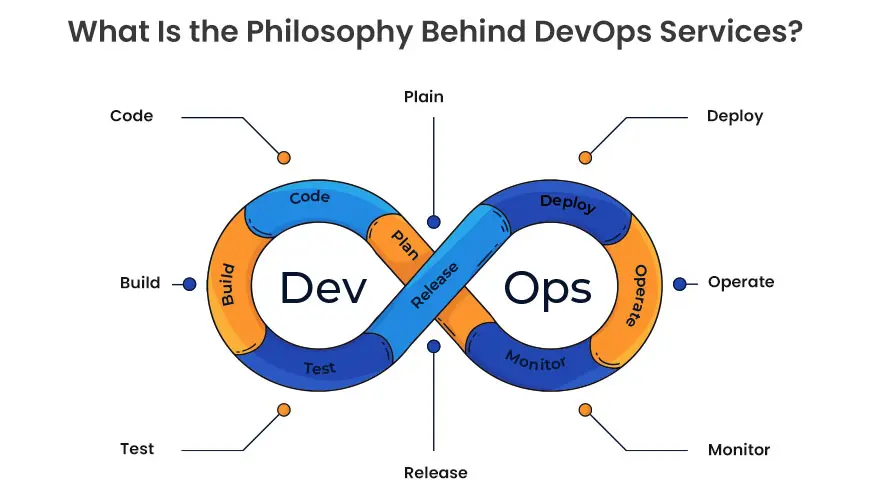 DevOps is built on these elements:
- Automation of redundant processes (for example, testing or deployment) to save time and focus on the major parts of the business
- Collaboration of the development and operations teams for ensuring increased turnaround time
- Feedback is quick. Teams can identify errors and plan to fix the issues in a jiffy.
- Ongoing improvement: Operations are continuously optimized and improved for better productivity and efficiency.
- Delivery and integration. Development team ensures that codes are changed in real-time for prompt delivery.
How DevOps Works: The DevOps Process Explained
The DevOps team includes members from the IT operations and development teams who collaborate across the product lifecycle to accelerate software development. Development and operations departments don’t work in silos. Starting from the development stage to the testing stage and implementation, DevOps process must go through a lot of steps:
- Planning the development process
- Designing and managing code
- Building the application
- Quality and performance test
- Releasing updates
- Deployment
- Assessing system performance
- Feedback collection for improvement
The DevOps market size has grown exponentially in recent years. It will grow from $14.95 billion in 2025 to $18.77 billion in 2026 at a compound annual growth rate (CAGR) of 25.6%.
Source: https://www.researchandmarkets.com/reports/5767407/devops-market-report#:~:text=The%20devops%20market%20size%20has,on%20continuous%20monitoring%20and%20feedback.
A Quick Look at DevOps Lifecycle
The DevOps lifecycle includes the stages from deployment and IT operations. This lifecycle aims to improve speed and efficiency, leading to much better and timely software delivery.
- Planning: This is the initial step that includes defining the goals of the project, mentioning requirements, and roadmaps. It includes setting up the workflow utilizing tools such as Azure Boards or Jira.
- Coding: This step includes writing, reviewing and managing the versions of code. Developers are responsible for it. They use various tools such as Git Hub, GitLab and more.
- Building: Code is stored and compiled with a shared repository.
- Testing: Automated test runs ensure the quality of the software and find any bugs and performance issues.
- Releasing: The application is prepared for deployment and production.
- Deployment: It includes moving the software to the production environment.
- Monitor and operate: Real-time monitoring for better stability.
Key DevOps Practices Every Organization Should Know
Organizations can level up their DevOps services by following the best practices which are here:
- Continuous integration (CI): Includes merging code changes from multiple developers into a centralized repository and shared control versions.
- Infrastructure-as-a-code: Ensure to use code to manage and provision the infrastructure. Instead of manual efforts, this practice allows you to define infrastructure using codes.
- Continuous delivery (CD): This practice involves deploying the compiled code after evaluation. Deployed applications undergo user acceptance testing (UAT).
- Automated testing: This practice includes the implementation of automated tests for unit, integration, and performance testing to accelerate feedbacks.
- Continuous feedback: Collect feedback using relevant tools and performance logs for boosting improvement.
- Monitoring and logging: Track application performance and infrastructure health. Get insights into application performance, user behavior and resource utilization.
- Why DevOps Is Important for Modern Businesses
DevOps services are important for businesses seeking to bridge the gap between the software development and operations teams. Organizations can leverage DevOps best practices to ensure enhanced team collaboration and improve customer satisfaction. Let’s see how DevOps services help businesses with high-quality software development:
- Enhanced efficiency with automated tasks and reduced manual operations. It allows teams to focus more on the major aspects of business. Automation reduced manual errors and overall business expenses.
- DevOps helps companies with faster time-to-market by promoting faster release of software updates and new features.
- DevOps eliminates department silos between operations and development department, fostering a healthy work culture.
- With DevOps, you can respond faster to changing market conditions. Get prompt customer feedback and fix issues quickly.
Common Use Cases of DevOps Services
1. Faster application development and deployment
DevOps services ensure automated operations and better collaboration between teams. It shortens development cycles and reduces manual errors.
Example: E-commerce companies need quick product updates and frequent additions to payment updates to stand out in the competitive market.
2. Cloud infrastructure management
DevOps services are used by modern businesses to manage cloud infrastructure. This helps them provision servers, scale infrastructure, and reduce manual configurations. Major cloud providers integrate with DevOps service providers for smooth operations.
3. Automated Testing and Quality Assurance
After the application is developed, testing is the next step. DevOps supports automated testing across the development cycle and ensures best-in-class software quality. It promotes faster, more timely bug detection and reduces errors in the production process.
Testing is critical in software development, and DevOps enables automated testing throughout the development lifecycle. For example, a fintech app tests for security issues before deployment.
Top Benefits of DevOps for Businesses
When the deployment and operations teams align well, it reduces lead time and helps create high-quality software. Here is the list of how DevOps helps businesses increase productivity.
1. Collaboration and increased reliability
DevOps is an approach that changes the siloed mindset. It focuses on “Us” instead of “I”. By integrating operations and development teams, DevOps fosters a culture of shared responsibility, ultimately leading to enhanced reliability.
2. Enhanced efficiency with automation
Teams that practice devOps implement automated testing and a CI/CD approach. This leads to streamlined workflows and decreases human errors.
3. Improved application quality
DevOps improves application quality by boosting collaboration and integrating quality assurance throughout the development cycle.
4. Enhanced customer satisfaction
Continuous improvement in the application and monitoring increases performance and uptime, leading to better customer satisfaction.
DevOps vs Traditional Software Development
Traditional software development is based on methods such as the waterfall model. It follows a method in which all stages of development are carried out in separate phases. With their slower, less flexible structures, traditional software development methods are outdated.
| Aspect |
DevOps |
Traditional Software Development |
| Approach |
Collaborative (Dev + Ops work together) |
Siloed (Development and Operations are separate) |
| Development Cycle |
Continuous (CI/CD pipelines) |
Sequential (Waterfall or staged approach) |
| Speed of Delivery |
Faster, frequent releases |
Slower, periodic releases |
| Automation |
High (automated testing, integration, deployment) |
Low to moderate (manual processes common) |
| Feedback Loop |
Continuous feedback and monitoring |
Delayed feedback after release |
| Risk Management |
Smaller, incremental changes reduce risk |
Larger updates increase risk |
| Collaboration |
Strong cross-team collaboration |
Limited collaboration between teams |
| Infrastructure |
Infrastructure as Code (IaC) |
Manually managed infrastructure |
| Testing |
Continuous testing throughout the lifecycle |
The testing phase occurs after development |
Future of DevOps
With the advancement in Artificial Intelligence and other modern technologies, here are some key trends that will shape the future of DevOps:
AIOps: AI and DevOps combination for better automation and predictive analytics that is intelligent.
Serverless computing: When developers work on abstracted infrastructure, developers should entirely focus on code.
GitOps: Git manages deployments, offering version control and auditability.
NoOps: When operations are automated fully, developers can prioritize development and innovation.
Conclusion
The future of DevOps emphasizes intelligent automation and predictive analytics, which will drive the overall business productivity. Cloud-based platforms will allows businesses leverage automation and this will improve the delivery quality and quickness of the the software. To understand more about how DevOps services can help you make the most of your investment, please contact us. Beyond Key offers end-to-end DevOps services which focus on cross-team collaboration frameworks.








 Non Profit