What is Microsoft Fabric IQ and how is it different from standalone Microsoft Fabric
Recently Microsoft launched Microsoft Fabric IQ, a semantic intelligence layer that promises to elevate Fabric from a mere unified data platform to a unified intelligence platform.
The Fabric IQ will be offered inside Microsoft Fabric and will provide a unified semantic intelligence layer powered by Agentic AI and Ontology. This powers Microsoft users with a new and competitive advantage that helps them unify analytics, AI agents, semantic intelligence, and business logic.
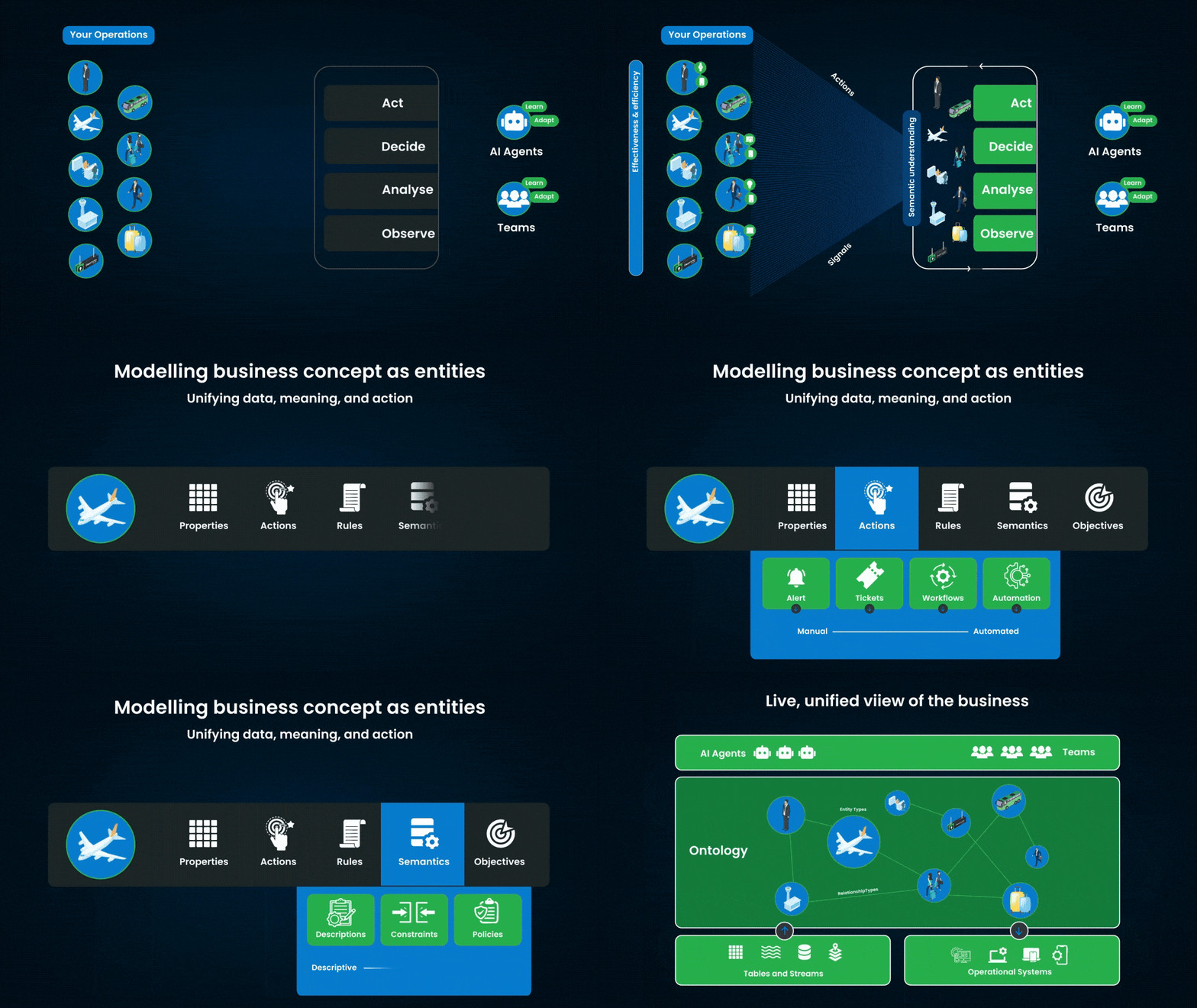
Fabric IQ won’t replace your current data estate but will help you excel in your upcoming data initiatives by bringing together data, meaning, and actions into a single semantic layer, that enables agentic AI and business users to reason, automate, and take actions based on real-time insights.
With IQ enabled by Microsoft Fabric, your data estate now becomes an intelligence layer that reasons, understands business entities, and powers real-time decisions. It’s a promising addition to the already booming Data & AI paradigm and now this new workload addition will help organizations transform from “data-driven” to intelligence-powered with its modern capabilities.
 How Microsoft Fabric IQ will help in reshaping your data analytics roadmap
Fabric IQ works as an interactive agent between humans and AI to better understand requirements from existing datasets, providing smart business insights with superior business logic.
With AI enabled intelligence, it offers a new class of agents known as “operational agents”. Traditionally, AI agents can understand patterns in each data set, but often struggle to understand patterns in that dataset in respective business terms.
However, Microsoft Fabric IQ promises to teach AI agents to not only identify regressive data patterns but better understand business operations to provide specialized analytics and insights for the end user.
How Microsoft Fabric IQ is different from RAG (Retrieval-Augmented Generation) models
The RAG model draws relevant documents to provide contextual content while the Fabric IQ develops a semantic graph that represents organizational structure, workflows and business logic which looks coherent & personalized according to modern business requirements.
For instance, Fabric IQ agents not only retrieve and compile information from static databases but understand its relationship with the actual business need, i.e., which suppliers provide which products, how customer regions map sales results, and how production connects to inventory systems.
How the Fabric IQ model streamlines the limitation of traditional semantic models
A decade back, sematic intelligence was introduced by Microsoft inside the Power BI ecosystem. These intelligence models were about to define entities and relationships and derive business logic from unintelligent data systems.
Mainly utilized for business intelligence, analytics, and visualization, these semantic models had some limitations as these were commissioned to derive business logic under restricted departmental boundaries and individual business reports. Due to these limitations, they could not derive 360* business logic for modern organizations.
Fabric IQ lifts this limitation by offering agents that can interact and monitor data records autonomously and take decisions based on the ontology’s understanding of the possible business scenarios.
Let us understand this scenario by picking a supply chain example that differentiates between traditional approach and modern semantic data intelligence.
A transportation and logistics organization has modeled its delivery and supply chain operations in the ontology schema. When real-time data intelligence shows traffic congestion in some parts of the city. Based on data intelligence, the AI agents can re-route the trucks automatically.
How this will reshape enterprise AI strategy
Context engineering is drastically important for seamless enablement of Agentic AI across modern enterprises.
A mix of semantic intelligence and ontological models does just that. Context is more about understanding why a request is made, whereas semantics understand the deeper meaning. Despite having larger datasets enterprises often struggle with AI agent reliability, Fabric IQ takes a different route enabling enterprises to move beyond just scaling compute or fine-tuning models. The Fabric IQ workloads clarify one fine technological objective that lies between semantic understanding of business logic that derive AI agent effectiveness for seamless modernization.
Conclusion
It’s 2026 already, and having access to large datasets is not enough anymore. Instead upgrading existing semantic models into operational ontologies using system AI tools like Fabric IQ could provide a brisk path in developing a unified business strategy to AI-driven excellence for the future.





 Non Profit