Agentic AI in Insurance: Transform Your Claims and Underwriting Operations
Introduction
Insurance operations face a real problem. Manual processes slow everything down. Underwriting processes experience delays because of the need for complete system integration. Customers expect to receive immediate responses, but traditional systems of their present time cannot fulfill this requirement.
Agentic AI in insurance changes this reality
Unlike basic automation or chatbots that follow rigid scripts, agentic AI acts independently. It sets goals and it makes decisions. It executes complex workflows without human intervention.
For claims, that means moving from first notice of loss to final settlement in hours instead of weeks. For underwriting, that means real time risk scoring and dynamic pricing that updates instantly.
The guide provides an explanation of agentic AI in insurance systems, which shows its operational value and provides organizations with their first steps toward achieving complete intelligent operations.
Understanding Agentic AI in Insurance
What Makes AI Agentic in an Insurance Context
Agentic AI refers to systems that pursue goals independently. Agentic AI in Insurance does not simply suggest a next step. It takes the step. It verifies data. It approves or flags exceptions. It learns from outcomes. Consider it a digital underwriter or claims adjuster that works around the clock within rules defined by the business.
From Assistive AI to Autonomous Systems
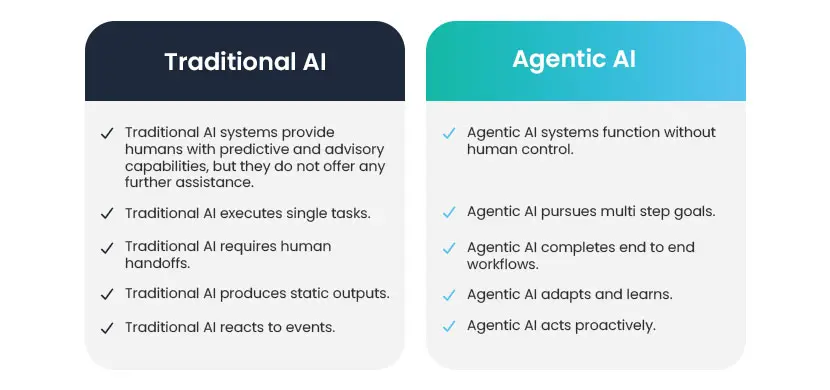
Traditional AI assists. It recommends prices. It flags risky claims. But a human must act on that information. Agentic AI removes the handoff and replaces it with action. The shift moves from “what should I do?” to “the system will handle it and alert me only when needed.”
The Role of Goal Oriented Decision Making
Agentic AI receives a high-level goal such as “settle this claim within policy limits.” Then it breaks that goal into steps. It verifies coverage. It requests documents. It checks fraud signals. It approves payment. It closes the file. Each step happens without a new prompt from a human user.
The Shift Toward Agentic AI in Insurance
Why Traditional Automation Is No Longer Enough
Rule based automation works for simple, repetitive tasks. Insurance workflows have exceptions, judgment calls, and changing data. Agentic AI handles ambiguity. It adapts when a document goes missing or when a risk score changes mid process.
Increasing Operational Complexity in Insurance
More data sources exist today than ever before. Regulatory updates arrive constantly. Customer channels continue to multiply. Human teams cannot scale to meet these demands alone. Agentic AI handles complex tasks which enable people to concentrate on managing relationships and handling exceptional situations.
Demand for Real Time, End to End Execution
Customers want quotes in seconds and claims paid in hours. End to end execution requires systems that act across policy administration, claims processing, billing, and external data sources. Agentic AI orchestrates this without manual triggers.
Key Capabilities of Agentic AI Insurance Systems
Agentic AI brings several core capabilities to insurance operations.
- Deciding autonomously within clear-cut parameters. The AI acts but never exceeds authority limits set by the business.
- Multi step task execution without human intervention. The system runs from first notice of loss to final settlement without stopping.
- Context awareness across policies, claims, and customers. The AI leverage past interactions and historical data then apply that to current work.
- Continuous learning from outcomes and feedback. The system determines its better options from analyzing which methods succeeded and which methods failed.
How Agentic AI Works in Insurance Workflows
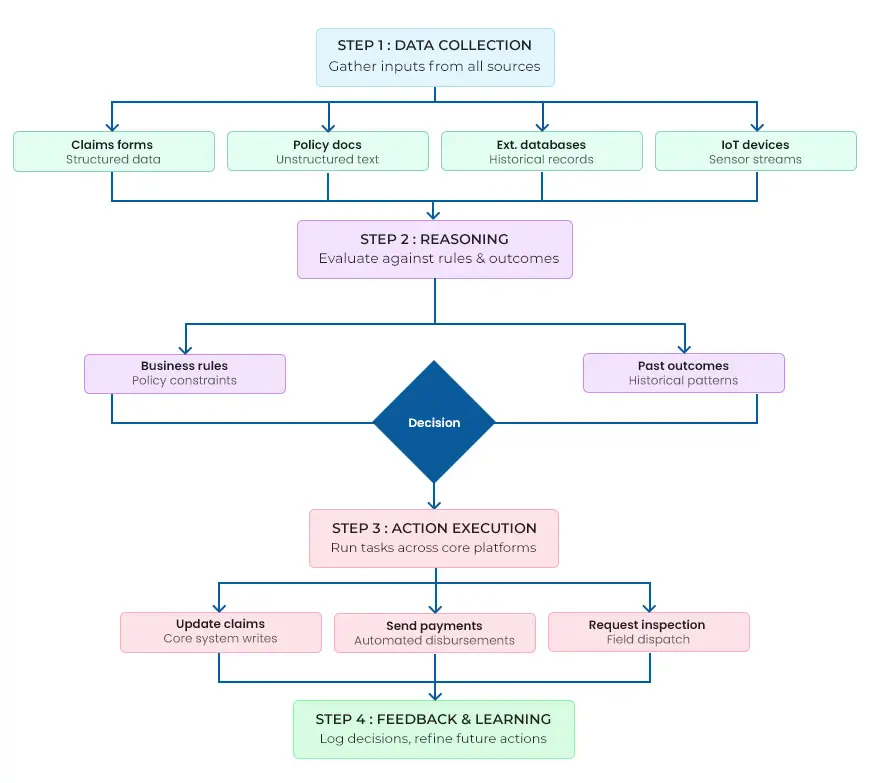
Agentic AI follows a clear four step process in production environments. AI Agents Are Now Running the Back Office at Insurance Giants.
- First, data collection. The system gathers data from various sources which include claims forms and policy documents and external databases and Internet of Things devices.
- Second, reasoning and decision making. The intelligence layer evaluates options against business rules and past outcomes.
- Third, action execution. The system runs tasks across core platforms including updating claims systems, sending payments, and requesting inspections.
- Fourth, feedback and learning. The Language Model logs every decision and keeps refining future actions based on the obtained results.
Core Components
For a successful AI deployment, numerous AI agents are needed to work together
- AI agents and orchestration layers
- Decision intelligence engines
- Data integration pipelines
- Application programming interface driven ecosystem connectivity
Business Benefits of Agentic AI in Insurance
Organizations that implement agentic AI see measurable improvements across their operations.
- Faster turnaround across claims and underwriting. Processing times drop from days to minutes.
- Reduced manual workload and operational costs. One agentic system can handle the work of multiple human reviewers.
- Improved accuracy and consistency in decisions. The AI never experiences fatigue or bias from mood or workload.
- Scalable operations without proportional hiring. Teams can handle ten times the volume with the same headcount.
- Better risk management and fraud control. Real time pattern detection works across millions of transactions simultaneously.
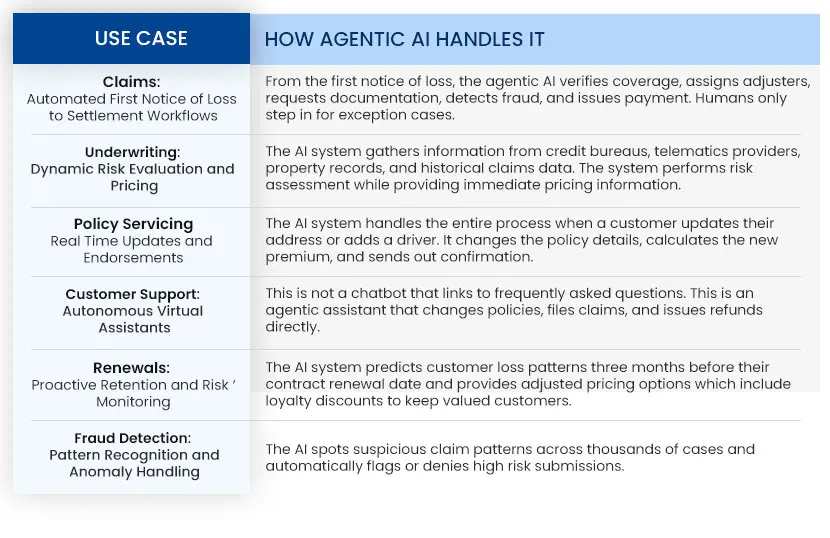
Agentic AI Insurance Use Cases Across the Value Chain
Agentic AI vs Existing AI Models in Insurance
Implementation Considerations for Agentic AI in Insurance
AI decision-making processes and their resulting outcomes require ongoing observation for assessment purposes. The system utilizes dashboards together with alerts to notify teams about AI decisions which involve high-value claims and borderline case assessments.
- Data readiness and quality remain critical. Garbage in leads to garbage out. Organizations should audit their data before starting any agentic AI project.
- Integration with legacy core systems requires planning. Application programming interfaces and middleware are essential. Agentic AI must read from and write to existing policy and claims systems.
- Governance, compliance, and control mechanisms must be established. Businesses need to define guardrails, set authority limits, and log every decision for audit purposes.
Risks and Challenges of Agentic AI in Insurance
The process of managing autonomy needs to comply with existing regulatory requirements. The regulators will require organizations to identify the person who made the decision. Organizations require their systems to have built-in explainability functions.
- Ensuring transparency in AI decisions. Black box models carry too much risk. Using interpretable models or post hoc explanations is strongly recommended
- Handling edge cases and exceptions. No AI handles every possible scenario. Building graceful fallback to human review is essential
Building trust in autonomous systems. Starting small and running parallel with human teams helps prove performance before full delegation.
The Future of Agentic AI in Insurance
- Fully autonomous insurance operations are emerging. Straight through processing will soon handle eighty to ninety percent of standard policies and claims.
- AI agents will collaborate across departments. A claims agent will talk to a fraud agent. An underwriting agent will talk to a retention agent. No humans will be needed for routine coordination.
- Hyper personalized, real time insurance ecosystems will become standard. Pay per mile auto, on demand renters insurance, and usage based commercial policies will become profitable and scalable.
- Continuous evolution through self learning systems. The AI will get smarter every month without requiring software updates.