Data Analytics in Healthcare: How Data Improves Outcomes and Efficiency
Australia’s healthcare system produces more data than ever before, but much of this data remains fragmented and underused. This is where data analytics in healthcare make a difference to enhance patient outcomes and optimise operations. In combination with public and private healthcare providers, Australia produces a significant volume of healthcare data, from EHRs, Medicare claims, pathology results, and remote monitoring devices. Efficient analysis of this data enables healthcare organisations to predict patient risks, streamline workflows, and provide personalised care.
In this blog, I will explain the role of data analytics in the Australian healthcare industry, key applications, benefits, trends, and the scope of partnering with leading analytics providers.
Understanding Data Analytics in Healthcare
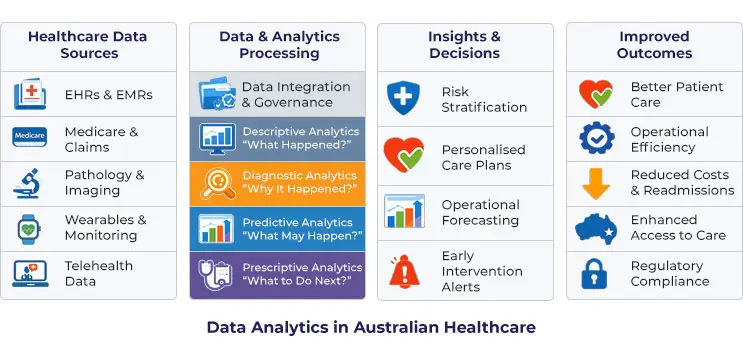
Healthcare analytics is the process of examining patient, operational and population-level data to give meaningful insights. This information helps decision makers to understand, forecast trends, and then take informed actions.
Key data sources in healthcare
- Electronic health records,or EHR recordsfrom Medicare, My Health Record and hospital EMRs
- Clinical data access from prescriptions, lab results, pathology, imaging and specialist notes
- Administrative data across billing, scheduling and insurance records
- Remote monitoring data collected from wearables, telehealth consultations, and chronic disease monitoring.
There are 4 broad types of data analytics:
- Descriptive analytics: understands “what happened”
- Diagnostic analytics: explains “why it happened”
- Predictive analytics: forecasts for “future outcomes”
- Prescriptive analytics: recommends “actionable steps”
Using these analytical approaches, Australian healthcare providers can move toward proactive, data-driven healthcare.
Importance of Data Analytics in Healthcare Industry
Australia’s healthcare system faces multiple pressures with the population dispersed across, increasing chronic diseases, and high demand for aged care services.
To solve these challenges, data analytics in healthcare helps by
- Providing support for value-based care,
- Improving operations and patient engagement in hospitals and clinics
- Early intervention for chronic health conditions
- Reducing preventive hospital admissions, especially in regional and rural areas
Australian government hospitals provide data-driven care through initiatives like My Health Record and national telehealth programs. These programs are increasing the adoption of healthcare analytics in Australia.
High-Impact use Cases for Healthcare Data Analytics
1. Diagnostics and early detection
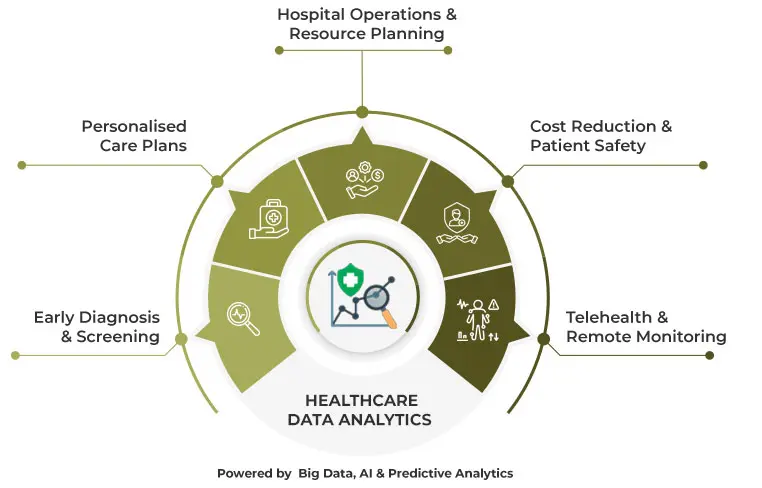
Analytics helps Australian clinicians look through large datasets to find diseases early. AI models can find patterns in imaging or lab results that can help with early treatment.
For example, hospitals in Australia are using predictive models for diabetic retinopathy screening. This helps find patients who are at risk before their vision gets worse, which lowers the number of cases of blindness.
2. Personalised treatment planning
Australian clinicians benefit from healthcare data analytics to design personalised care plans based on patient history and lifestyle data. Predictive analytics helps forecast how patients will respond to medications and treatments.
This includes:
- Tailored care for chronic disease management programs in severe conditions
- Oncology departments to support chemotherapy and radiotherapy decisions on historical treatment and patient data
3. Operational efficiency and resource management
Hospitals in Australia are under constant pressure to daily manage bed availability, and efficiently plan ICU allocation, and workforce capacity. Analytics-driven planning in operations has been valuable in Australia to optimise resources due to limited staff and infrastructure.
Some uses include:
- Predicting how many patients will come in to help with staffing and scheduling
- Making the best use of operating theatres and critical equipment
4. Reducing costs and improving patient safety
Analytics help stop unnecessary procedures, lower the risk of complications, and flag high-risk patients for early treatment.
For example, predictive readmission models in Australian public hospitals have reduced unnecessary readmissions, saved millions in operational costs, and improved patient safety.
5. Telehealth and remote patient monitoring
Analytics in telehealth enables:
- Monitoring chronic conditions remotely
- Improved healthcare access and reduced travel costs
- AI-assisted help for making decisions during teleconsultations
Why is Data-Driven Care a Competitive Necessity?
Australian healthcare providers
- Better planning of resources by predicting patient numbers to arrange for the needed staff members.
- Real-time insights aid faster decision-making from analytical data.
- Reduced operational inefficiencies which fund savings into frontline services and patient care.
- Full compliance with the Privacy Act 1988 and My Health Record Act.
Patients
- Increased personalised treatment and care plans
- Earlier detection of health risks and minimise disease progression
- Better coordination across providers
- Improved patient experiences and care journeys by reducing waiting times
Real-World Impact across Australian Healthcare
Across Australia, data is a tool which helps people live healthier in their own communities. Some use cases include:
- NSW Health: By anticipating needs before they become emergencies, NSW is helping patients manage chronic conditions from home, reducing avoidable admissions and stays.
- In Queensland Health: telehealth services are placed to fill the healthcare gap for rural families, reducing unnecessary travel.
- Western Australia Health: tracks vaccination rates and supports preventive initiatives before diseases spread.
- Not-for-profit healthcare providers: consistent approach by GPs and social workers to give coordinated care at every step of check-up.
The Role of Big Data in Healthcare
Big Data means large or complex datasets for traditional processing. In Australia, this includes genomics, imaging, wearables and telehealth data.
This data helps healthcare teams spot disease patterns early before they progress, and conditions worsen. It supports personalised care by bringing together relevant insights and information to guide treatment decisions.
Big data provides health authorities with a comprehensive view to strategize vaccination and preventive health programs. It also forms a foundation for AI and machine learning tools and systems that diagnose clinical conditions and monitor patients for informed decisions.
Choosing the Right Partner for Data Analytics in Healthcare
Data analytics to work requires a partner who understands how clinical teams operate, can make sense of complex data, and knows how to work with Australia’s healthcare and regulatory environment.
At Beyond Key, we believe healthcare works best when providers can focus on patient care at its core. We help Australian healthcare teams simplify their data landscape. Our expertise in AI and data science helps in confident decision-making and smoother operations.
Conclusion
Data analytics is making a big difference in Australian clinics and healthcare recently. The shift toward data-driven healthcare is a fundamental change in how we work with our frontline teams today. In this high-pressure industry, when decisions are made on facts rather than guesswork, the result will be creating smarter, connected systems for providers and patients alike. By bringing together information from multiple systems, clinicians get a complete view of a patient’s health, creating informed decisions.
FAQs
- What are the different types of data analytics in healthcare?
There are four main types.
Descriptive analytics shows what has already happened, such as patient admission trends.
Diagnostic analytics explains why it happened, for example identifying causes of readmissions.
Predictive analytics uses historical data to forecast future risks, such as disease progression.
Prescriptive analytics suggests actions, like recommending early intervention for high-risk patients.
- What does a data analyst in healthcare do?
A healthcare data analyst collects, cleans, and analyses clinical and operational data. They work with EHRs, claims data, lab results, and hospital systems to identify patterns and trends. Their insights support clinical decisions, improve hospital operations, and ensure compliance with healthcare regulations.
- What is an example of big data analytics in healthcare?
An example is using large datasets from imaging, pathology, and patient records to predict disease risk. For instance, predictive models can analyse thousands of retinal images to detect early signs of diabetic retinopathy, allowing treatment before vision loss occurs.
- How to select the best healthcare analytics platform?
Choose a platform that integrates easily with existing systems like EHRs and billing software. It should support real-time analytics, strong data security, regulatory compliance, and scalable architecture. User-friendly dashboards and AI capabilities are also important for clinical adoption.
- What is the future of data analytics in healthcare?
The future is focused on AI-driven decision support, real-time remote monitoring, and personalised medicine. Advanced analytics will help predict diseases earlier, automate administrative tasks, and improve care coordination. Data interoperability and stronger privacy frameworks will also shape the next phase of digital healthcare.





 Non Profit